Adil Raza Khan | March 27, 2026
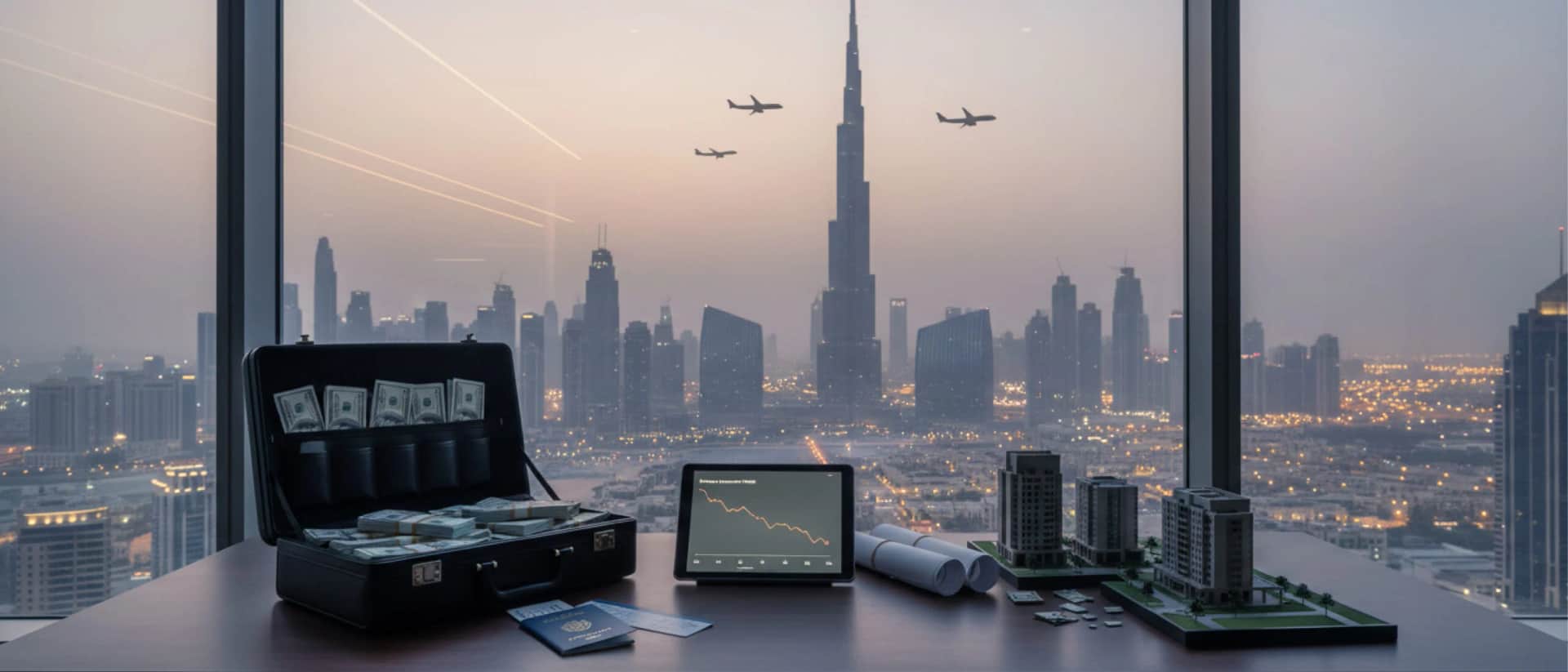
Dubai Property investors are not leaving the UAE market despite the tensions of the Iran war. Recent market indications show very minute and temporary stagnation, and not a retrenchment of funds. Dubai Property investors are holding on, bargaining prices, and redistributing risk, but not quitting the market.
This change is more of a re-establishment of geopolitical mood, rather than a structural decline. In the case of the UAE market during the war events in Iran, the most important theme is precautionary continuity, where the capital is not withdrawn, and the confidence in the long term would not be lost.
Curated Opportunities
Flexible buying options for smarter property decisions.
Handpicked properties sorted for the strongest value.
Investment-focused listings with return potential.
Browse Dubai communities with properties for sale.
There is no massive capital flight on the UAE market, which means that the Dubai Property investors are not abandoning it in 2026. Statements by the masses that are reported by the Economic Times affirm that we should not talk of exit, but rather a recalibration of risk on the part of the investors.
Reuters reported a reduction by almost 37 per cent in annual and 49 per cent every month in the real estate dealings of Dubai in the first quarter of 2026, suggesting that the deal-making process slowed down. Nevertheless, the Dubai Property investors remain in the market where they are now moving towards restrained, and selective purchases, instead of a sprawl of expansion.
Geopolitical risk in the region and short-term uncertainty affecting the UAE market amid the intensified Iran war are making Dubai Property investors apprehensive. This has led to a short-term demand stagnation and long decision-making time.
In a real-life context, Dubai Property investors are:
According to the reports, some sellers are giving up to 10-15 percent discounts (in large value segments). This implies a negotiation process that is buyer-initiated rather than a breakdown in the basics of demand.
Capital flight of real estate in Dubai is nonexistent because of the Iran conflict. There is constant official and financial analysis of capital being still part of the UAE ecosystem, and that investors reposition and do not necessarily leave.
The allocations of Dubai Property investors, especially institutional and high-net-worth investors, are not decreasing. At the same time, foreign investments are still growing in the UAE, confirming that even in the face of short-term geopolitical pressures on the country, the confidence of long-term capital does not decrease.
Dubai property prices are not generally falling, but we can see localized price adjustments in retaliation to the reduction in the volume of transactions. Reuters coverage of the market points out that discounts of up to 15 percent are being witnessed in some markets to close deals.
To the Dubai Property investors, this is a phase of price adjustment, where the over-valued prices are being re-adjusted. No sign of a system wane or desperate selling in the larger market.
Dubai Property investors do not act like that, as some expats and end-users have been temporarily moving when geopolitical tension has reached its maximum. Trading in this segment is short-lived and emotional, and sometimes more associated with the safety perception and not with financial strategy.
Dubai Property investors head in the direction of long-term returns such as rental yield and capital gain. Consequently, they have not changed their investment positions significantly in the UAE market under the Iran war conditions.
Dubai Property investors are also making active changes to match the prevailing risk conditions. It has been moving towards the defensive and income-oriented investment strategies.
Key adjustments include:
It is a smart tactical repositioning that indicates that Dubai Property investors are not retreating but realigning their positions to suit the market.
Best Project Finder
Filter opportunities by budget, property type, bedroom mix, and strategy to uncover projects aligned with your investment goals.
Iran war tensions will not deter the strong and stable investment destination of Dubai. Capital is also still drawn to it as a high-yield, tax-efficient, and regulated real estate market globally. Dubai still
has its safe-haven status, which is backed by:
For Dubai Property investors, these fundamentals outweigh short-term geopolitical risks in the UAE market amid Iran war developments.
These fundamentals surpass short-term geopolitical risks in the UAE market in relation to the developments of the Iran war to Dubai Property investors.
Current indicators show:
These fundamentals surpass short-term geopolitical risks in the UAE market in relation to the developments of the Iran war to Dubai Property investors.
At the time of the rebound of the real estate in Dubai, it is anticipated that the liquidity would be resilient, the range of investors would be diverse, and the supply of the projects would be continuous. In the past, Dubai Property investors have shown the ability to come back to business within a short time after disruption.
The slowdown is short-term; the fact that pent-up demand exists and developers continue to work on them indicates that the slowdown is only a temporary situation. The recovery of the market is likely to be slow but resolute, as people will have renewed confidence in the market.
The existing market offers a strategic entry point to the investors in Dubai Property at more favorable terms. Short-term uncertainty has resulted in flexibility in pricing and less competition that would help long-term investors.
Dubai Property investors who act during this phase can:
This corresponds with a counter-cyclical investment strategy, where one would make value gains in times of uncertainty in the UAE market in the conditions of the Iran war.
Dubai Property investors are not leaving the UAE market during the war tensions with Iran. The market is experiencing a temporary sentiment correction and not a structural correction. Confirmation of the intention to slow down transactions, selective offers, and the presence of capital is both verified by the real market reports!
For Apil Properties, the conclusion is clear:
The UAE market, given the Iran war, is still strong, opportunity-based, and structurally sound, where Dubai Property investors have become used to adjusting, repositioning, and investing long-term with confidence.
Yes, foreign buyers are still active as Dubai Property investors continue selective purchases despite UAE market amid the uncertainty of the Iran war.
Investor confidence has softened in the short term, but Dubai Property investors still show a strong long-term commitment.
Yes, off-plan demand slows first as Dubai Property investors shift toward ready and lower-risk assets.
Luxury segments are seeing higher negotiation pressure, with Dubai Property investors seeking price corrections.
Rental demand remains stable as Dubai Property investors benefit from consistent population inflow and housing needs.
Yes, developers and sellers are offering flexible plans and discounts to attract Dubai Property investors.
Short-term ROI may compress, but Dubai Property investors still achieve strong yields over the long term.
Launches continue, but absorption rates are slower as Dubai Property investors adopt a cautious approach.
Ready properties in prime areas are considered safer by Dubai Property investors in the UAE market amid Iran war.
Yes, Dubai Property investors typically re-enter fast due to strong fundamentals and missed opportunities.

WRITTEN BY
Adil Raza Khan is a Dubai luxury real estate expert with over 13 years of experience in the UAE property market. He is the Chairman of APIL Properties.
Investment Finder
Use smart filters to discover Dubai projects matched to your investment goals.
Try the Investment Finder
The Dubai Real Estate Market is set to see record-breaking momentum with transaction value reaching AED139.2 billion in Q1 2026—fueled by strong off-plan demand, foreign capital inflows, and increasing end-user activity.
Dubai is keeping its lead over other property hubs around the world thanks to its investor-friendly policies and the high potential for returns, as noted in market reports by Arabian Business and major brokerage data providers.
The Dubai Real Estate Market is not only expanding in terms of volume but also gaining greater value and quality as buyers are increasingly looking towards projects that are supported by infrastructure, credibility of the developers, and potential appreciation of capital value.
The Dubai Real Estate boom has evolved into a more stable, investment-driven cycle thanks to this structural shift in demand.

Capital appreciation in Dubai property market is the rise in property value over time, influenced by factors such as demand, location development, and macroeconomic conditions. To an investor, it is the money gained by selling the property for more than the initial investment.
Simply put, when you buy real estate in Dubai, and the value of that property improves over the next several years, then that gain in value is your capital appreciation. In Dubai, however, this concept has more than just the notion of price growth; it is correlated to infrastructure growth, off-plan deals, and demand from investors all over the world.
Dubai has emerged as one of the world's most vibrant real estate markets. It is offering opportunities for both immediate profit and future investment and wealth. For anyone interested in investing strategically in Dubai properties instead of speculatively, it is crucial to understand the concept of capital appreciation in the local real estate market.
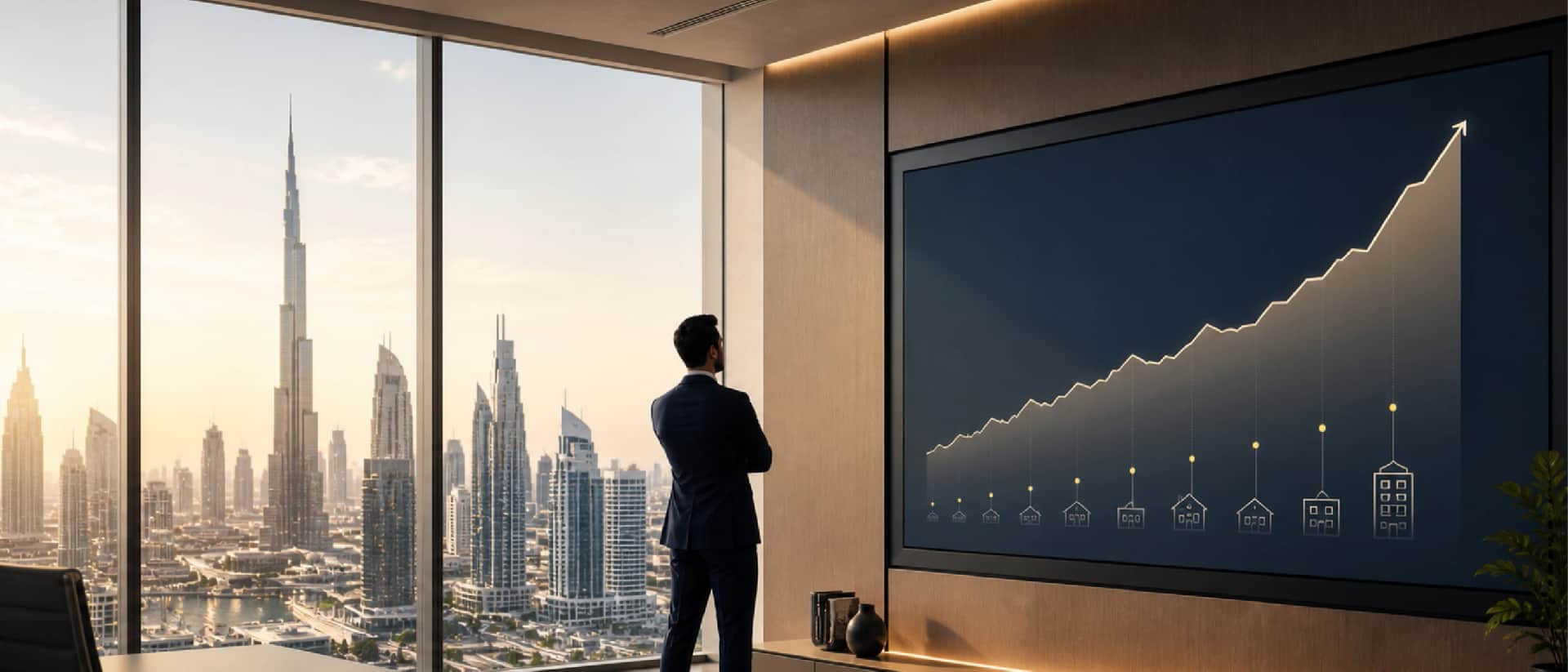
According to Dubai Land Department (DLD) statistics, the Dubai Property Market registered a sharp growth in April 2026, with total real estate transactions reaching AED 68.56 billion. It is more than a 20 percent month-on-month growth.
The surge is not a short-term spike but the result of structural demand drivers such as inflows of foreign investment, population growth, and sustained off-plan development activity across the masterplanned communities of the city of Dubai.
The Dubai Property Market has been able to exhibit its liquidity strength in both residential and commercial real estate segments. It will further help it to establish itself as one of the most dynamic global real estate hubs in 2026.