Adil Raza Khan | April 23, 2026

Dubai real estate scams could be prevented by conducting a proper verification process, regulatory checks, and disciplined investment decisions. The market is attractive around the world in 2026. Nevertheless, the increase in the complexity of transactions and online exposure has amplified the exposure of Dubai real estate fraud, particularly for foreign investors.
As it applies to Apil Properties clients, it is necessary to know how these risks arise and how they are controlled before any transaction is made.
The real estate ecosystem of Dubai is highly controlled and governed by the Dubai Land Department and the Real Estate Regulatory Agency. Nevertheless, with such an effective framework, cases of real estate fraud in Dubai are also evident in certain areas. These are largely observed in off-plan and secondary deals where there are gaps in verifications.
Curated Opportunities
Flexible buying options for smarter property decisions.
Handpicked properties sorted for the strongest value.
Investment-focused listings with return potential.
Browse Dubai communities with properties for sale.
Dubai real estate scams can be defined as fraudulent or misleading. These involve the false representation of property descriptions, illegal brokerage, counterfeit ownerships, and financial accounting fraud in transactions. These risks do not occur as a systemic failure in 2026. Rather, they are transaction-level vulnerabilities. They are affected by the digital growth and the cross-border investing practice.
Recent enforcement efforts demonstrate that hundreds of brokers and listings have been inspected or fined due to non-compliance. This indicates a stricter regulatory environment as opposed to the unregulated growth of fraud.
Meanwhile, international financial reporting by the financial news outlets like Reuters and The Guardian brings to the fore a more intricate market landscape. There have been fluctuations in transaction volumes, and selective price corrections are being experienced.
This atmosphere exposes one to Dubai property investment frauds. The danger is more when investors do not depend on local purchases, independent verification, or local guidance.
Generally, Dubai property investment scams do not occur because of the failure of regulation, but due to poor due diligence. The most prevalent are the mispriced listings, unlicensed middlemen, and payment transactions that do not go through controlled escrows.
In several reported cases of property scams in Dubai, investors were subjected to the following problems:
One rule has always been strengthened by the authorities. Any off-plan transactions would have to go through regulated escrow mechanisms. Any misalignment with this framework will mean a lot of exposure to Dubai investment fraud and loss of money.
The exposure of real estate fraud in Dubai by the year 2026 is closely associated with conditions in the market, and not the inability to regulate the market.
Dubai is still getting a lot of inflow of capital and high-net-worth migration all over the world. The city is still a significant location to international investors who want to invest in assets on a long-term basis.
Nonetheless, according to the Reuters reports, there has been a moderate transaction activity in some segments. There are selective pricing adjustments in some areas.
This generates an effect of pricing dispersion. There are assets that are aggressively sold at below benchmarks. Under these circumstances, any offers that seem considerably lower than market value cannot be an accurate representation of the market value.
Rather, they are able to report on possible real estate scams in Dubai. This risk is increased in cases that are coupled with urgency-based sales strategies or a lack of transparency in documentation.
Dubai has one of the most organized real estate regulations in the world. Dubai Land Department and RERA are in charge of it. These bodies have licensing requirements, escrow regulations, and transparency of transactions in the primary and secondary markets.
Projects have to be registered by all developers prior to being marketed. Off-plan transactions have to be channeled through escrow accounts that are overseen by regulators. This framework is a big mitigation of systemic fraud.
Nevertheless, real estate fraud in Dubai is still evident in instances where dealings are made outside the formal frameworks. In the majority of cases, it is not the failure of regulation. It is non-compliance by investors with verification measures.
To know how to avoid property scams in Dubai, one has to be compliance-first. It cannot solely count on marketing assertions or broker guarantees.
The first step that investors should take is to authenticate property ownership and project registration via the Dubai Land Department systems. This will verify that the asset is legal and is duly registered.
It is also important that the broker be verified. Transactions should only be done with licensed agents who are registered by RERA. Unregistered resellers continue to be a common cause of Dubai property investment fraud.
Another important layer is pricing validation. The institutional investors make comparisons of various assets in the same micro-market. This assists in setting fair value scales and minimizing the risks of misleading discount schemes that are usually associated with Dubai investment fraud.
Best Project Finder
Filter opportunities by budget, property type, bedroom mix, and strategy to uncover projects aligned with your investment goals.
Real estate scams in Dubai can be organized into definite risk groups. Before making any transaction, investors have to scrutinize each category.
All these types of risks are evident in the reported instances of property scams in Dubai. This strengthens the significance of organised due diligence in all the steps of the investment process.
Dubai is still among the safest and most controlled property markets in the world. The existence of centralized control by the Dubai Land Department and RERA makes sure there is good governance within the transactions.
Dubai property fraud is not completely eradicated. But they are successfully addressed with compliance systems. Investors, following the rules and regulations, authentication of documentation, and utilizing the escrow mechanism, are mostly safeguarded from Dubai investment fraud situations.
Institutionally, market instability does not contribute to real estate risk in Dubai. It is caused by process failures. The majority of problems occur when investors do not follow the verification process or use sources that are not verified.
The 2026 market data show that there would still be worldwide demand for Dubai property. This is facilitated by population increase, infrastructural development, and inflows of capital. Transaction moderation and selective price corrections have, however, brought a more complex pricing environment.
According to Reuters reports, there have been some fluctuations in volumes and prices in some of the segments. This is not a sign of weakness in the market. Rather, it is a maturing cycle as asset selection and due diligence are gaining prominence.
Under these conditions, Dubai real estate fraud is likely to arise where there is a sense of urgency, remote purchasing, and a lack of proper checkups.

The real estate sector in Dubai has robust long-term fundamentals in 2026. Economic diversification and the confidence of global investors support these. Nevertheless, the changing forms of transactions demand a more disciplined way of investment.
In the case of Apil Properties clients, the most important principle is evident. Real estate scams in Dubai can be prevented if investment choices are made based on confirmed data, regulatory adherence, and organized benchmarking of markets.
A compliance-based approach not only reduces the exposure to real estate fraud in Dubai, but also places the investor in a place where one can enjoy one of the strongest and most competitive property markets in the world.
Dubai real estate scams are fraudulent property activities like fake listings, forged documents, or unlicensed brokerage transactions.
You can avoid Dubai real estate scams by verifying property ownership, using RERA-licensed agents, and paying only through escrow accounts.
Dubai property investment scams are not widespread but occur in cases of poor due diligence or unverified transactions.
Real estate scams in Dubai usually happen through fake listings, fake agents, or payments outside regulated escrow systems.
Yes, Dubai is safe for real estate investment in 2026 if investors follow regulatory checks and verified channels.
Real estate fraud Dubai refers to illegal practices like ownership forgery, misrepresentation, or unauthorized property sales.
You can verify a property through the Dubai Land Department system and confirm its registration and ownership details.
Signs include unrealistic discounts, pressure to pay quickly, lack of documentation, and unlicensed agents.
Dubai real estate scams happen mainly due to investor inexperience, remote buying, and lack of verification.
The safest way is to invest through RERA-licensed brokers, escrow-protected projects, and verified listings only.

WRITTEN BY
Adil Raza Khan is a Dubai luxury real estate expert with over 13 years of experience in the UAE property market. He is the Chairman of APIL Properties.
Investment Finder
Use smart filters to discover Dubai projects matched to your investment goals.
Try the Investment Finder
The Dubai Real Estate Market is set to see record-breaking momentum with transaction value reaching AED139.2 billion in Q1 2026—fueled by strong off-plan demand, foreign capital inflows, and increasing end-user activity.
Dubai is keeping its lead over other property hubs around the world thanks to its investor-friendly policies and the high potential for returns, as noted in market reports by Arabian Business and major brokerage data providers.
The Dubai Real Estate Market is not only expanding in terms of volume but also gaining greater value and quality as buyers are increasingly looking towards projects that are supported by infrastructure, credibility of the developers, and potential appreciation of capital value.
The Dubai Real Estate boom has evolved into a more stable, investment-driven cycle thanks to this structural shift in demand.

Capital appreciation in Dubai property market is the rise in property value over time, influenced by factors such as demand, location development, and macroeconomic conditions. To an investor, it is the money gained by selling the property for more than the initial investment.
Simply put, when you buy real estate in Dubai, and the value of that property improves over the next several years, then that gain in value is your capital appreciation. In Dubai, however, this concept has more than just the notion of price growth; it is correlated to infrastructure growth, off-plan deals, and demand from investors all over the world.
Dubai has emerged as one of the world's most vibrant real estate markets. It is offering opportunities for both immediate profit and future investment and wealth. For anyone interested in investing strategically in Dubai properties instead of speculatively, it is crucial to understand the concept of capital appreciation in the local real estate market.
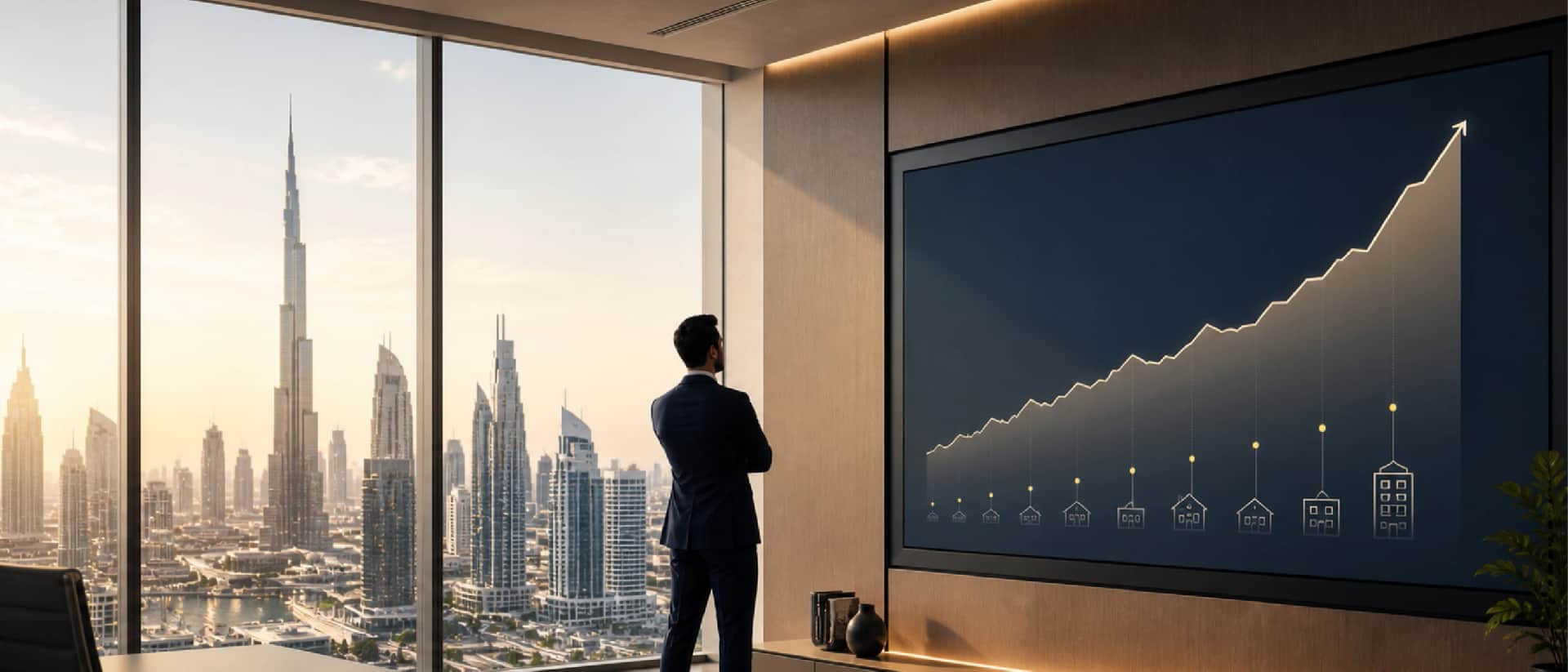
According to Dubai Land Department (DLD) statistics, the Dubai Property Market registered a sharp growth in April 2026, with total real estate transactions reaching AED 68.56 billion. It is more than a 20 percent month-on-month growth.
The surge is not a short-term spike but the result of structural demand drivers such as inflows of foreign investment, population growth, and sustained off-plan development activity across the masterplanned communities of the city of Dubai.
The Dubai Property Market has been able to exhibit its liquidity strength in both residential and commercial real estate segments. It will further help it to establish itself as one of the most dynamic global real estate hubs in 2026.