Adil Raza Khan | May 2, 2026

The Dubai Removes Minimum Property Value policy is a change in 2026 when the UAE government removed the AED 750,000 property value requirement for single property owners under the Dubai investor visa system.
This reform affects the Dubai 2 year residency visa, and the eligibility for residency based on property ownership (irrespective of value). This is a fundamental change in the UAE visa system where the eligibility for residency is based on property ownership rather than the amount invested in Dubai real estate.
Curated Opportunities
Flexible buying options for smarter property decisions.
Handpicked properties sorted for the strongest value.
Investment-focused listings with return potential.
Browse Dubai communities with properties for sale.
As per new update, Dubai 2 year residency visa system now has no minimum value criteria for single property owners under the Dubai investor visa system. So any legally registered and completed property in Dubai can now be used for residency, regardless of its value.
But the system still has criteria for joint owners and mortgaged properties, allowing UAE authorities to maintain control over the system.
The Dubai investor visa is now based on ownership. Investors with a ready-built property registered at Dubai Land Department stand a chance of residency.
The Dubai 2 year residency visa opens up to a broader investor pool, including first-time investors in Dubai real estate with lower and middle incomes.
The shared ownership and mortgaged properties will still require financial checks to keep the UAE visa program under control.
Dubai lifted the minimum property value requirement to broaden the pool of investors in Dubai real estate investment and diversify the investor base from across the world. According to APIL experts, this decision enhances the Dubai investor visa system by increasing accessibility to residency and tying it with investment in real estate.
The effect on the Dubai real estate market is a strong demand in the lower and mid-market segments. Now, more real estate investors may invest in Dubai properties not only to generate a profit but also to obtain a Dubai 2 year visa. This transforms the real estate market into a residency-driven market.
There is an increase in Dubai property investment trends for higher transactions and quick off-plan absorption. This helps developers because visa eligibility becomes a key selling feature to buyers, so sales move faster for their projects. Investors also exhibit greater holding behaviour
The primary benefit is more access to the Dubai investor visa, enabling more international investors to invest in Dubai real estate. This boosts demand for mid-end housing, supports liquidity for resale, and off-plan.
Best Project Finder
Filter opportunities by budget, property type, bedroom mix, and strategy to uncover projects aligned with your investment goals.
The key downside is competition for entry-level Dubai housing. The rise in demand leads to pressure on prices at the low end of the market, particularly in tight supply markets. And the market becomes more polarised, with entry-level housing segments increasingly contested. Luxury markets are stable with higher visa quotas (such as the Golden Visa).
With additional investors in Dubai's real estate market, competition for more affordable housing grows.
Increased demand for affordable Dubai properties may result in price pressure in the short run.
Market segmentation in Dubai real estate market between competitive low end and high-end luxury.
Buyers' negotiation power may get limited in high competition Dubai areas.
This policy change boosts Dubai market competition. Developers compete more in less than 1.5M AED properties with flexible financing and residency benefits. Investors also face increased competition for ready properties. It weakens bargaining power and boosts bidding in Dubai investment properties.
The Dubai investor visa update is very good for foreign investors as it lowers entry barriers and links property investment to residency in the UAE.
Dubai real estate investment is likely to grow gradually due to more investors and higher demand for residency.

Dubai Removes Minimum Property Value is a structural demand expansion policy that enhances access to the Dubai investor visa program and expands Dubai 2 year visa.
It boosts Dubai real estate investment inflows, liquidity, and market share. But it also boosts competition in entry-level segments and places short-term upward pressure on prices in entry-level segments.
Overall, the policy is a step towards a residency-based real estate economy in which UAE visa, residential property ownership, and investment growth are intertwined.
Dubai Removes Minimum Property Value policy allows investors to qualify for the Dubai investor visa without a minimum property price requirement.
Yes, any completed and registered property in Dubai can qualify for the Dubai 2 year residency visa.
The Dubai 2 year residency visa is a renewable visa granted to investors who own property in Dubai real estate.
The Dubai investor visa now works on ownership-based eligibility instead of requiring a fixed investment amount.
Yes, Dubai real estate investment remains attractive due to increased accessibility and residency-linked benefits.
No, there is no minimum investment requirement for sole property owners under the updated policy.
Any completed and legally registered property in Dubai qualifies, subject to standard verification conditions.
Yes, higher demand may create price pressure in entry-level Dubai real estate segments.
Yes, but mortgaged properties require additional financial verification under UAE visa rules.
First-time and mid-income investors benefit the most from this policy change.

WRITTEN BY
Adil Raza Khan is a Dubai luxury real estate expert with over 13 years of experience in the UAE property market. He is the Chairman of APIL Properties.
Investment Finder
Use smart filters to discover Dubai projects matched to your investment goals.
Try the Investment Finder
The Dubai Real Estate Market is set to see record-breaking momentum with transaction value reaching AED139.2 billion in Q1 2026—fueled by strong off-plan demand, foreign capital inflows, and increasing end-user activity.
Dubai is keeping its lead over other property hubs around the world thanks to its investor-friendly policies and the high potential for returns, as noted in market reports by Arabian Business and major brokerage data providers.
The Dubai Real Estate Market is not only expanding in terms of volume but also gaining greater value and quality as buyers are increasingly looking towards projects that are supported by infrastructure, credibility of the developers, and potential appreciation of capital value.
The Dubai Real Estate boom has evolved into a more stable, investment-driven cycle thanks to this structural shift in demand.

Capital appreciation in Dubai property market is the rise in property value over time, influenced by factors such as demand, location development, and macroeconomic conditions. To an investor, it is the money gained by selling the property for more than the initial investment.
Simply put, when you buy real estate in Dubai, and the value of that property improves over the next several years, then that gain in value is your capital appreciation. In Dubai, however, this concept has more than just the notion of price growth; it is correlated to infrastructure growth, off-plan deals, and demand from investors all over the world.
Dubai has emerged as one of the world's most vibrant real estate markets. It is offering opportunities for both immediate profit and future investment and wealth. For anyone interested in investing strategically in Dubai properties instead of speculatively, it is crucial to understand the concept of capital appreciation in the local real estate market.
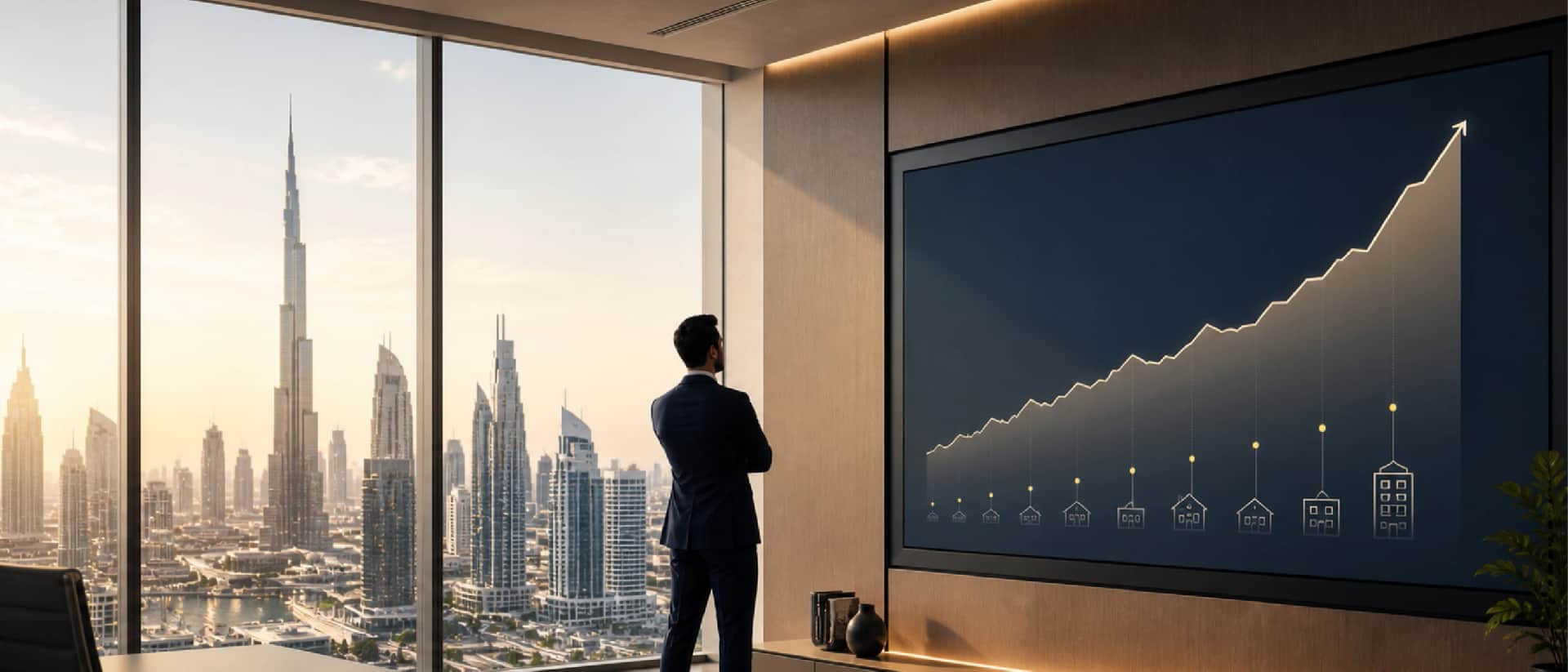
According to Dubai Land Department (DLD) statistics, the Dubai Property Market registered a sharp growth in April 2026, with total real estate transactions reaching AED 68.56 billion. It is more than a 20 percent month-on-month growth.
The surge is not a short-term spike but the result of structural demand drivers such as inflows of foreign investment, population growth, and sustained off-plan development activity across the masterplanned communities of the city of Dubai.
The Dubai Property Market has been able to exhibit its liquidity strength in both residential and commercial real estate segments. It will further help it to establish itself as one of the most dynamic global real estate hubs in 2026.