Adil Raza Khan | April 13, 2026
Flip Properties in Dubai can still be profitable when there is geo-political tensions, but not as a quick-profit strategy. Rather, it turns into a cyclical investment strategy, where achieving success is determined not by quick resale profits but by the strength of demand over the long term, liquidity needs, and time.
When geopolitical uncertainty is involved, Dubai does not lose its interest among investors; on the contrary, it tends to increase, as a safe-haven market. However, the pace of property flipping in Dubai decelerates, and the fundamentals remain robust.
Curated Opportunities
Flexible buying options for smarter property decisions.
Handpicked properties sorted for the strongest value.
Investment-focused listings with return potential.
Browse Dubai communities with properties for sale.
The action of the investors shifts to security instead of speculation when global tensions are high. This has a direct effect on flipping property in Dubai. Whereby it is not for short-term trading but strategic holding.
Dubai is still among the most powerful world real estate markets, and recent statistics prove that it is resilient. Market records and the Dubai Land Department trends have shown that the city registered over 215,000 property deals in 2025, valued at over AED 682 billion, which is approximately 31 percent value growth of the previous year. This indicates that the demand is still high despite the uncertain global conditions.
But in Dubai, real estate flipping is more discerning, and there are fewer rapid exits, and more focus on high-quality locations and reputed developers.
Yes—but not for quick profit.
In times of geopolitical instability, Fast appreciation cycles turn into slow and stable growth cycles of Flip Properties in Dubai. Buyers grow wary, holding time rises, and the resale liquidity is restricted.
Deloitte Dubai Real Estate Outlook, the market still remains a safe-haven to international investors even in times of geopolitical uncertainty, and residential prices still show approximately 20% growth in recent cycles (2024 data). Today, however, growth is less aggressive and speculative as it is based on actual demand.
This implies that flipping in Dubai is not dead- but it is only to investors who know how and when to do what.
Is property flipping profitable in Dubai? Yes, but profitability depends heavily on entry price and exit timing.
According to the latest data of the market analysis conducted by Property Finder, Dubai real estate is on a steady increase with an increase in prices of approximately 5-8 per year in the recent cycle, even though the transaction volumes in the recent cycle have already reached record levels.
Nevertheless, analysts (such as Fitch Ratings as reported in Reuters) have cautioned that a possible price adjustment of up to 10% 15 can happen owing to an increase in supply pipelines; this implies that flipping margins will be tight in the near term.
Thus, property flipping in Dubai is not a sure short-term profit model anymore, although it is still profitable.
To figure out how to flip property in Dubai in times of geopolitical tensions, one will need to change the approach:
Investors usually concentrate on off-plan projects whose payment schemes are flexible, and those whose developers have a good reputation. It is aimed not at resale but at capital gain in building stages. Dubai property flipping ROI was historically 10-30 percent in strong cycles, but in uncertain markets, the ROI is more time-dependent and compressed.
Thus, property flipping in Dubai now can be handled as an organized process of investment and not speculation.
The cost of flipping property in Dubai plays a critical role in net profitability.
An average ratio of property flipping costs Dubai investors between 6-10 percent of the total transaction value, based on:
This is because although the asset may have an appreciation, poor cost planning may erode the profit margins. The knowledge of flipping property in Dubai costs is necessary as geopolitical unpredictability tends to add holding time, which indirectly adds to the overall cost of flipping.
Recent verified market data highlights strong resilience in Dubai real estate:
This validates the fact that real estate flipping in Dubai has been sustained by a good underlying demand even in unstable international environments.
Moreover, Bloomberg reports that the high-end segment of the real estate market in Dubai was still expanding regardless of the geopolitical tensions that the country is in, and the sales of high-value property are projected to rise substantially in 2025, indicating that investors are not going anywhere soon.
Best Project Finder
Filter opportunities by budget, property type, bedroom mix, and strategy to uncover projects aligned with your investment goals.
In property flipping in Dubai, location is the most critical factor for the success.
Downtown Dubai, Dubai Marina, Palm Jumeirah, and Dubai Hills Estate are some of the high-demand areas with end-users and investors always willing to invest in them, making them better placed in terms of flipping in times of geopolitical tensions.
Such regions are liquid since they are not solely speculation-based but lifestyle-based.
The idea of Flipping Houses in Dubai under the circumstances of geopolitical tensions makes a distinct boundary between risk and opportunity.
Risks:
Opportunities:
This is the reason why property flipping in Dubai is more calculated and not speculative in times of global instability.
Historical ROI on property flipping in Dubai has been high because of the fast market growth and inflows of globally-based investors.
Nevertheless, recent trends indicate a change:
This reflects a maturing market where flipping property in Dubai is less about speed and more about timing discipline.
Despite geopolitical tensions, Dubai remains the recipient of capital inflows because of:
Reuters and Financial Times reports about UAE real estate trends demonstrate that Dubai is a safe-haven market across the globe, even when the uncertainty in the region is increasing. That is why even in turbulent geopolitical times, Flip Properties in Dubai can be relevant.

To sum up, Flip Properties in Dubai in times of geopolitical tensions is not a fast-profit plan. It is a cyclical, systematic investment strategy that rewards patience, timing, and prudent choice of assets.
Although flipping property in Dubai continues to be profitable, the flipping nature has evolved, as it is no longer about quick speculative returns. But rather value appreciation over time because of the solid fundamentals.
The investors who adjust to the market cycles will have their way. Plus, those who anticipate quick-fix liquidity and short-term returns will have slowed returns. The current market is not fast but strategic, timely, and resilient in the real estate flipping in Dubai.
Yes, but only with a long-term strategy and the right timing.
Yes, but profits depend on market cycle and location.
Around 6%–10% of the property value including fees and charges.
Buy early in strong projects and exit at peak demand.
Typically ranges between 5% to 15% in the current market.
Downtown, Marina, Palm Jumeirah, and Dubai Hills Estate.
A slower investment strategy focused on long-term resale.
Transfer fees, commissions, and holding expenses.
Yes, if done with patience and proper market analysis.
Early entry, strong developer, and flexible exit planning.

WRITTEN BY
Adil Raza Khan is a Dubai luxury real estate expert with over 13 years of experience in the UAE property market. He is the Chairman of APIL Properties.
Investment Finder
Use smart filters to discover Dubai projects matched to your investment goals.
Try the Investment Finder
The Dubai Real Estate Market is set to see record-breaking momentum with transaction value reaching AED139.2 billion in Q1 2026—fueled by strong off-plan demand, foreign capital inflows, and increasing end-user activity.
Dubai is keeping its lead over other property hubs around the world thanks to its investor-friendly policies and the high potential for returns, as noted in market reports by Arabian Business and major brokerage data providers.
The Dubai Real Estate Market is not only expanding in terms of volume but also gaining greater value and quality as buyers are increasingly looking towards projects that are supported by infrastructure, credibility of the developers, and potential appreciation of capital value.
The Dubai Real Estate boom has evolved into a more stable, investment-driven cycle thanks to this structural shift in demand.

Capital appreciation in Dubai property market is the rise in property value over time, influenced by factors such as demand, location development, and macroeconomic conditions. To an investor, it is the money gained by selling the property for more than the initial investment.
Simply put, when you buy real estate in Dubai, and the value of that property improves over the next several years, then that gain in value is your capital appreciation. In Dubai, however, this concept has more than just the notion of price growth; it is correlated to infrastructure growth, off-plan deals, and demand from investors all over the world.
Dubai has emerged as one of the world's most vibrant real estate markets. It is offering opportunities for both immediate profit and future investment and wealth. For anyone interested in investing strategically in Dubai properties instead of speculatively, it is crucial to understand the concept of capital appreciation in the local real estate market.
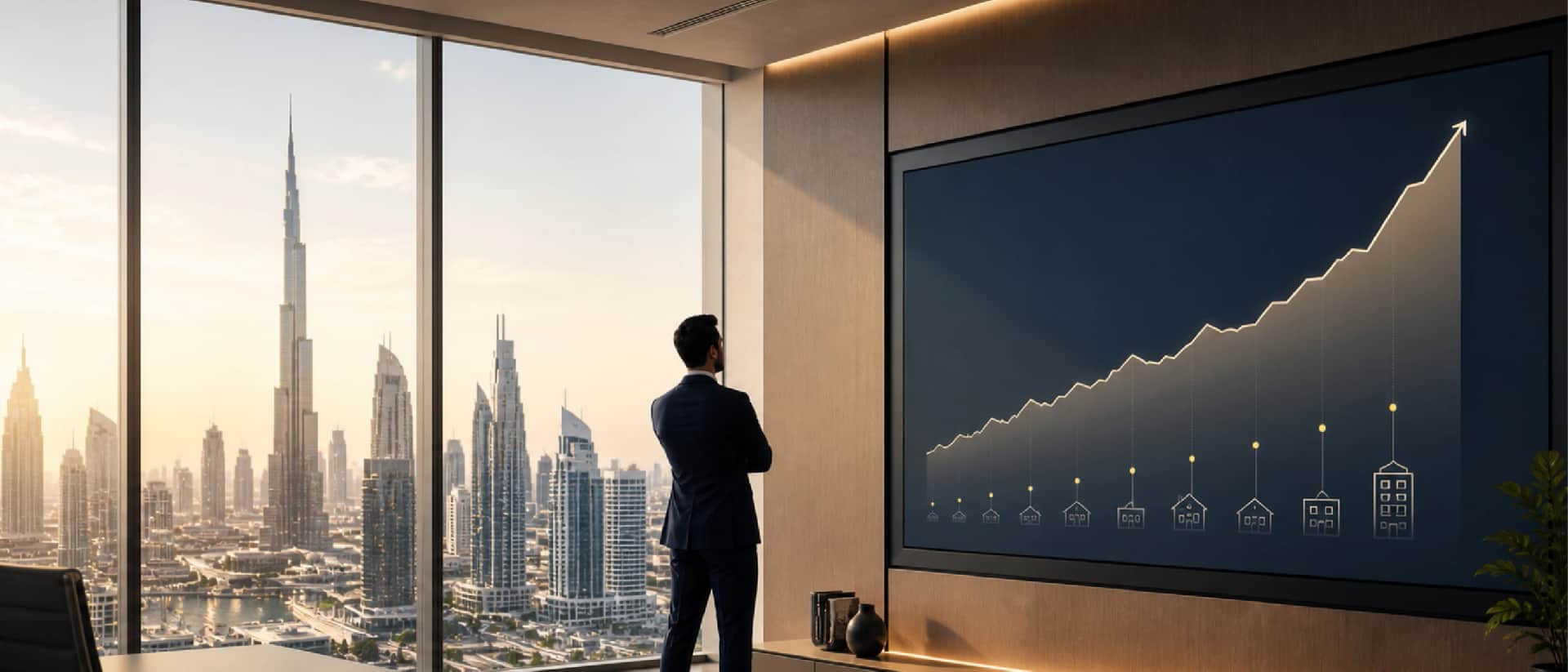
According to Dubai Land Department (DLD) statistics, the Dubai Property Market registered a sharp growth in April 2026, with total real estate transactions reaching AED 68.56 billion. It is more than a 20 percent month-on-month growth.
The surge is not a short-term spike but the result of structural demand drivers such as inflows of foreign investment, population growth, and sustained off-plan development activity across the masterplanned communities of the city of Dubai.
The Dubai Property Market has been able to exhibit its liquidity strength in both residential and commercial real estate segments. It will further help it to establish itself as one of the most dynamic global real estate hubs in 2026.