Maximize ROI on Dubai Property Investments | April 28, 2026
In 2026, Maximize ROI on Dubai Property Investments, buy at a discount, focus on cash flow, and invest in assets with limited supply during the market correction. With the Dubai real estate market correction underway, savvy investors are focusing less on speculation and more on data-driven approaches to manage cash flow, timing, and asset quality.
The Dubai real estate market is not in a crash; it is in a correction following a boom. The market is transitioning into a stabilization phase with increasing supply and moderate growth in prices, reports cited by the Khaleej Times and Reuters have shown. This presents a unique opportunity for savvy investors to lock in high returns with improved real estate valuations.
Curated Opportunities
Flexible buying options for smarter property decisions.
Handpicked properties sorted for the strongest value.
Investment-focused listings with return potential.
Browse Dubai communities with properties for sale.
Dubai's real estate market correction in 2026 is largely due to increasing supply and a normalisation following years of exponential growth. Recent industry reports show that more than 50,000 residential units are expected to be completed in 2026 and that hundreds of thousands of units will be in the pipeline by 2030.
Meanwhile, sales volumes are at historically high levels. Historical data cited by local market analysts reveal property prices are still well above year-on-year levels, but they have slowed from the double-digit growth between 2021 and 2024. This is a trend towards a more normal cycle rather than a correction.
This shift signals a shift in the investment opportunity for investors away from flipping and into understanding Dubai real estate during market correction and how to play your cards right.
To maximize ROI Dubai real estate in a correction cycle, investors should focus on buying at value, generating revenue, and selling at the right time, as opposed to capital gain.
The key is buying property below its intrinsic value. According to reports, market segments are already seeing discounts of 10-15% in oversupplied areas. The initial purchase price directly enhances Dubai investment property ROI.
Secondly, rental yield drives returns. As price appreciation settles down, income-generating assets generate cash. Expatriates and international investors remain attracted to Dubai, ensuring rental demand.
Lastly, time is of the essence. Experienced investors with a strategy to achieve the highest return on investment (ROI) in Dubai property know corrections are buying opportunities, not selling opportunities. Investing in market downturns and selling during the subsequent expansion (predicted by many experts to be around 2027-2028) can magnify returns.
Dubai's property prices are not declining, rather they are stagnating with some specific segment declines. Reports confirm that while there have been some small decreases in price, luxury and prime assets are holding up.
This differentiation is key. Dubai Property Market Trends suggest a division between assets in high demand and low supply versus mid-market developments with supply constraints. Near-shore, villa and branded developments are holding up better than mid-market, high-density apartments.
This micro-market segmentation is crucial to maximize ROI on Dubai Property Investments in the current cycle.
In a market correction, the right asset class becomes critical. Our Dubai real estate trends analysis reveals that villas, townhouses, and lifestyle properties generally outperform apartments in terms of capital gain and yield in slower market cycles.
High-end and branded properties also remain in demand with high-net-worth individual buyers, providing security and value appreciation. At the same time, apartment saturation could lead to rental yields being pressured.
That's why investors looking for Dubai Property Market Trends for Maximum Returns are turning to assets of scarcity over supply.
Yes, 2026 is an ideal time to invest in Dubai property for long-term investors. Corrections are when the best deals are struck to obtain assets at a lower price.
As insights from Gulf News and Khaleej Times suggest, Dubai's fundamentals remain robust, with continued population, infrastructure growth, and foreign investment. This bodes well for future demand, despite short-term supply constraints that lead to price corrections.
For investors looking to increase the return on Dubai Property Investments, buying during the correction provides the opportunity to realise value now as well as in the future.
Best Project Finder
Filter opportunities by budget, property type, bedroom mix, and strategy to uncover projects aligned with your investment goals.
There are risks involved but these can be managed. The most prominent risk for this cycle is excess supply in some neighbourhoods, which may result in lower capital gains and strained rental markets.
Also, off-plan projects in the early stages of development are riskier because of possible delays and changes in demand. That's why savvy investors opt for near-handover or ready-to-move-in properties in correction cycles.
In Dubai, navigating market correction calls for a balance between risk and reward. Those who simply focus on capital appreciation without regard to the rental yield or fundamentals of the location may miss out on solid investment opportunities.
To achieve the best return on investment in Dubai Property Investments in 2026, a multifaceted approach of value investing, yield investing, and timing the market is crucial.
Buyers should look for properties that can be rented immediately, have a strong location, and are unlikely to see the supply increase in the future. Buying at a discount not only limits downside risks but also improves long-term returns.
It's also crucial to have a clear exit plan. Whether it's to hold for rental return or to sell at the next boom, this will maximise returns. This strategy is in line with the shift in Dubai Property Market Trends from speculative to informed investments.
The 2026 correction is not a crisis, but a reset for Dubai's real estate market. This is a time when savvy investors can capitalise on market correction to leverage the best opportunities for Maximising ROI Dubai real estate in the long run.
By emphasising quality, taking advantage of market anomalies and understanding long-term drivers of demand, the goal of maximising ROI on Dubai Property Investments can be achieved even in a market correction.
At Apil Properties, we aim to assist investors in making the right moves to transition from one phase to the next, and to spot opportunities that match current market realities and future potential.
Focus on buying below market value in high-demand areas and prioritizing rental yield over speculation.
Yes, corrections create discounted entry points that improve long-term ROI potential.
JVC, Arjan, Business Bay, and emerging waterfront communities offer strong rental yields and stability.
Prices are expected to stabilize with selective corrections in oversupplied segments, not a market crash.
Yes, it is considered a strategic entry phase for long-term investors due to market cooling.
Invest in high-yield properties, secure below-market deals, and avoid oversupplied areas.
Dubai rental yields typically range between 5% to 9% depending on location and property type.
Only near-handover or reputable developer projects are safer during correction cycles.
Main risks include oversupply, slower appreciation, and poor location selection.
Tax-free income, high rental demand, and strong infrastructure make it globally competitive.

WRITTEN BY
Adil Raza Khan is a Dubai luxury real estate expert with over 13 years of experience in the UAE property market. He is the Chairman of APIL Properties.
Investment Finder
Use smart filters to discover Dubai projects matched to your investment goals.
Try the Investment Finder
The Dubai Real Estate Market is set to see record-breaking momentum with transaction value reaching AED139.2 billion in Q1 2026—fueled by strong off-plan demand, foreign capital inflows, and increasing end-user activity.
Dubai is keeping its lead over other property hubs around the world thanks to its investor-friendly policies and the high potential for returns, as noted in market reports by Arabian Business and major brokerage data providers.
The Dubai Real Estate Market is not only expanding in terms of volume but also gaining greater value and quality as buyers are increasingly looking towards projects that are supported by infrastructure, credibility of the developers, and potential appreciation of capital value.
The Dubai Real Estate boom has evolved into a more stable, investment-driven cycle thanks to this structural shift in demand.

Capital appreciation in Dubai property market is the rise in property value over time, influenced by factors such as demand, location development, and macroeconomic conditions. To an investor, it is the money gained by selling the property for more than the initial investment.
Simply put, when you buy real estate in Dubai, and the value of that property improves over the next several years, then that gain in value is your capital appreciation. In Dubai, however, this concept has more than just the notion of price growth; it is correlated to infrastructure growth, off-plan deals, and demand from investors all over the world.
Dubai has emerged as one of the world's most vibrant real estate markets. It is offering opportunities for both immediate profit and future investment and wealth. For anyone interested in investing strategically in Dubai properties instead of speculatively, it is crucial to understand the concept of capital appreciation in the local real estate market.
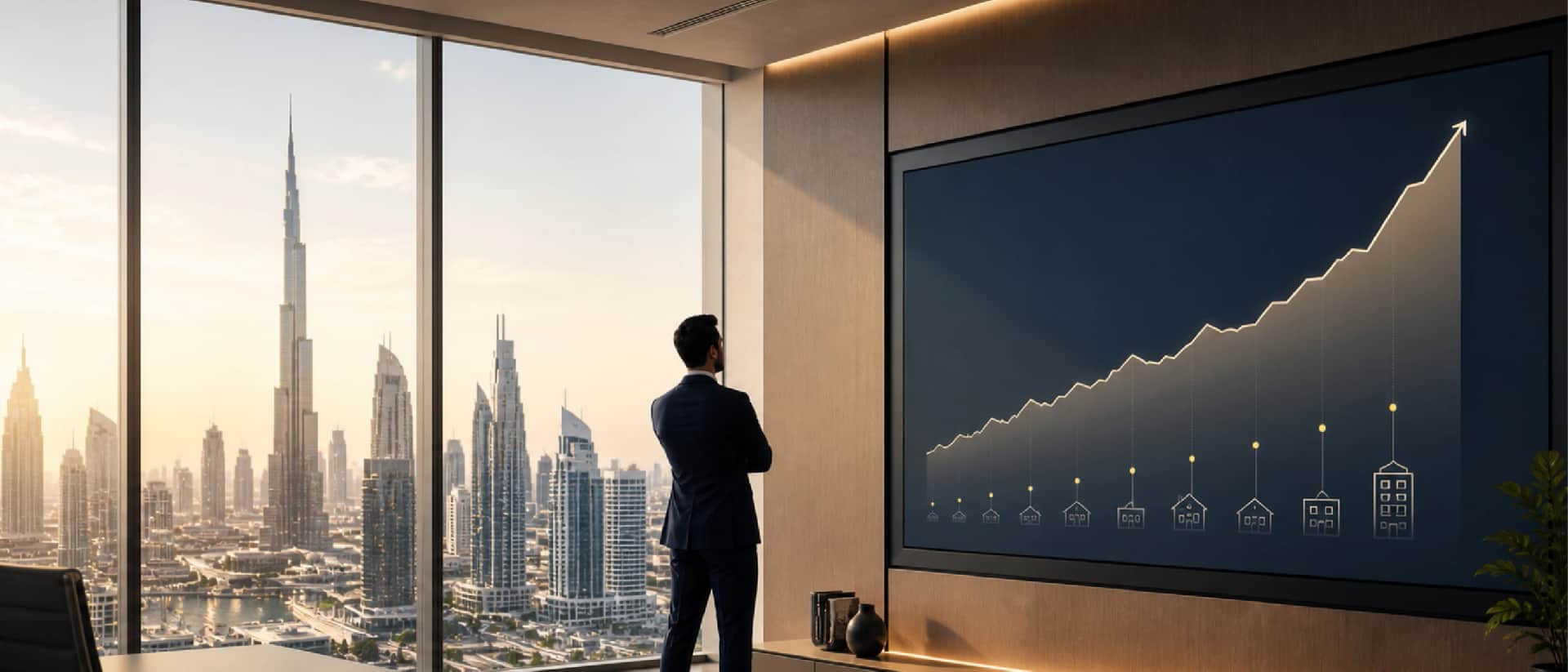
According to Dubai Land Department (DLD) statistics, the Dubai Property Market registered a sharp growth in April 2026, with total real estate transactions reaching AED 68.56 billion. It is more than a 20 percent month-on-month growth.
The surge is not a short-term spike but the result of structural demand drivers such as inflows of foreign investment, population growth, and sustained off-plan development activity across the masterplanned communities of the city of Dubai.
The Dubai Property Market has been able to exhibit its liquidity strength in both residential and commercial real estate segments. It will further help it to establish itself as one of the most dynamic global real estate hubs in 2026.