Adil Raza Khan | April 22, 2026
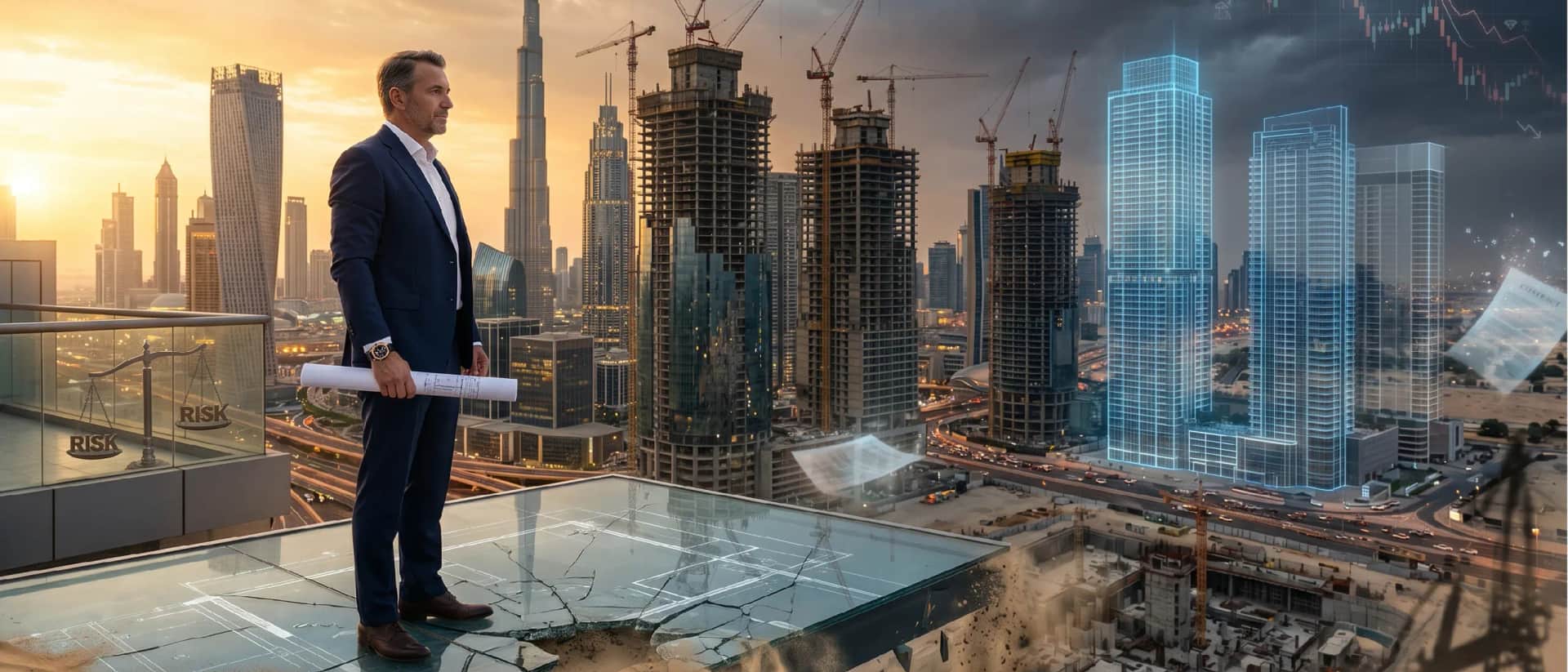
Dubai Off-Plan Risk in Investments in 2026 is a maturing real estate cycle with strong fundamentals and more supply concentration and selective liquidity pressure. The Dubai property market is structurally sound. It is backed by population growth, inflow of foreign investments, development of tourism, and the power of regulations.
Nevertheless, the returns of investments in 2026 are becoming more time-dependent, geographical, and quality developer-focused and less market momentum-driven.
For Apil Properties, this institutional analysis of Dubai Off-Plan Investment Risks in 2026 presents a structured view of market dynamics, supply absorption trends, liquidity cycles, and segment-specific risk exposure.
Curated Opportunities
Flexible buying options for smarter property decisions.
Handpicked properties sorted for the strongest value.
Investment-focused listings with return potential.
Browse Dubai communities with properties for sale.
Dubai Off-Plan Investment Risks in 2026 are based on a massive supply pipeline coming into the market over a narrow delivery timeline. The residential units are estimated to reach over 100,000 in the year 2026 and about 70,000-80,000 units in 2027.
Such a level of development shows great confidence in the long-term demand cycle of Dubai. Nevertheless, it also causes a temporary absorption mismatch in a certain community heavy with apartments.
Structural support to demand is evidenced by population growth, which has gone beyond multi-million growth levels within the past years. Plus, the unwavering participation of foreign investors. However, supply distribution in clustered locations causes proximity pressure as opposed to structural frailty.
This is one of the reasons why the risk of real estate in Dubai 2026 is not market-wide, but rather segmented.
The property market in Dubai is still exhibiting good performance basis in the year 2026. The market registered about 160,000+ transactions in 2025. The off-plan sales activity accounted for nearly 60% to 70% of the total sales activity, based on regional brokerage and market tracking reports.
The growth in prices has now become stabilized at a sustainable level of about 8% to 12% per year, as compared to the accelerated cycles in the past. This implies a shift to a better and more mature market structure as opposed to speculative growth.
According to institutional research and global real estate projections, Dubai is currently in a steady-growth cycle, in which returns are becoming more of an asset selection and holding strategy than of general market uplift.
Consequently, Dubai Off-Plan Investment Risks in 2026 are not spread throughout the entire ecosystem, but in micro-markets.
Supply timing concentration is the main factor that contributes to the rise in Dubai Off-Plan Investment Risks in 2026. There are several mega projects coming to completion at overlapping periods of time, especially in mid-density residential areas.
This builds short-term inventory during handover periods, as resale listings go up at the same time. Demand is healthy, but the rate of absorption is different in communities. This will create a localized pricing pressure and not a general market adjustment. It is a logical consequence of the overburdening of supply cycles and is in line with the worldwide real estate patterns in growing urban centers.
That is why off plan property Dubai risks are more apparent in some clusters, particularly in the areas where there are many investors and apartment zones.
Dubai Off-Plan Investments Risks in 2026 are focused in few segments where the investor levels are high and with overlapping supply pipelines.
Increased exposure occurs in:
Lower exposure is observed in:
Exit liquidity risk during the completion phases is the greatest off plan property risk in Dubai in 2026. This arises when several investors set out to sell off similar units at the same time. The level of resale competition rises, and the pace of transactions decelerates.
The previous cycles enabled easier assignment sales and early exits as a result of greater speculative demand. Nevertheless, this flexibility has been minimized in some aspects because of synchronized project deliveries in 2026.
Consequently, this can lead to investors having longer holding periods or a reduction in price in response to the saturation of supply in the locality. This is one of the structural elements of Dubai Off-Plan Investment Risks in 2026, and especially in short-term investment plans.
Regulatively, it is possible to answer the question in the affirmative: Is off-plan property safe in Dubai 2026. Dubai has one of the most developed property governance systems in the world.
This includes:
These structures provide great transparency and greatly minimise legal and operational risk. Nevertheless, there is a risk to financial performance. It has a connection with market cycles, rather than regulatory safety. Thus, the real estate risks in 2026 in Dubai can be best described as timing and liquidity risks in a stable and well-regulated ecosystem.
The hidden risks of off plan properties in Dubai are not construction risks but rather liquidity risks. Resale saturation at handover stages is one of them: at such stages, several investors sell out at the same time, and the pricing pressure is temporary.
The other is developer-driven launch cycles in which secondary market values of prior purchases can be influenced indirectly by the pricing of a new project.
These risks cannot be detected at the entry stage. They come out in exit cycles. This is the reason structured Dubai off-plan investment analysis should comprise liquidity stress analysis and pricing analysis.
Best Project Finder
Filter opportunities by budget, property type, bedroom mix, and strategy to uncover projects aligned with your investment goals.
A systematic Dubai off-plan investment study reveals that the market is shifting to a more institutional and absorption-oriented market.
Off-plan remains at about 60 percent-70 percent of all residential transactions, showing long-term investor confidence.
Nevertheless, investor behavior is becoming more like:
This movement is enhancing the stability of the market and minimizing speculative volatility. Consequently, there are now balanced pros and cons of Dubai off-plan property. Upside is more location-dependent, whereas downside risk is more selective.
The risks of buying property in Dubai in 2026 are more of a timing nature than structural. Supply density, micro-market absorption strength, and reputation of the developer. Also, exit timing strategy has become a necessary factor that the investors consider before making investment choices.
Although there are local risks, Dubai is underpinned by sound macroeconomic fundamentals such as population growth, tourism boost, investment in infrastructure, and foreign capital inflows, which are sustainable. This is to make sure that Dubai property investment risks are controlled and divided as opposed to systemic.
The decision should you invest in off plan Dubai 2026 is based on investment horizon and strategy discipline.
Short-term investors are more exposed to:
Long-term investors benefit from:
Thus, the Dubai Off-Plan Investment Risks in 2026 can be viewed as timing and selection risks, but not the constraints that apply to the entire market.
Understanding how to avoid off plan property risks Dubai requires a disciplined investment strategy.
Key approaches include:
These ways will go a long way in mitigating exposure to Dubai Off-Plan Investment Risk in 2026.

The future of Dubai Off-Plan Investment Risks 2026 is stable and structurally favorable. The economy is not in decline; it is becoming more of a discriminating investment climate where supply growth and absorption flows are more and more subdivided.
Although there is risk concentration in some regions and within timeframes, Dubai has shown high levels of macroeconomic resilience owing to the underlying long-term demand fundamentals.
To sum it up, Dubai Off-Plan Investment Risks in 2026 are the indications of a healthy market development where opportunities are high, yet the success is achieved by making informed decisions, strategic positioning, and disciplined execution, not wide speculative exposure.
They are mainly supply-driven liquidity and timing risks in specific micro-markets, not a market-wide weakness.
Yes, it is legally safe due to RERA and escrow protections, but financial returns depend on market timing.
Main risks include delayed resale, oversupply in some areas, and exit liquidity pressure at handover.
Yes, it remains strong, but returns are now more selective and location-dependent.
Exit liquidity risk during completion when multiple investors try to sell at the same time.
By choosing reputed developers, avoiding oversupplied areas, and planning exit strategy early.
Due to population growth, foreign investment inflows, tourism expansion, and limited prime supply.
It is evaluation of supply, demand, developer track record, and exit liquidity conditions before investing.
Yes, but only with long-term strategy and careful selection of location and developer.
They include resale saturation, delayed exits, and pricing pressure during project handovers.

WRITTEN BY
Adil Raza Khan is a Dubai luxury real estate expert with over 13 years of experience in the UAE property market. He is the Chairman of APIL Properties.
Investment Finder
Use smart filters to discover Dubai projects matched to your investment goals.
Try the Investment Finder
The Dubai Real Estate Market is set to see record-breaking momentum with transaction value reaching AED139.2 billion in Q1 2026—fueled by strong off-plan demand, foreign capital inflows, and increasing end-user activity.
Dubai is keeping its lead over other property hubs around the world thanks to its investor-friendly policies and the high potential for returns, as noted in market reports by Arabian Business and major brokerage data providers.
The Dubai Real Estate Market is not only expanding in terms of volume but also gaining greater value and quality as buyers are increasingly looking towards projects that are supported by infrastructure, credibility of the developers, and potential appreciation of capital value.
The Dubai Real Estate boom has evolved into a more stable, investment-driven cycle thanks to this structural shift in demand.

Capital appreciation in Dubai property market is the rise in property value over time, influenced by factors such as demand, location development, and macroeconomic conditions. To an investor, it is the money gained by selling the property for more than the initial investment.
Simply put, when you buy real estate in Dubai, and the value of that property improves over the next several years, then that gain in value is your capital appreciation. In Dubai, however, this concept has more than just the notion of price growth; it is correlated to infrastructure growth, off-plan deals, and demand from investors all over the world.
Dubai has emerged as one of the world's most vibrant real estate markets. It is offering opportunities for both immediate profit and future investment and wealth. For anyone interested in investing strategically in Dubai properties instead of speculatively, it is crucial to understand the concept of capital appreciation in the local real estate market.
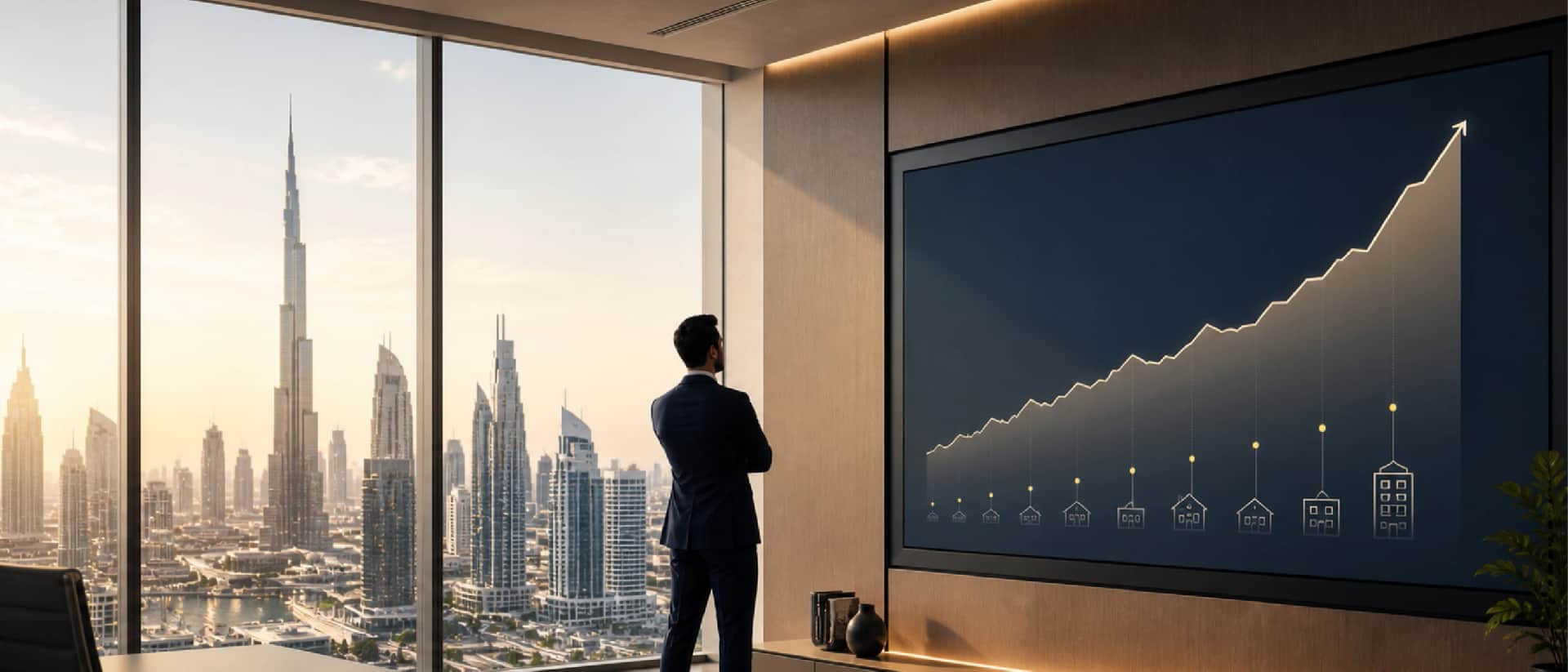
According to Dubai Land Department (DLD) statistics, the Dubai Property Market registered a sharp growth in April 2026, with total real estate transactions reaching AED 68.56 billion. It is more than a 20 percent month-on-month growth.
The surge is not a short-term spike but the result of structural demand drivers such as inflows of foreign investment, population growth, and sustained off-plan development activity across the masterplanned communities of the city of Dubai.
The Dubai Property Market has been able to exhibit its liquidity strength in both residential and commercial real estate segments. It will further help it to establish itself as one of the most dynamic global real estate hubs in 2026.