Adil Raza Khan | August 16, 2025

An Off-plan property is either under construction or yet to be built. So, they are always brand-new properties with the latest installations and amenities, unlike ready properties, which can be several years old.
The units will be available for possession and moving in once they are completed. Buyers or investors benefit from flexible payment plans that segment the property purchasing price payable over a period of time. No need to pay the amount in a single go!
Curated Opportunities
Flexible buying options for smarter property decisions.
Handpicked properties sorted for the strongest value.
Investment-focused listings with return potential.
Browse Dubai communities with properties for sale.
The flexibility enjoyed in the payment structure and the freedom of time it allows in wrapping up the full payment make off-plan real estate properties more alluring.
1) Time-based payment plans are where you make payments as per a schedule that is predetermined between the developer and you at the time of booking the property. The schedules and amounts are specified in the SPA (Sales Purchase Agreement) so you stay well-informed beforehand.
2) You also have Construction-linked payment plans where you pay an installment only when the developer reaches a certain construction milestone. You can expect to pay 50%, 60%, 70%, or even 80% of the property price during the construction stage as per the defined milestones. The final payment you pay on project completion.
For example, if your off-plan unit is on the 80/20 Payment Plan, it means 80% of the cost is payable during the construction stage (divided into installments). The remaining 20% is on handover.
3) Post-handover Payment Plans is like a time-based payment plan but with the scope to pay the final amount over an extended period after you get the property key. For example, You pay 30% during the construction stage, 40% on handover (project completion), and the remaining 30% after you get the property key over a few years (2, 3, 4, or 5 years as mentioned in the plan).
4) 1% payment plans are creating much hype these days. This is a payment plan where
It looks tempting, but usually you end up overpaying. The properties sold under this scheme also cost more per square foot than they should. Be selective and careful.
Reputation and Success Track of the Developer
Location Determines the Off-plan Profitability
Future Growth Potential
ROI & Rental Yields
Best Project Finder
Filter opportunities by budget, property type, bedroom mix, and strategy to uncover projects aligned with your investment goals.
No investment is 100% risk-free. The Dubai off-plan real estate market, however, prioritizes investors' interests. Remember it!
The information here is a simplified version of the mandatory stages involved in buying off-plan properties in Dubai. For deeper insights, check out how to buy an off-plan property in Dubai.
Stage 1: You choose the off-plan property you like. Either you approach the developer and manage things single-handedly or go ahead through your appointed real estate agent.
Stage 2: Pay the booking fee, which is not a fixed amount and also is not the downpayment. Sign the Booking Form or OTP (Offer to Purchase) to register your interest in the property. The document will cover the main terms of sale.
Stage 3: Now, pay the downpayment to the real estate developer’s escrow account. The booking fee you already paid is adjusted to the downpayment amount!
Stage 4: The SPA or Sales Purchase Agreement, is registered with the Dubai Land Department between the seller and the buyer. You or your agent should carefully read the paper, as it includes details of the seller (developer in this case), buyer, property, payment details, and the terms and conditions.
Stage 5: Now, to register the property in your name, you need to pay the Dubai Land Department fee of 4% of the purchasing price. Collect the OQOOD.
Stage 6: Pay the installments as per the payment scheme and wait for the handover. You can mortgage it, or after a few initial payments, you can resell it from this stage onwards.
Stage 7: The Municipality and Fire Department will do a pre-handover inspection and will give BCC (Building Completion Certificate) to the developer confirming the suitability of the property for habitation. You pay the final payment when the developer shows you the BCC.
Stage 8: Do a pre-handover inspection on your own before accepting the unit. Get Title Deed and make the final payment.
Stage 9: Contact DEWA and get the water, electricity, and gas connections.
Stage 10: Once the utility connections are properly verified, the developer gives you the property key. You have your property now!
Dubai Marina: Dubai Marina is an iconic waterfront community with several off-plan real estate properties like triplexes, penthouses, duplex apartments, and luxury houses. Dubai Marina apartments usually have a 6% to 7% ROI.
Rove Home Dubai Marina, Madain Tower, and Residences Du Port Autograph Collection.
Palm Jumeirah: Your investment cannot go wrong on off-plan units on the world’s largest and most scenic man-made island. Villas, mansions, apartments, penthouses, and duplexes are available. Over the years, the area saw an average capital appreciation of 7–9% and rental yields of 5–6%.
Passo by Beyond, Armani Beach Residence, and One Crescent Palm.
Downtown Dubai: Burj Khalifa, Dubai Opera, Dubai Fountain, and Dubai Mall make up the neighborhood here. Apartments, penthouses, duplexes, and triplexes are available. In 2024, Downtown Dubai made 4,436 transactions worth AED 14 billion.
Baccarat Residences, W Residences, and Velor Penthouses.
Dubai Creek Harbour: A sustainable waterfront community, Dubai Creek Harbour is the biggest project by Emaar so far. It offers luxury townhouses, penthouses, and apartments. Long-term investment potentiality is promising here.
Silva, Altan, and Albero.
Business Bay: The most stylish business/finance hub of Dubai, with amenity-enriched apartments, duplexes, penthouses, triplexes, and townhouses. Rental yield here is 8% to 13%.
Tiger Sky Tower, Waldorf Astoria Residence, and Binghatti Aquarise.
Dubai South: The area is the next-gen Dubai built around the world’s largest airport (Al Maktoum International Airport) and is good for apartments and mansions.
MAAK Residence, Lilian Residences, and Windsor House.
First-Time Home Buyer Loan Program
FTHB is an initiative by the Dubai Government to help first-time home buyers own a property more easily. It was launched recently in 2025.
Priority access to the latest project launch (off-plan properties) by reputed developers, preferential prices on off-plan units, more flexible payment plans for buying off-plan properties, zero-interest DLD fees and quicker and more affordable loan facilities, among other facilities, are available.
PS. The property price must be within AED 5 million, and the applicant should be 18 years old. Click here to know more about the FTHB loan program.
Summing up
The blog answers all your basic queries about off-plan properties and important details like the payment plans, top areas to consider, and the regulatory initiatives in the investment market in Dubai. Once you know these basics, you will be able to cultivate your understanding better about the booming off-plan real estate segment of Dubai.
If ever you need more assistance and deeper insights, we will be glad to help you.

WRITTEN BY
Adil Raza Khan is a Dubai luxury real estate expert with over 13 years of experience in the UAE property market. He is the Chairman of APIL Properties.
Investment Finder
Use smart filters to discover Dubai projects matched to your investment goals.
Try the Investment Finder_1783320909.webp&w=1920&q=65)
Capital appreciation in Dubai property market is the rise in property value over time, influenced by factors such as demand, location development, and macroeconomic conditions. To an investor, it is the money gained by selling the property for more than the initial investment.
Simply put, when you buy real estate in Dubai, and the value of that property improves over the next several years, then that gain in value is your capital appreciation. In Dubai, however, this concept has more than just the notion of price growth; it is correlated to infrastructure growth, off-plan deals, and demand from investors all over the world.
Dubai has emerged as one of the world's most vibrant real estate markets. It is offering opportunities for both immediate profit and future investment and wealth. For anyone interested in investing strategically in Dubai properties instead of speculatively, it is crucial to understand the concept of capital appreciation in the local real estate market.
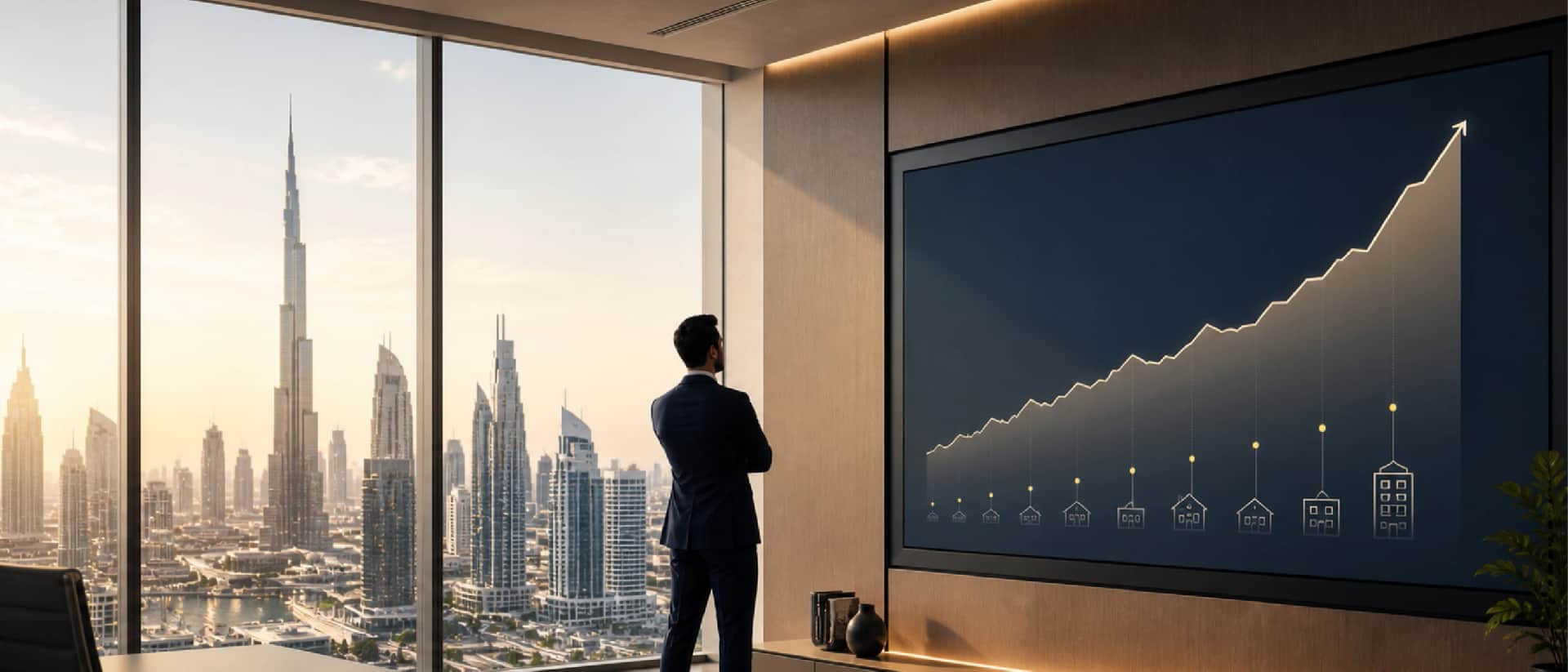
According to Dubai Land Department (DLD) statistics, the Dubai Property Market registered a sharp growth in April 2026, with total real estate transactions reaching AED 68.56 billion. It is more than a 20 percent month-on-month growth.
The surge is not a short-term spike but the result of structural demand drivers such as inflows of foreign investment, population growth, and sustained off-plan development activity across the masterplanned communities of the city of Dubai.
The Dubai Property Market has been able to exhibit its liquidity strength in both residential and commercial real estate segments. It will further help it to establish itself as one of the most dynamic global real estate hubs in 2026.

Yes - investing in Dubai luxury property in 2026 as a long-term strategy is a good opportunity to grow your capital rather than to earn rental income in the short-term. The high-net-worth migration, zero-tax ownership, and lack of ultra-prime supply make the Dubai luxury property market continue to outperform other cities around the world.
In 2025, Dubai registered approximately AED 900+ billion worth of real estate dealings, with luxury areas accounting for a significant portion of the worth increment. The global media reports about the increase in demand for branded homes and waterfront villas, indicating an evident surge in the Dubai luxury property market.
Prime area price increases have been 15-25% per year, and ultra-luxury properties over $10M are still setting sales records. This substantiates the robust momentum in Dubai's luxury property market, backed by international investors.
Nevertheless, rental yields remain at an average of 46 percent, and that is an appreciation. On the whole, luxury property in Dubai is a high-potential, fact-supported investment in long-term wealth creation.