Adil Raza Khan | January 27, 2026

Dubai Property Exit Strategy 2026 is necessary for investors seeking to sell or re-market their holdings in Dubai as the market becomes dynamic, as well as to enjoy the highest profit and the lowest risk. With the Dubai real estate market maturing in 2026, it is important to know that the Dubai exit strategy planning for 2026 is important to both short-term and long-term investors. The most important factors in performing an effective exit are strategic timing, location, and cost planning.
Curated Opportunities
Flexible buying options for smarter property decisions.
Handpicked properties sorted for the strongest value.
Investment-focused listings with return potential.
Browse Dubai communities with properties for sale.
A Dubai property investment exit plan should be adopted at the most opportune time in 2026, when the market is at its peak, that is, between October and April, when buyers are most interested. By selling at this time, you are likely to get quicker deals and better offers.
The high-demand areas, such as Downtown Dubai, the Palm Jumeirah, and the Dubai Hills Estate, tend to be more resilient to the slowdown of the overall market. Thus, seasonal timing is an important aspect of an effective exit strategy in Dubai real estate.
A lack of an efficient Dubai real estate exit strategy starts with establishing investment objectives, risk tolerance, and holding periods desired. Short-term investors can also get good gains by selling off at around 70-80% project completion. Thus, gaining early before the supply surges.
The exit strategy of long-term investors in Dubai property should observe the rental yields and macroeconomic trends affecting the Dubai property, so that the Dubai property exit strategy 2026 is at the highest rental demand, and the prices are stable. Strategic planning enables the investors to offset capital gains and cash flow opportunities and reduce the risks of the market which may arise.
The choice of selling or retaining your property is determined by the location, nature of the property and your Dubai exit strategy. Premium locations might keep valuing at a minor rate, and a brief hold would be lucrative.
But excess supply in the secondary markets could demand that they move out sooner, and the price can fall. With a well-planned sale on supply projections, rental trends and buyer demand, you would have to achieve optimum returns in your property exit strategy in Dubai.
Your Dubai property exit strategy 2026 will have a direct influence on the possible resale costs. In 2026, when there will be an influx of new supply of property, by selling before the massive handovers in the oversupply regions, you can cushion your returns.
Real estate in mature settlements where demand is high holds value better. The timing, location, property type, and exit strategies assist investors in protecting the resale value of the properties and maximising the ROI.
Cost consideration is important when implementing a Dubai exit strategy. The transaction costs, or Dubai Land Department transfer fees, agency commissions, and marketing or legal expenses usually decrease net profits by 7 to 10% of the sale price. These costs need to be factored into your Dubai real estate exit strategy as they would make your profit estimates realistic, as well as assist in optimising your exit schedule.
In order to have an effective Dubai exit strategy, place is a factor. Miscellaneous communities, including Downtown Dubai, Business Bay, Dubai Marina, and Palm Jumeirah, are always recorded to have high resale prices.
This is because of the high demand and good developments, and low supply. Villas and luxury apartments in these regions tend to outscore other segments and make them the best to apply a property exit strategy in Dubai.
The perfect holding period is the key to your Dubai property investment exit plan. The higher risks in short-term fluctuations occur until 2026, and the combination of rental earnings and capital gains is likely to yield greater net returns on properties owned between 3 and 5 years. Long-term investment enables the investor to get a market cycle advantage and strategise with the Dubai exit strategy planning for 2026.
The sale of Dubai apartments through flipping is still profitable in selective segments. The resale potential of the properties in popular regions and good developments is very high. Nevertheless, excess supply in the secondary markets might experience a margin squeeze. This calls for a close study of the Dubai real estate exit strategy so that you can be right on the timing to sell your Dubai real estate.
The expected 2026 wave of property supply, which is projected to bring tens of thousands of new units, will affect the dynamics of resale. Overcapacity in some locations will lead to a drop in prices, and those areas that are prime with steady demand will not be affected. The supply trends are also an important consideration in your property exit strategy in Dubai to get the most returns out.
Best Project Finder
Filter opportunities by budget, property type, bedroom mix, and strategy to uncover projects aligned with your investment goals.
The Dubai exit strategy also involves knowledge of legalities and financing of financial obligations. The transfer of ownership, acquisition of NOCs, payments of service charges, and coping with taxes are all crucial processes that may influence the timing and profitability. Your Dubai real estate exit strategy 2026 should be efficient, and it is best to make it comprehensive.
Yes, the rental income will be a key consideration in your Dubai property investment exit plan. High rental returns improve the value of the property and have the advantage of being able to exit when you want. Developers can choose to invest in the properties of the high-rent neighbourhood to maximise cash flow and profits from the resale in the future.
Market cycles are important in the development of any Dubai Property Exit Strategy 2026. The real estate market in Dubai cycles through growth, stabilization and correction, and by understanding such cycles, the investors know when to exit the market well.
Therefore, the best time to sell is when the property is experiencing growth, and the best time to hold is during a stabilisation stage. Then the rental returns will be made before resale. On the other hand, trying to get out in a correctional move in the market may compress profit and lengthen the period in the market. Upon strategic observation of market cycles, your Dubai real estate exit strategy is informed and will give maximum returns.
The exit planning varies between off-plan and ready property. An off-plan Dubai exit strategy is generally aimed at selling the company before the project is completed to achieve early appreciation, yet it has a certain construction and delivery risk.
In Dubai, by contrast, a prepared property exit strategy uses the instant liquidity, rental history, and physical property value, which can be of more interest. Depending on their risk level, the duration of holding, and the Dubai property investment exit plan are allowed to choose the strategy to be applied.
The resale value is the key to Dubai's exit strategy planning for 2026. Begin by examining the recent prices of transactions within your community, price per square foot, rental returns, and demand-supply forces. Real estate in strategic locations such as Downtown Dubai, Palm Jumeirah and Dubai Marina tends to be better retained.
But on the other hand, any over-supplied or developing areas may experience slower resale. With consideration of transaction costs, developer premiums, and market conditions, you can realistically predict resale prices and create a proper property exit strategy in Dubai.
Yes, there is a full implementation of the Dubai real estate exit strategy 2026 by foreign investors. Dubai is permissive to total ownership in specific freehold zones. The procedure to sell or purchase property is not difficult for international purchasers and vendors.
Through proper planning, the foreign investors will be able to move in accordance with the market trends, rental performance, and community demand. Hence, the Dubai property investment exit plan will be equally available to both local and foreign investors.
The Dubai property exit strategy 2026 entails the evaluation of a number of risks. The timing and profitability of resales may be affected by the market conditions, oversupply at a particular community and delay in off-plan developments. The outcomes also depend on economic factors, regulatory changes and changes in buyer demand.
Risk management strategies that include diversifying the type of property, monitoring the supply-demand, and planning to hold on to property longer than originally budgeted should be factored in by investors in order to protect the returns in any situation that may arise during the Dubai exit strategy.

The mistakes made by investors are designed to fail their Dubai property investment exit plan. These are neglecting market cycles, overstating holding costs, pricing up properties or neglecting to consider the cost of transaction, such as agency commissions and DLD transfer costs.
The other pitfall is a failure to watch location-specific patterns, including emergent supply or future developments of infrastructure. This immediately influences resale prices. Such mistakes can be avoided by making your property exit strategy in Dubai and guaranteeing more predictable payouts.
It is necessary that a Dubai Property Exit Strategy 2026 be in place to enable investors maximise ROI in a maturing and more competitive market. The keys to a profitable exit are strategic planning, cost knowledge, tracking the supply-demand trends, and choice of prime locations. Incorporating these considerations in your Dubai exit plan, investors will have the opportunity to make secure financial returns and the best returns in 2026 and beyond.
A Dubai Property Exit Strategy 2026 is a plan for selling or repositioning your property to maximize returns and minimize risk in the current market.
The best time is during peak market activity from October to April when buyer demand and offers are strongest.
Market cycles influence resale timing, with growth phases maximizing capital gains and corrections potentially reducing profits.
Off-plan strategies target pre-completion sales for early gains, while ready property strategies leverage immediate liquidity and rental history.
Resale value depends on location, price-per-square-foot trends, rental yields, and current supply-demand dynamics.
Yes, foreign investors can sell or reposition properties in designated freehold areas following Dubai’s standard resale processes.
Key risks include oversupply, market fluctuations, project delays, economic shifts, and regulatory changes.
Properties are typically held 3–5 years to optimize combined rental income and capital growth before exit.
Prime areas like Downtown Dubai, Palm Jumeirah, Dubai Marina, and Business Bay offer strong resale potential.
Common mistakes include ignoring market cycles, underestimating costs, overpricing, and neglecting location-specific trends.
Yes, strong rental yields can increase property value and offer flexibility in exit timing.
Rising supply can compress prices in secondary areas, so strategic timing is key to protect returns.
A balanced approach that considers both ensures optimal returns based on market conditions and property type.
Transfer fees, NOCs, and transaction costs must be factored in to ensure compliance and net profitability.
Forecasts rely on historical trends, rental yields, supply pipelines, and end-user demand in your target community.

WRITTEN BY
Adil Raza Khan is a Dubai luxury real estate expert with over 13 years of experience in the UAE property market. He is the Chairman of APIL Properties.
Investment Finder
Use smart filters to discover Dubai projects matched to your investment goals.
Try the Investment Finder
Capital appreciation in Dubai property market is the rise in property value over time, influenced by factors such as demand, location development, and macroeconomic conditions. To an investor, it is the money gained by selling the property for more than the initial investment.
Simply put, when you buy real estate in Dubai, and the value of that property improves over the next several years, then that gain in value is your capital appreciation. In Dubai, however, this concept has more than just the notion of price growth; it is correlated to infrastructure growth, off-plan deals, and demand from investors all over the world.
Dubai has emerged as one of the world's most vibrant real estate markets. It is offering opportunities for both immediate profit and future investment and wealth. For anyone interested in investing strategically in Dubai properties instead of speculatively, it is crucial to understand the concept of capital appreciation in the local real estate market.
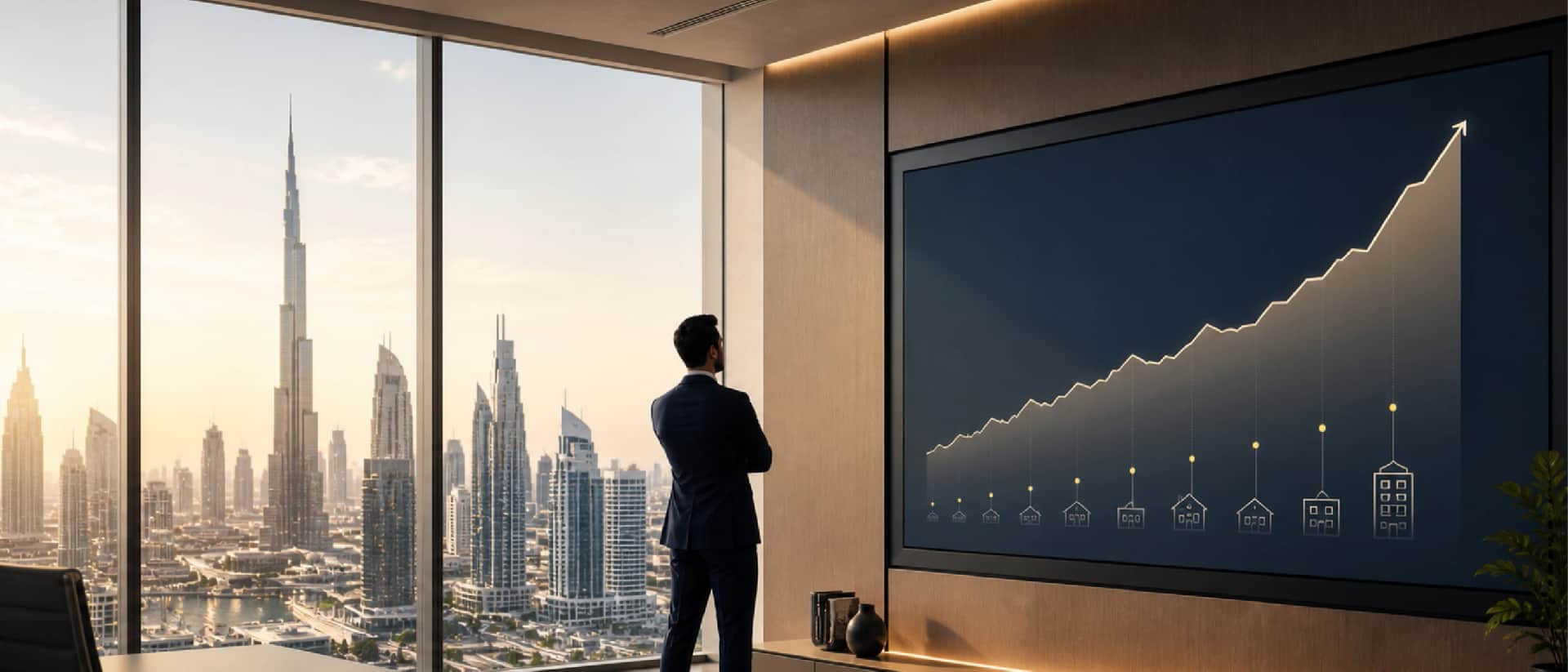
According to Dubai Land Department (DLD) statistics, the Dubai Property Market registered a sharp growth in April 2026, with total real estate transactions reaching AED 68.56 billion. It is more than a 20 percent month-on-month growth.
The surge is not a short-term spike but the result of structural demand drivers such as inflows of foreign investment, population growth, and sustained off-plan development activity across the masterplanned communities of the city of Dubai.
The Dubai Property Market has been able to exhibit its liquidity strength in both residential and commercial real estate segments. It will further help it to establish itself as one of the most dynamic global real estate hubs in 2026.

Yes - investing in Dubai luxury property in 2026 as a long-term strategy is a good opportunity to grow your capital rather than to earn rental income in the short-term. The high-net-worth migration, zero-tax ownership, and lack of ultra-prime supply make the Dubai luxury property market continue to outperform other cities around the world.
In 2025, Dubai registered approximately AED 900+ billion worth of real estate dealings, with luxury areas accounting for a significant portion of the worth increment. The global media reports about the increase in demand for branded homes and waterfront villas, indicating an evident surge in the Dubai luxury property market.
Prime area price increases have been 15-25% per year, and ultra-luxury properties over $10M are still setting sales records. This substantiates the robust momentum in Dubai's luxury property market, backed by international investors.
Nevertheless, rental yields remain at an average of 46 percent, and that is an appreciation. On the whole, luxury property in Dubai is a high-potential, fact-supported investment in long-term wealth creation.