Adil Raza Khan | March 20, 2026

No — the Dubai property market is not structurally slowing down, even amid the ongoing Iran war in 2026. Although there has been certain short-term caution and low transaction momentum, core market signs like continuing deal activity and price stability in key areas. The consistent investor interest demonstrates that the market is healthy and strong in the face of pressure.
The real activity in the first quarter of 2026 is still recorded with thousands of transactions and high-value sales being recorded. The developers and financial institutions continue to operate as usual. The current geopolitical crisis has impacted the market more than the market fundamentals, i.e. buyers might hold off. But there are no signs of the systemic slowdown in the real demand and market structure.
Curated Opportunities
Flexible buying options for smarter property decisions.
Handpicked properties sorted for the strongest value.
Investment-focused listings with return potential.
Browse Dubai communities with properties for sale.

The high-performing and significant record-setting real-estate deals in Dubai in 2025 have already set the stage for good performance in 2026 and later. The geopolitical tensions in the Middle East, such as the Iran war, have not hindered market growth as the market is continuing to outperform the expectations of a slowdown, and this goes to show that fundamental factors, rather than speculation, drive the growth in the market.
Experts note that the market’s growth is rooted in structural fundamentals:
According to industry experts, the real estate market in Dubai is at the next stage of the development, not a downfall. Increase in population, movement of wealth, and continued demand are indications that Dubai is not a cyclical or speculative market. But it is a stable international real estate hub.
The Dubai property market's slowing down is largely a short-term perception rather than a reality. This is evidenced by the fact that in early 2026, some 2,876 property transactions worth AED 9.13 billion were registered, which indicates that the market is active.
Although the luxury and speculative segments have been moderated only temporarily, the mid-market and off-plan residential apartments are still commanding high demand. The depth and liquidity of the market enable it to absorb the temporary sentiment shocks without any impact on the overall stability, according to the report of institutional investors and developers.
Property prices are largely stable across Dubai. Core residential and off-plan projects are stable with slight alterations in the luxury sectors. Luxury sales, such as those of apartments amounting to Dh422 million, show that the interest in the high-end real estate remains intact. That indicates that despite the uncertainty in geopolitical factors, the market fundamentals, such as demand and developer activity, can be used to maintain price stability.
The strength of the market is owed to the good fundamentals within the banking sector, development, and investor confidence. Banks have conservative lending behaviour and have a strong capital buffer, which is capable of absorbing temporary shocks. Projects are still delivered on time, which guarantees their regularity.
The domestic and international long-term investors make up a huge percentage of transactions. This makes the transaction less volatile. These reasons ensure that a temporary recession does not turn into a structural market downturn.
Banks in Dubai are very cautious in their lending and have well-balanced sheets, which contribute to the market absorbing any shock that is temporary shock. Over-leveraging is avoided by a conservative loan-to-value ratio and close lending scrutiny. This is the reason that, despite the news stories that imply caution, the banking system puts the brakes on the market and avoids drastic corrections in prices.
Best Project Finder
Filter opportunities by budget, property type, bedroom mix, and strategy to uncover projects aligned with your investment goals.
The confidence of investors is still high. Foreign and institutional purchasers are still involved in mid-market and off-plan developments. Transactions that are ultra-luxury, like Dh422 million properties sold out, indicate that there is still a demand. The regulatory environment, geographical location, and future growth prospects of Dubai assure investors of future growth despite the short-term geopolitical uncertainties.
The outlook for 2026 is positive. The transitory carefulness in luxury or speculative segments is likely to correct itself when regional circumstances are stabilized. Dubai has the potential to keep growing and thriving. This is because of the presence of active developers, favorable banking systems, and the continued demand of investors. Analysts expect the residents and investors to develop further interests, further cementing Dubai as a safe-haven of real estate.
The Dubai real estate market cannot crash since the real estate market fundamentals, such as banking, developer activity, and investor demand remain strong. Banks are also well-capitalized, developers keep delivering projects regardless of the situation, and pricing and transaction volumes are supported by long-term demand from residents and foreign buyers. Moderation of activity is temporary, and structural resilience aids in averting any crash in the market.
The Dubai property market is experiencing a few institutional and structural issues that will not allow a collapse. Banks are capitalized and keep a conservative lending policy, developers keep to the timely delivery of the projects, and the number of long-term investors is high.
It offers a practical market due to population increase, rental demand, and constant inflows of foreigners. These fundamentals bring about stability in the system even as sentiment decelerates in the short run.
Key Factors:

Temporary reduction in buyer behaviour, particularly in the luxury or speculative segment, is not a factor in the long-term growth since the market has a good structural foundation. Banks are kept afloat, settlebacks are taken by developers, and market stability is stabilized by long-term investors and rental demand.
The Dubai property market has been steadily expanding, even with the temporary caution imposed by geopolitical news. It has ensured the loyalty of investors and has preserved its image across the world.
At the beginning of 2026, the real estate market of Dubai started on a high note, having made record sales in 2025, which served as a starting point for development. The unpredictabilities in the region, such as the Iran war notwithstanding, the fundamental factors, such as the strong investor confidence, inflows of people, robust banking, and steady developer presence, make the market strong. As the need to acquire amidst the mid-market and high-end regions persists, Dubai is well on its way to consolidating its position as a safe and globally desirable real estate destination.
No — market activity continues with strong transactions and steady demand, not a structural slowdown.
Strong fundamentals and ongoing transactions continue even amid geopolitical tensions.
Some forecasts suggest minor corrections, but broad stability persists due to structural demand.
The market remains active with continued buying, selling, and solid investor participation.
Headline sentiment may reflect caution, but core price support remains in key segments.
Short-term sentiment has softened, but systemic demand indicators still show resilience.
Trends indicate sustained interest from end-users and investors, with gradual cooling in speculative activity.
Some caution exists, but many investors continue to participate, especially in mid-market and lifestyle segments.
Market fundamentals suggest stability and potential long-term growth, though buyers should assess segments carefully.
No confirmed crash; price and transaction data show the market still functions and records activity.

WRITTEN BY
Adil Raza Khan is a Dubai luxury real estate expert with over 13 years of experience in the UAE property market. He is the Chairman of APIL Properties.
Investment Finder
Use smart filters to discover Dubai projects matched to your investment goals.
Try the Investment Finder_1783320909.webp&w=1920&q=65)
Capital appreciation in Dubai property market is the rise in property value over time, influenced by factors such as demand, location development, and macroeconomic conditions. To an investor, it is the money gained by selling the property for more than the initial investment.
Simply put, when you buy real estate in Dubai, and the value of that property improves over the next several years, then that gain in value is your capital appreciation. In Dubai, however, this concept has more than just the notion of price growth; it is correlated to infrastructure growth, off-plan deals, and demand from investors all over the world.
Dubai has emerged as one of the world's most vibrant real estate markets. It is offering opportunities for both immediate profit and future investment and wealth. For anyone interested in investing strategically in Dubai properties instead of speculatively, it is crucial to understand the concept of capital appreciation in the local real estate market.
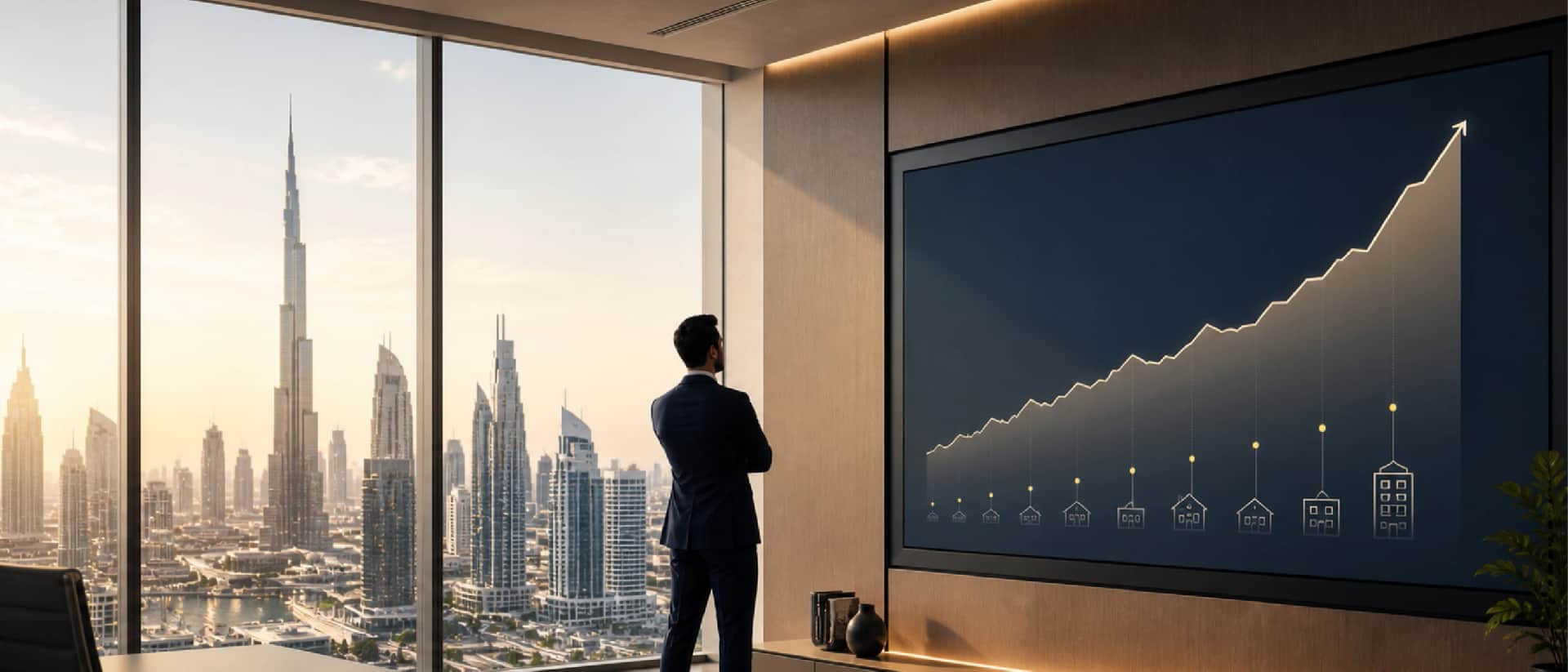
According to Dubai Land Department (DLD) statistics, the Dubai Property Market registered a sharp growth in April 2026, with total real estate transactions reaching AED 68.56 billion. It is more than a 20 percent month-on-month growth.
The surge is not a short-term spike but the result of structural demand drivers such as inflows of foreign investment, population growth, and sustained off-plan development activity across the masterplanned communities of the city of Dubai.
The Dubai Property Market has been able to exhibit its liquidity strength in both residential and commercial real estate segments. It will further help it to establish itself as one of the most dynamic global real estate hubs in 2026.

Yes - investing in Dubai luxury property in 2026 as a long-term strategy is a good opportunity to grow your capital rather than to earn rental income in the short-term. The high-net-worth migration, zero-tax ownership, and lack of ultra-prime supply make the Dubai luxury property market continue to outperform other cities around the world.
In 2025, Dubai registered approximately AED 900+ billion worth of real estate dealings, with luxury areas accounting for a significant portion of the worth increment. The global media reports about the increase in demand for branded homes and waterfront villas, indicating an evident surge in the Dubai luxury property market.
Prime area price increases have been 15-25% per year, and ultra-luxury properties over $10M are still setting sales records. This substantiates the robust momentum in Dubai's luxury property market, backed by international investors.
Nevertheless, rental yields remain at an average of 46 percent, and that is an appreciation. On the whole, luxury property in Dubai is a high-potential, fact-supported investment in long-term wealth creation.