Adil Raza Khan | January 23, 2026
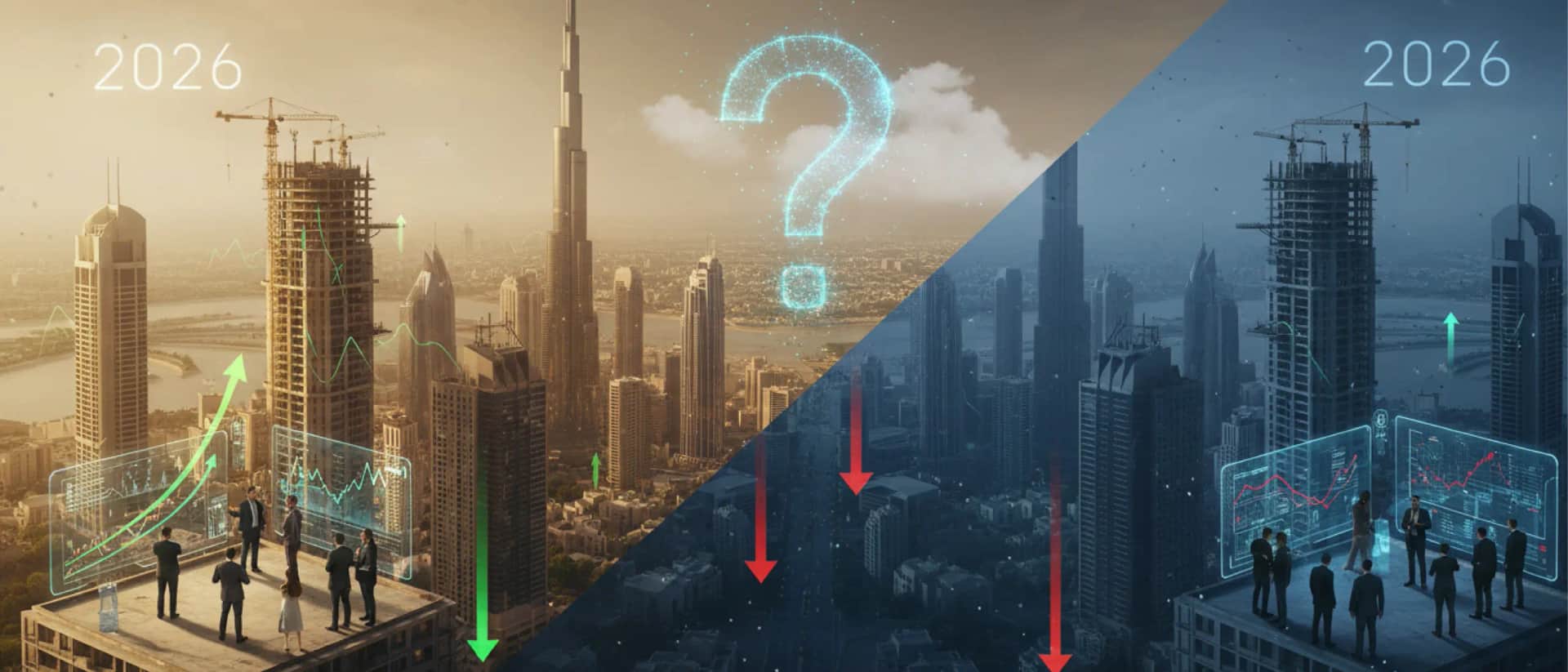
Will Dubai Property Prices Rise or fall is the top question among buyers, investors, and end-users for 2026. According to the latest transaction data, developer delivery schedule, rental trend and past price cycles, the answer is obvious: Dubai property prices are expected to rise by a modest margin in 2026, with selective adjustments in over-supplied markets.
There is no likelihood of a wide market crash. The market is instead entering a period of stability and sustainable growth. This is because some mid-market apartments might be slightly adjusted, but prime villas and low supply communities will only appreciate.
The real estate cycle in Dubai is no longer speculative. It is fueled by actual demand, population, and investor confidence. Dubai Property Prices are levelling off as per fundamentals rather than hype. This makes it a more predictable and safe environment to buyers.
Curated Opportunities
Flexible buying options for smarter property decisions.
Handpicked properties sorted for the strongest value.
Investment-focused listings with return potential.
Browse Dubai communities with properties for sale.
In 2026, Dubai property prices will likely increase generally, although this growth will differ according to location and type of property. The Dubai property market forecast shows that the prime locations like Palm Jumeirah, Downtown Dubai, and Emirates Hills can perform better. Conversely, the over-supplied apartment complexes might either be stabilized in terms of prices or exhibit slight drop.
The annual price increase is estimated to be within 3-7, where the villas and townhouses will be on the high end and apartments with high supply near the flat. Such trend is an indication of robust, fundamentals-based growth. It is an indication of a maturing market and not an overheated market.
The selective feature of growth implies that buyers and investors should be more tactical. In 2026, to make a profitable decision, it is necessary to understand supply pipelines, rates of their absorption, and the demand at a location.
Yes, will property prices rise in Dubai is still a valid expectation. Dubai housing market prognosis reveals that moderate growth in the prices of villas, townhouses, and low-density communities will be observed.
Family relocation to Dubai, long-term residents and lifestyle buyers are the segments that enjoy the demand due to their emphasis on space, community planning and quality of life. This demand guarantees a continuous increase in the price of real estate property in Dubai despite the apartment market's slump.
Prime communities and waterfront developments, particularly branded ones, will likely perform strongly. The people who will be interested in investing in these regions will have the advantage of both capital gains and rental incomes.
For buyers asking will property prices fall in Dubai, the answer is nuanced. The flat prices or minor decreases can be observed in some high supply apartment regions. This has mainly been attributed by the fact that the new project handovers are more than the immediate needs.
Nevertheless, it is a correction of supply rather than a market crash. The overall property price trend in Dubai is stable. The corrections in Dubai have traditionally been segment-specific. Luxury villas and branded townhouses are here to stay, with the mass-market apartments possibly modifying marginally to indicate market equilibrium.
Those buyers who are keen on studying the supply and absorption will still have some avenue to join these segments at reasonable prices.
The Dubai real estate prices are expected to remain high as of early 2026 as compared to the 2023 cycles. The prime villas, waterfront villas, and branded villas are moderately appreciating. Apartments in high supply areas are mostly stable.
This stability has been verified by the Dubai property price index, although the volume of transactions is high, indicating that there is confidence. It is no longer speculation that drives price growth. Rather, it shows the true market essentials like the rental market needs, population increase and location quality.
There will be an upward trend of average prices in all parts of Dubai of between 3 to 7%, which depends on the asset type and the community. This is a sign to the investors that there is still opportunity in the market without them incurring the speculative risk.
The 2026 price correction is mild and controlled. It mainly occurs in the mid-market apartment communities that have high levels of supply. The price in these regions has been adjusted by about 5 to 10%, to be similar to the price of rental yields and affordability levels.
The luxury and low-supply villas and townhouses are affected to a large extent. This is a normal process of correction. It does not allow overvaluation and ensures the stability of the market in the long run.
The Dubai property price forecast 2026 reveals that this is a normal practice in developed markets. They enhance transparency, remove speculative bubbles and enable investors and end-users to make better decisions.
The fundamentals of the market are good. The rental returns are between 6-8%, and the population is growing steadily, and mortgage stress is low.
The crash necessitates the collapse of demand, forced selling and plummeting of prices. All these requirements are absent. Some buyers interpret a crash when in reality it is a correction in the segment, especially with the over-supplied apartments.
Luxury and villas are good locations that stand firm. The Dubai property price graph indicates that the market is healthy as the prices have stabilised at higher prices. That is, the market is becoming smartly cool rather than falling.
A price correction is a small, moderate change, usually 5 to 10%, usually occasioned by a temporary excess. A crash in the market is characterised by a steep decline in prices of the majority of markets, as well as a decline in demand and panic on the part of investors. The corrections in Dubai are not a crash but that of 2026.
High demand zones, villas and prime locations are not affected. This distinction can be used by investors to distinguish healthy market adjustments and actual risk, as indicated in the Dubai property price forecast 2026.
According to the Dubai property price forecast 2026, there is an indication of moderate growth between 3 to 7%, as per asset type and location. Low-supply and prime communities are projected to perform well. Excessive apartments are likely to experience little growth or minor modifications.
Analysis of the Dubai property price chart shows that there is a slow movement of prices in accordance with increases in income and rental demand. Past experience indicates that Dubai is most effective in the case of moderate growth and moderate corrections.
The promise of this is a good indicator of long term investors who are interested in sustainable returns and not in short term speculation.
The current Dubai property price trend is an indication of a consolidation following the booming years before. The prices are stabilising at a higher level, giving the market a more predictable environment.
The Dubai property price graph attests to the flattening curve, which decreases volatility. The buyers are active and are being discriminating, and sellers are pricing reasonably. Such a balance can be used to achieve stable and sustainable returns on investment.
Traditionally, Dubai does well when there is moderation of growth in its annual cycles following good performances. The corrections of the prices in oversupplied regions are typical and contribute to the market balancing. Dubai property price graphs depict that the controlled growth is succeeded by stable appreciation periods.
This trend is the reason why the prices will increase in a moderate way in 2026. The combination of mature growth cycles together with continuous population growth and rental demand forms a strong basis for the investors and the end users.
Best Project Finder
Filter opportunities by budget, property type, bedroom mix, and strategy to uncover projects aligned with your investment goals.
The average property price in Dubai is still gradually increasing in 2026. The growth is less accelerated and more sustainable. The appreciation is average with a range of 3-7%.
Prices have become a reflection of the end-user demand, rental potential and the quality of the assets. This enhances transparency in the market and minimises the possibility of speculative bubbles.
Dubai property prices are on varying movements according to the type of property. These are the villas and townhouses that have been on a steady increase because of the low supply and high demand by the end-users, and their prices have risen by 4 to 7 per year.
The value of luxury apartments in prime locations is increasing at an average rate, whereas the high supply apartment communities are largely stabilising or experiencing a slight correction of about 5%. The trend is similar to the Dubai property price trend, which indicates that the primary determinants of value in 2026 are location and asset quality.
Some areas to invest in Dubai will be in a position to perform better compared to the market. Market activity shows notable growth and investor interest in Jumeirah Village Circle (JVC), Business Bay, and Meydan. The investors are also targeting emerging locations like Dubai South and Dubai Creek Harbour. The growth of these sites has been 4 to 7% annually, and this makes a strategic decision to invest in such places in 2026.
The supply is a major determinant of Dubai Property Prices Rise or fall in specific areas. Over-supplied apartment communities experience reduced growth. Low-density and low-land community societies have resilience.
The ability to know the future inventory, absorption rates, and developer delivery schedules is essential in relation to buyers and investors. It is the reason why 2026 is a year when market intelligence is a crucial factor as timing.
The average rental yields continue to be high in Dubai, having been between 6 and 8, depending on the type of property and location. There is the effect of high yields, which favour the price of property as investors are guaranteed a consistent income despite a decrease in capital growth.
The yields of villas, townhouses and waterfront apartments are better compared to those of oversupplied apartment communities. This explains the fact why the current trend in the price of properties in Dubai is generally upward direction. Rental-crowded investors are able to minimise risk and enjoy the steady price growth that is steady.
The chart of the price of property in Dubai and the property price index represent a market that is robust. Its price corrections are predicted to be mild and slow. The volatility is not high, and that is a good sign of a healthy market maturation.
The trends of historical Dubai property price graphs support the argument that Dubai is more comfortable operating in moderated growth cycles and correcting to restore the balance between supply and demand. 2026 fits well with these historical trends.
Yes, 2026 is a strategic buying year for end-users and long-term investors. Prices are stable. Choice is wider. Bargaining power has been enhanced.
The market is not collapsing; it is correcting intelligently. The crashing can lead to lost opportunities. Customers with location-specific, asset quality-specific, and rental or resale-specific demands are set to make medium- and long-term profit.

So, Dubai Property Prices Rise or fall in 2026
The expert answer is: prices are expected to rise moderately overall, with selective corrections in oversupplied apartment segments.
The real estate market of Dubai is stable, market-oriented, and essentially robust. They are best placed by buyers who emphasise quality, location, and resale or rental value.
Our calculations at Apil Properties rely on the trends in transactions, supply lines, rental rates, and past cycles of prices. Dubai does not need to slow down; it is becoming a smarter and more sustainable market.
Most forecasts indicate that Dubai property prices will rise moderately in 2026, with some segments seeing stability or mild correction.
No — analysts expect controlled correction in some areas, not a broad market crash.
Villas, townhouses, and prime luxury properties are expected to outperform mid-market apartments in price growth.
Some oversupplied apartment segments may see mild price correction, but steep declines are unlikely.
Prices are forecast to rise around 3–7% in 2026, with stronger gains in select premium areas.
Population growth, foreign investment, and long-term residency reforms continue to support strong demand.
Yes — rental yields remain competitive, often in the mid-to-high single digits across key communities.
Yes — rising supply is expected to soften price growth in some areas, especially apartments.
Many experts agree that 2026 offers strategic buying opportunities, especially for long-term investors.
Yes — luxury and prime segment prices are expected to remain resilient or grow faster than the general market.

WRITTEN BY
Adil Raza Khan is a Dubai luxury real estate expert with over 13 years of experience in the UAE property market. He is the Chairman of APIL Properties.
Investment Finder
Use smart filters to discover Dubai projects matched to your investment goals.
Try the Investment Finder_1783320909.webp&w=1920&q=65)
Capital appreciation in Dubai property market is the rise in property value over time, influenced by factors such as demand, location development, and macroeconomic conditions. To an investor, it is the money gained by selling the property for more than the initial investment.
Simply put, when you buy real estate in Dubai, and the value of that property improves over the next several years, then that gain in value is your capital appreciation. In Dubai, however, this concept has more than just the notion of price growth; it is correlated to infrastructure growth, off-plan deals, and demand from investors all over the world.
Dubai has emerged as one of the world's most vibrant real estate markets. It is offering opportunities for both immediate profit and future investment and wealth. For anyone interested in investing strategically in Dubai properties instead of speculatively, it is crucial to understand the concept of capital appreciation in the local real estate market.
According to Dubai Land Department (DLD) statistics, the Dubai Property Market registered a sharp growth in April 2026, with total real estate transactions reaching AED 68.56 billion. It is more than a 20 percent month-on-month growth.
The surge is not a short-term spike but the result of structural demand drivers such as inflows of foreign investment, population growth, and sustained off-plan development activity across the masterplanned communities of the city of Dubai.
The Dubai Property Market has been able to exhibit its liquidity strength in both residential and commercial real estate segments. It will further help it to establish itself as one of the most dynamic global real estate hubs in 2026.

Yes - investing in Dubai luxury property in 2026 as a long-term strategy is a good opportunity to grow your capital rather than to earn rental income in the short-term. The high-net-worth migration, zero-tax ownership, and lack of ultra-prime supply make the Dubai luxury property market continue to outperform other cities around the world.
In 2025, Dubai registered approximately AED 900+ billion worth of real estate dealings, with luxury areas accounting for a significant portion of the worth increment. The global media reports about the increase in demand for branded homes and waterfront villas, indicating an evident surge in the Dubai luxury property market.
Prime area price increases have been 15-25% per year, and ultra-luxury properties over $10M are still setting sales records. This substantiates the robust momentum in Dubai's luxury property market, backed by international investors.
Nevertheless, rental yields remain at an average of 46 percent, and that is an appreciation. On the whole, luxury property in Dubai is a high-potential, fact-supported investment in long-term wealth creation.



_1770044051.webp&w=1920&q=75)

_1770044073.webp&w=1920&q=75)
_1770045385.webp&w=1920&q=75)
_1770046180.webp&w=1920&q=75)