Adil Raza Khan | August 25, 2025

Congratulations on successfully buying your first or new property in Dubai! But, have you ever given any serious thought to how affordable it will be to manage your own property after the handover? A lot of you already have, but a few surely haven’t yet. Dubai Property Service Charges is a significant determinant of how budget-friendly it will be to manage your purchased unit. Once you get the key to your property after the official handover, you are responsible for paying the service charges. And it doesn’t matter whether you already moved in or the property stays vacant waiting for you or your tenants.
We have penned several blogs to date explaining various crucial aspects of acquiring properties and benefitting from the ownership for the end-users and investors alike. During our personal consultations, we see many of our clients are either clueless or misguided about the Dubai service charges, which surely don’t favor a happy ownership experience.
The situation prompted us to step in and make the information more public. Read till the end to equip yourself with all vital pieces of information for a basic understanding.
Curated Opportunities
Flexible buying options for smarter property decisions.
Handpicked properties sorted for the strongest value.
Investment-focused listings with return potential.
Browse Dubai communities with properties for sale.
Dubai Property Service Charges are recurring payments for the upkeep of the properties owned in Dubai. The fees are payable after you get the key of the property post handover. This is the amount of monetary charges you pay for accessing and using certain services (amenities, common building areas) as the rightful owner of one or multiple property units inside the development building based in a community or a standalone one.
Service charges are regulated by the Dubai government under the Mollak system. Developers cannot randomly just set an exorbitant service fee on the property owners in the emirate. They cannot overcharge you.
You, as the rightful property owner, need to pay service charges in Dubai on a Quarterly basis. It means you pay an installment every 3 months, totaling 4 installments (service charge cost segmentations) each year.
You pay your service charges only for the community amenities or shareable amenities and the common areas you access. Never should you be made to pay for the indoor facilities inside your apartments or units.
You pay service fees for using your:
You pay these charges either to the Developer of your property project or to their appointed Property Management Company. The project managing entity is appointed by the developers to maintain and supervise the operations of the entire project (the building), including the common areas and community/building amenities.
You pay your property service charge as the property owner or as the landlord of the property.
Definitely NO! Tenants in Dubai do not need to pay service charges for rental properties. Utility bills (electricity and water supply charges) and other parts of the staying expenses or bills are their responsibility, but never service charges.
As a landlord, your net ROI on your purchased unit is the rent you receive minus the service charge.
What are the other types of Expenses or Bills that Your Tenants are Responsible for?
Your tenants will not pay service charges but will pay these bills that we will mention here.
Also, remember, these bill payments become your responsibilities besides service charges if you are staying in your purchased property alone or with your family. So, what are they?
DEWA Bill
Simply put, these are your electricity and water supply bills. DEWA stands for Dubai Electricyt and Water Authority. On an approximate basis, you or your tenant might need to pay AED 60 to AED 300 per month. The final amount depends on one’s usage as well.
Wi-Fi Bill
One needs to pay a monthly bill for home wi-fi the amount for which is based on the chosen plan and usage period. Etisalat & du are two main provides of domestic Wi-fi service in Dubai. On an approximate basis, let us assume one would need to pay around AED 300 to AED 600 per month.
AC-Chiller Bill
If your residential building or property development is using a private chiller or the district cooling system, you (or your tenant) needs to pay extra for the AC’s power or AC-chiller Bill. In case your building is chiller-free where the entire building is centrally air-conditioned, the tenants need not pay it extra and you, as the landlord, can include the cost in the rent itself. AC-chiller bill doesn’t come separately and is accounted for in the DEWA bill (utility bill) consumption charges of the tenants.
On an approximate basis, the A/C Chiller bill charge ranges from AED 400 to AED 1,000 monthly. You, as a property owner, either adjust it in the rent or pass the responsibility separately to the tenant. If you are staying and have no tenant, it is your responsibility.
Gas Bill
EMGAS and Al Fananr Gas are two major gas providers in Dubai city. Expect your Gas Bill to be around AED 45 to AED 100 per month based on your usage. Your tenant pays it and never the landlord.
No, you also pay service charges for your purchased Villas and Townhouses. Service charges are not restricted to just apartments in Dubai. Here are some basic service charge rates for three different popular types of property in Dubai. These are not fixed.
Under certain situations one might need to pay a little more as the service charge if the project building is of premium class with high-end amenities by top-notch developers in Dubai.
Similarly, the service charge rate might trigger down if the project development in Dubai is at a very poor or odd location and the amenity choices are limited.
Yes, it does. Prime locations with good connectivity and accessibility have properties with service charges revolving around the upper-end range of what we mentioned just now for each property type.
For example,
Best Project Finder
Filter opportunities by budget, property type, bedroom mix, and strategy to uncover projects aligned with your investment goals.
Let us give you an example of how much you can expect to pay in a year.
Annual Service Charge
Service charge payable each year: 800 sq ft * 15/sq ft = 12,000
You pay AED 20,000 per year as your Annual Service Charge in Dubai.
Quarterly Service Charge
Service charge payable after every 3 months: AED 12,000/4 = AED 3,000.
You pay AED 3,000 every 3 months as your Quarterly Service Charge in Dubai.
You can do a bank transfer or pay personally at the office of the developer. You can also pay service charges in Dubai for your owned properties online through the Mollak online portal.
You can use the DLD website for accessing the Mollak Online Portal or use the Dubai REST app for the same. Some developers have their own online service charge payment portals, like MyNakheel by Nakheel Properties.
Also, you can opt for the Empay UAE App, the DEWA Smart Application, EasyPay, and the DEWA website for the payment.
We are mentioning the steps that you need to follow if you use the Dubai REST app for paying the service fees.
Step 1: Download the Dubai REST App. Go to the homepage
Step 2: Click on the ‘Login’ icon. On inputting the login credential, you will be redirected to the dashboard page.
Step 3: Click on the ‘Property Type’ and ‘Units.’
Step 4: A list of Units you own will appear.
Step 5: Click inside the Unit Detail box to select the property unit.
Step 6: Check the displayed unit details. Tap/click on the ‘option’ icon.
Step 7: The app shows a list of services applicable for your selection.
Step 8: The app will show the invoice of the service charges for the property unit.
Step 9: Click on the ‘pay’ icon. It will redirect you to the NOQODI Payment Gateway.
Step 10: Different payment options are displayed, like Credit Card, NOQODI Wallet, and Direct Deposit).
Step 11: Upon successfully making the payment through your chosen method, you will receive a confirmation message. Now, tap on ‘back.’
Step 12: To see the invoices paid, click on the ‘Mollak Service Charges’ icon.
Download the Dubai REST App and follow the steps to find it on your own. No need to depend on anyone for finding out the rate of the property service charges in Dubai for different projects.
Step 1: Tap on ‘Services.’
Step 2: Search for ‘Service Charge.’
Step 3: Tap on ‘Service Charges Index.’
Step 4: Select ‘Proceed to Service.’
Step 5: Opt for ‘Enter Details Manually.’
Step 6: Either input the Project Name (for random searchers) or the Title Deed (for property buyers who have it).
Step 8: Select the ‘Usage.’
Voilà, you will see the service charge fees easily now!

The Dubai service charge index by the Dubai Land Department is a tool to find out service charges applicable across different properties in the emirate. It is available for the public and always is accurate and regularly updated.
You need to open the Dubai Land Department’s office website and click/tap on the service charge section. You will be asked to input your property details (building project name or community name besides other details). You will be displayed the service fee figures.
Check the competitive rates in your location for other similar property types. Assess which are attuned to standard charges popular across Dubai real estate.
The Dubai service charge index is published by the DLD or Dubai Land Department, and monitored via the RERA service charge index tool. You can even use a service charge index calculator on the official portal.
Summing up
The blog intends to satisfy your basic queries and doubts regarding Dubai Property Service Charges. It should not be mistaken for the property maintenance charges because they are different financial responsibilities. Service fees are always on the owner or the landlord of the property. It is important that before purchasing any property, you also consider the service fees factor, among other crucial points.
If you need to know anything else regarding property service charges in Dubai, reach out to us personally for deeper insights.
How do I pay service charges in Dubai in 2026?
You can pay via Mollak online portal, Dubai REST App, developer portals (Nakheel, Emaar), or bank transfer.
Who collects Dubai property service charges?
Service charges are collected by your property developer or their appointed property management company.
Are service charges mandatory in Dubai?
Yes, property owners must pay service charges as regulated by RERA; non-payment may lead to penalties.
How are service charges calculated in Dubai 2026?
They are calculated per square foot, based on property type, location, and amenities, following the RERA service charge index.
What is the service charge per sq ft for apartments in Dubai?
In 2026, apartment charges range from AED 12–25 per sq ft per annum, depending on location and facilities.
What about service charges for villas and townhouses?
Villas and townhouses typically incur AED 3–7 per sq ft per annum in 2026.
Can tenants pay service charges in Dubai?
No, tenants only pay utilities; service charges are the owner’s responsibility.
How do I check service charges for my property in 2026?
Use the Dubai REST App, Mollak portal, or RERA/DLD service charge index for accurate details.
Are service charges different for developers like Nakheel, Emaar, or Dubai Holding?
Yes, rates may vary slightly depending on developer policies and project amenities.
What happens if I don’t pay my Dubai property service charges?
You may lose access to community amenities, face legal notices, and incur fines under RERA regulations.
How often are service charges paid in 2026?
Payments are typically quarterly, but some developers may allow annual payments.
Where can I find the Dubai Service Charge Index for 2026?
The DLD website and RERA portal provide the latest service charge index, updated regularly for 2026.

WRITTEN BY
Adil Raza Khan is a Dubai luxury real estate expert with over 13 years of experience in the UAE property market. He is the Chairman of APIL Properties.
Investment Finder
Use smart filters to discover Dubai projects matched to your investment goals.
Try the Investment Finder_1783320909.webp&w=1920&q=65)
Capital appreciation in Dubai property market is the rise in property value over time, influenced by factors such as demand, location development, and macroeconomic conditions. To an investor, it is the money gained by selling the property for more than the initial investment.
Simply put, when you buy real estate in Dubai, and the value of that property improves over the next several years, then that gain in value is your capital appreciation. In Dubai, however, this concept has more than just the notion of price growth; it is correlated to infrastructure growth, off-plan deals, and demand from investors all over the world.
Dubai has emerged as one of the world's most vibrant real estate markets. It is offering opportunities for both immediate profit and future investment and wealth. For anyone interested in investing strategically in Dubai properties instead of speculatively, it is crucial to understand the concept of capital appreciation in the local real estate market.
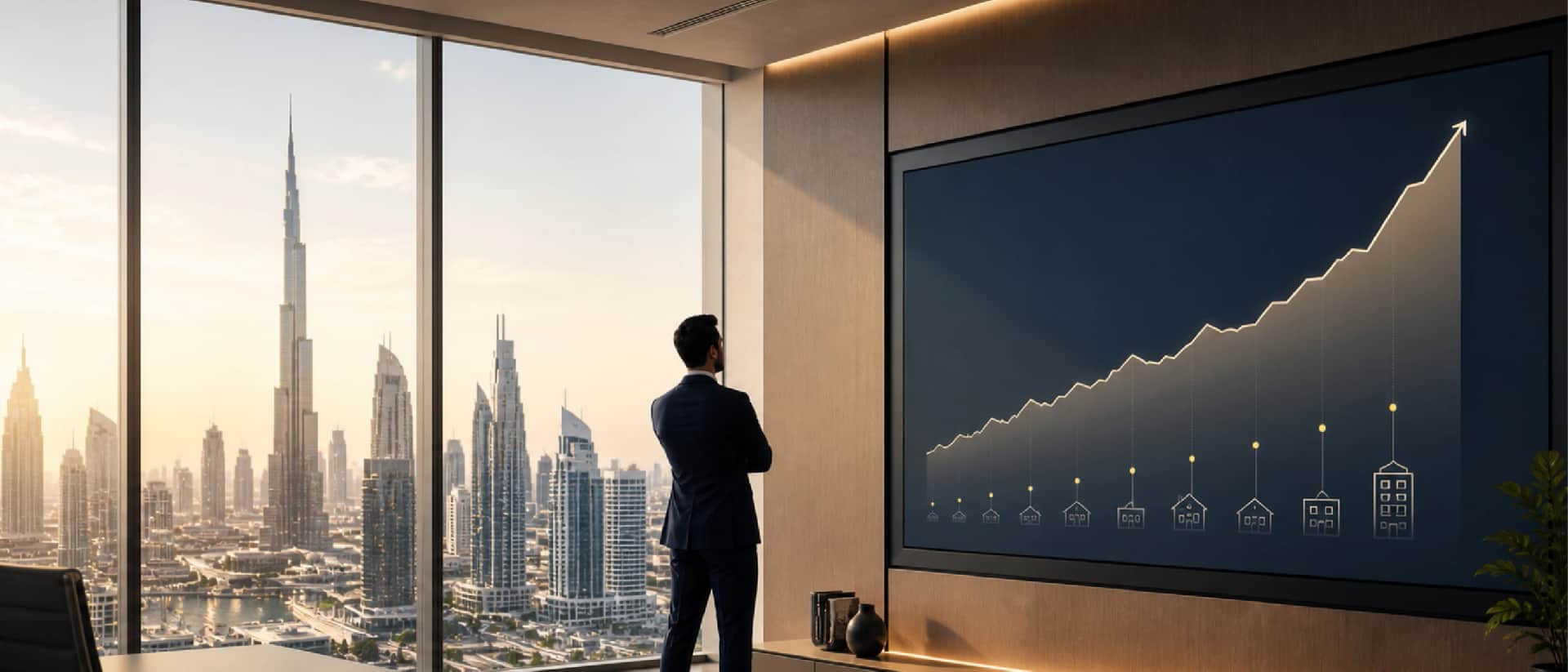
According to Dubai Land Department (DLD) statistics, the Dubai Property Market registered a sharp growth in April 2026, with total real estate transactions reaching AED 68.56 billion. It is more than a 20 percent month-on-month growth.
The surge is not a short-term spike but the result of structural demand drivers such as inflows of foreign investment, population growth, and sustained off-plan development activity across the masterplanned communities of the city of Dubai.
The Dubai Property Market has been able to exhibit its liquidity strength in both residential and commercial real estate segments. It will further help it to establish itself as one of the most dynamic global real estate hubs in 2026.

Yes - investing in Dubai luxury property in 2026 as a long-term strategy is a good opportunity to grow your capital rather than to earn rental income in the short-term. The high-net-worth migration, zero-tax ownership, and lack of ultra-prime supply make the Dubai luxury property market continue to outperform other cities around the world.
In 2025, Dubai registered approximately AED 900+ billion worth of real estate dealings, with luxury areas accounting for a significant portion of the worth increment. The global media reports about the increase in demand for branded homes and waterfront villas, indicating an evident surge in the Dubai luxury property market.
Prime area price increases have been 15-25% per year, and ultra-luxury properties over $10M are still setting sales records. This substantiates the robust momentum in Dubai's luxury property market, backed by international investors.
Nevertheless, rental yields remain at an average of 46 percent, and that is an appreciation. On the whole, luxury property in Dubai is a high-potential, fact-supported investment in long-term wealth creation.