Adil Raza Khan | March 18, 2026

The claim of a Dubai Real Estate Index Crash by 20% during the Iran war is partially misleading. Yes, a decline of around 20% was observed—but this was in the stock-based real estate index, not in actual property prices.
This is one of the most important distinctions to investors. Whereby the news that caused panic was the headlines, the reality behind this is that the property market in Dubai is facing a temporary sentiment-driven correction, and NOT A COLLAPSE in the structure. The distinction between stock index dynamics and real property values is the core part of the fact and fiction in the narrative of the Dubai real estate myth vs reality 2026.
Curated Opportunities
Flexible buying options for smarter property decisions.
Handpicked properties sorted for the strongest value.
Investment-focused listings with return potential.
Browse Dubai communities with properties for sale.

Yes—but not in the way it is often portrayed. The Dubai Financial Market (DFM) Real Estate Index dropped by approximately 20% over a brief span of time due to the investor reaction to regional geopolitical tensions, rather than the property market itself.
It is a market index of listed developers, such as the big names in the industry, such as Emaar Properties and Damac Properties. Since the stock prices are instantaneously sensitive to news, the index gave a temporary impression of fear and repricing of risk, which can be mistaken to mean a literal fall of physical property prices. Factually, the Dubai property market crash 2026 is nothing that has taken place, and all the significant market pointers have been stable despite Iran war.
Therefore, the fact that the Dubai Real Estate Index Crash by 20% is factual on the side of the equities does not mean that the property market is also crashing.
To get a real picture of the stock market situation Dubai Property Prices & Real Estate Index, one should take into consideration the two distinct dynamics post-Iran war:
The index is highly sensitive to short-term news, international investor sentiment, and speculative trading. Stock market reactions are immediate, which explains the sharp dip observed. Investors often react to war headlines, oil price fluctuations, and macroeconomic uncertainty, even when the fundamentals of the underlying real estate remain intact.
The index is very susceptible to short-term news, international investor sentiment, and speculative trading. The reaction to the stock market is instantaneous, hence the steep decline. Investors tend to respond to war headlines, oil price fluctuations, and macroeconomic uncertainty, although the underpinning of the underlying real estate might be amenable.
Price movements of actual property are, by way of comparison, much slower. They are based on real transactions, supply-demand dynamics, and long-term investment flows. A diversified global investor base supports the residential market in Dubai, and specifically the luxury and waterfront segment of the residential market.
Such investors are not that responsive to volatile fluctuations in the short term, i.e. physical property prices hardly reflect the fluctuations that the DFM real estate index performance reflects.
This is the reason why the performance of the DFM real estate index may decline drastically when the real estate market is stable. That is also the reason why the news of the Dubai Real Estate Index Crash by 20% tends to confuse people who want to purchase it, yet the reality on the ground is clear and strong.
No, the Dubai property market did not crash during the Iran conflict. There were some small price changes, but the retailer kept it within certain segments and deals, and was typically about 3 to 7%, primarily because of transitory bargaining power.
The prices of the property have not been significantly fluctuating in the priority segments.
Indeed, within this trend of the luxury property market in Dubai, high-demand developments, especially those made by leading developers such as Emaar Properties - registered great sales on new launches under this trend. This is an indicator of a high buyer trust, a latent demand, and shows that the real estate price index in Dubai 2026 still shows stability.
Basically, it is a pause and not a panic in the market, and the investor mood is likely to stabilize as the headlines stabilize.
Although the news is being headlined about the Dubai Real Estate index crash, the sellers in Dubai are not reducing their asking price. As a matter of fact, the existing listing prices in most prime and luxury developments are matching, and at times increasing, above the levels before the conflict. This is a good show of seller confidence and market stability.
The main reasons why this trend is supported by;
In brief, there has been a sentiment-led pause, rather than a price meltdown, on the market. This makes it evident that price swings on any stock index are temporary in Dubai property prices.

Key Points:
No. It is not a financial but a geopolitical situation.
The government in the UAE has been able to handle the situation satisfactorily. It can carry on with the normal day-to-day activities, services, and infrastructure.
Banks are stable, lending is controlled, and real estate projects are not hampered. This shows that the stability of the Dubai market has not deteriorated despite the tension that is experienced in the region.
Yes. The real estate market of Dubai is structurally sound, according to the current UAE property market news 2026. There was a short-term potential of the slow sluggishness of transaction volumes, but still the city registered 3,570 transactions worth AED 11.93 billion in early March. This shows that things are going on despite regional tensions, especially as per the Dubai luxury property market trend. All these factors, such as activity, site visits, and negotiations, have returned, and this shows that confidence in the market has not diminished.
Key stability indicators include:
The economic activity, infrastructure, and day-to-day life have not been halted in Dubai. This provides more credibility to the investor even in times of geopolitical tension.
The market is strengthened by the controlled banking activities, escrow-backed projects, and the strict adherence to the construction regulations. This stability in the government, discipline in banking, and investor confidence is a factor to the long-term stability of Dubai real estate and make it a haven in the environment.
The UAE banking industry uses rigorous credit assessment, low-risk exposure limits, and balanced loan-to-value ratios. This makes the market not overleverage. In contrast to cycles in the past, there is no excessive lending done speculatively, so banks can absorb shocks without causing a ripple effect.
This ensures financial discipline and shock absorption capacity.
Most Dubai Buyers apply high initial capital, hence they do not need mortgages or leveraged financing. This leads to a reduced systemic risk and reduced panic selling in short-term shocks.
The UAE officials have managed to uphold tranquility in times of regional tensions. This has ensured that people's safety, economic stability, and investor confidence are high. It is a normal life in the city of Dubai, as it is functioning normally, with utilities and businesses operative, which strengthens the reputation of the city as a safe and stable real estate destination.
UAE authorities have ensured:
Life in Dubai is still normal and uninterrupted, even during tensions.
The major developers, such as Emaar Properties and Damac Properties, have a solid cash reserve, escrow-backed financing, and healthy presales. This keeps the projects on schedule and investor confidence in their work high, even in the face of geopolitical uncertainty.
The developers like Emaar Properties still show:
The market resilience has been strengthened by high launch demand of many projects even during the period of the conflict.
Best Project Finder
Filter opportunities by budget, property type, bedroom mix, and strategy to uncover projects aligned with your investment goals.
While the DFM real estate index performance dropped by approximately 20%, this is only a sign of the equity market instability and not of the weakness of physical property. The prices of real estate are long-term, transactional, and strong, implying that short-term headline panic does not directly impact market fundamentals.
The Dubai Real Estate Index Crash by 20% is more a manifestation of equity market action, which:
The current episode demonstrates the classic principle: short-term stock market panic ≠ property market collapse. Those investors with such dynamic knowledge are able to see market opportunities where others are basing their actions on headlines.
Yes. Tactical opportunities to investors have been generated by the temporary change in sentiment despite the Iran war and strikes!
These projects are in line with the trends of the Dubai property index and investors are able to join high-quality projects under good conditions. It should be mentioned that these are strategic sales accelerators that do not signify distress but demonstrate the confidence of the developers in the stability of the markets.
Yes. Tactical opportunities to investors have been generated by the temporary change in sentiment despite the Iran war and strikes!
These projects are in line with the trends of the Dubai property index and investors are able to join high-quality projects under good conditions. It should be mentioned that these are strategic sales accelerators that do not signify distress but demonstrate the confidence of the developers in the stability of the markets.
Absolutely. The UAE is still among the safest real estate markets in the Middle East and Asia!
UAE offers:
This ensures continued global investor trust and capital inflow.
Based on Dubai real estate price index 2026 and ongoing market trends:
The Dubai Real Estate Index Crash by 20% report is an indication of volatility in the sentiment of the market rather than a lack of strength. The city is well placed towards post-war recovery, inflow of capital, and long term growth.
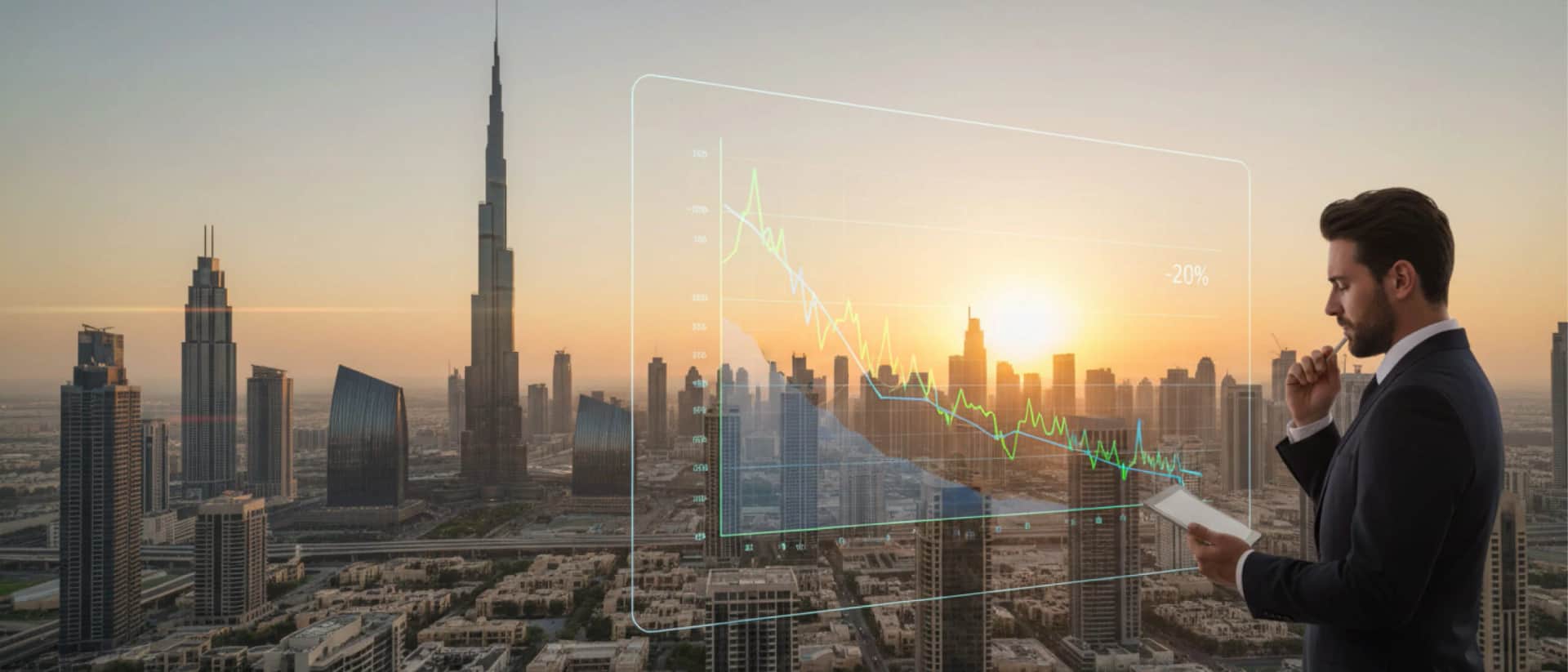
The Dubai Real Estate Index Crash by 20% is more of a misinterpretation of the stock market activities as opposed to the property market.
For investors and end-users, the key takeaway is clear:
Even in the context of geopolitical uncertainty, Dubai real estate is stable, resilient and opportunity-driven.
On-ground experience, transactional data, and market analysis at Apil Properties affirm that the situation at hand is a strategic opportunity and not a sign of a downward trend. Informed investors will be in a position to use the unparalleled stability and liquidity in the city, coupled with a favorable ecosystem, to generate good long-term returns in Dubai.
No, only the DFM stock index dropped; property prices stayed stable.
No, minor 3–7% adjustments in some deals only.
It’s sentiment-driven; stock reacts faster than actual property.
No, most listings remain firm or higher.
No, the situation is geopolitical, not financial.
Yes, with DLD fee waivers, flexible plans, and developer incentives.
Very stable; transactions and infrastructure operate normally.
Due to government stability, strong infrastructure, and developers’ financial strength.
Dubai offers better safety, connectivity, and global appeal than most regional peers.
Yes, higher oil boosts regional liquidity and investor confidence, supporting demand.

WRITTEN BY
Adil Raza Khan is a Dubai luxury real estate expert with over 13 years of experience in the UAE property market. He is the Chairman of APIL Properties.
Investment Finder
Use smart filters to discover Dubai projects matched to your investment goals.
Try the Investment Finder_1783320909.webp&w=1920&q=65)
Capital appreciation in Dubai property market is the rise in property value over time, influenced by factors such as demand, location development, and macroeconomic conditions. To an investor, it is the money gained by selling the property for more than the initial investment.
Simply put, when you buy real estate in Dubai, and the value of that property improves over the next several years, then that gain in value is your capital appreciation. In Dubai, however, this concept has more than just the notion of price growth; it is correlated to infrastructure growth, off-plan deals, and demand from investors all over the world.
Dubai has emerged as one of the world's most vibrant real estate markets. It is offering opportunities for both immediate profit and future investment and wealth. For anyone interested in investing strategically in Dubai properties instead of speculatively, it is crucial to understand the concept of capital appreciation in the local real estate market.
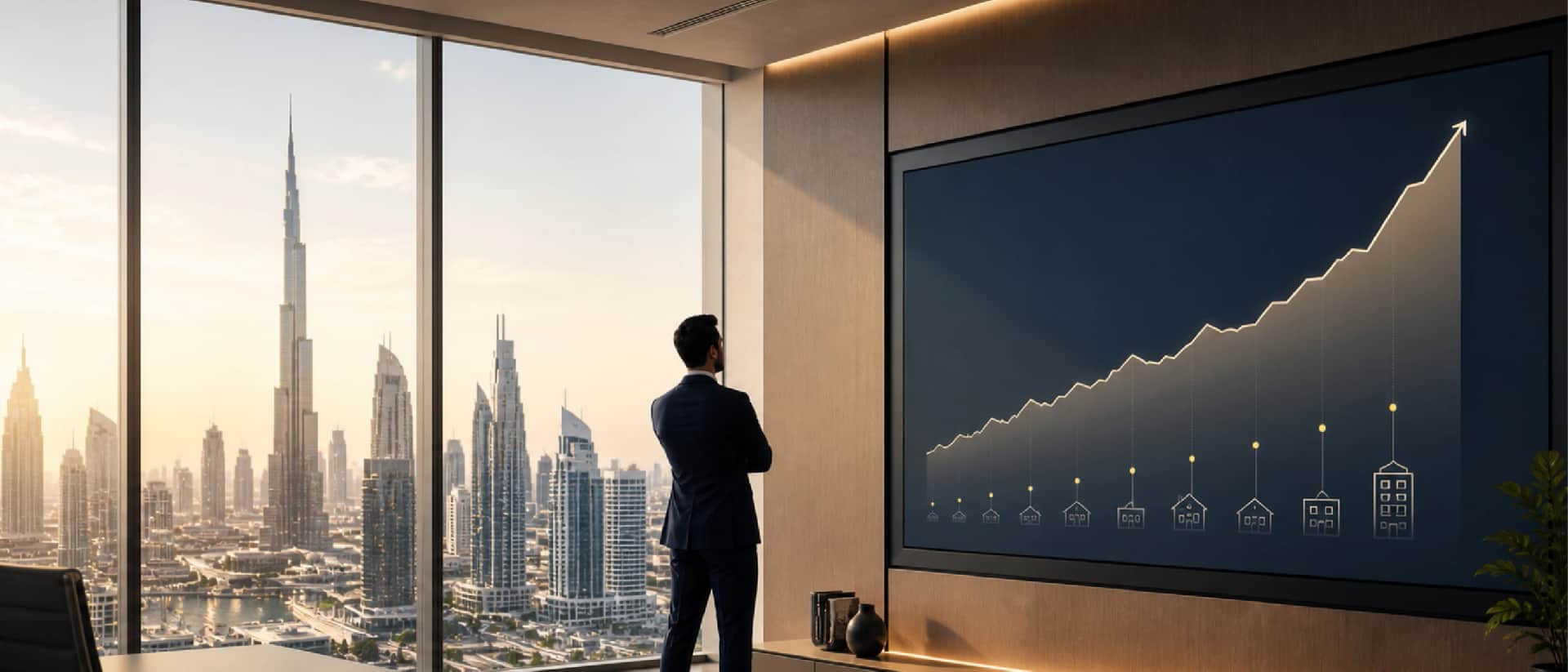
According to Dubai Land Department (DLD) statistics, the Dubai Property Market registered a sharp growth in April 2026, with total real estate transactions reaching AED 68.56 billion. It is more than a 20 percent month-on-month growth.
The surge is not a short-term spike but the result of structural demand drivers such as inflows of foreign investment, population growth, and sustained off-plan development activity across the masterplanned communities of the city of Dubai.
The Dubai Property Market has been able to exhibit its liquidity strength in both residential and commercial real estate segments. It will further help it to establish itself as one of the most dynamic global real estate hubs in 2026.

Yes - investing in Dubai luxury property in 2026 as a long-term strategy is a good opportunity to grow your capital rather than to earn rental income in the short-term. The high-net-worth migration, zero-tax ownership, and lack of ultra-prime supply make the Dubai luxury property market continue to outperform other cities around the world.
In 2025, Dubai registered approximately AED 900+ billion worth of real estate dealings, with luxury areas accounting for a significant portion of the worth increment. The global media reports about the increase in demand for branded homes and waterfront villas, indicating an evident surge in the Dubai luxury property market.
Prime area price increases have been 15-25% per year, and ultra-luxury properties over $10M are still setting sales records. This substantiates the robust momentum in Dubai's luxury property market, backed by international investors.
Nevertheless, rental yields remain at an average of 46 percent, and that is an appreciation. On the whole, luxury property in Dubai is a high-potential, fact-supported investment in long-term wealth creation.