Adil Raza Khan | March 31, 2026

In 2026, Dubai's real estate market remains one of the strongest and most appealing in the world to international investors from more than 100 countries.
The city of Dubai has experienced a high level of activity in the residential, commercial, and off-plan property transactions, with over 215,000 property transactions recorded in 2025, totalling AED 682 billion. The median residential price per square foot stands at AED 1,692, and rental yields in high-demand communities are between 6 and 8.5%, which are significantly higher than most cities in the world.
Foreign investment has been strong even during the regional tensions, such as the Iran war, as cash buyers and long-term investors have ensured that the market is stable. Still, common misconceptions about Dubai property are present among many investors as they fear the market crash, the downfall of prices, or are limited to owning their properties.
These misconceptions provide important factors for making informed decisions, optimizing returns, and operating securely in the dynamic Dubai real estate environment.
Curated Opportunities
Flexible buying options for smarter property decisions.
Handpicked properties sorted for the strongest value.
Investment-focused listings with return potential.
Browse Dubai communities with properties for sale.
Considering the facts stated above, now we are going to deconstruct the most popular myths of foreign investors in 2026.
Dubai property prices are not collapsing due to the Iran war. Some buyers wait, and the volumes of transactions stagnate, but in major regions, the prices are stable. The market is cushioned by cash buyers, stringent rules, and long-term demand. A temporary warning is not a crash in the market, and the areas with high demand, such as Downtown, Palm Jumeirah, and Dubai Marina, are still valuable to investors.
Dubai is not experiencing a real estate crash from the Iran conflict. Although real estate stock index or sector ETFs can decline, the actual real estate transaction prices will not be affected so much. Millions of transactions are still being carried out every month, and the long-term demand is still there. The property sector of Dubai is stable and will not be affected by the short-term geopolitical change in sentiments due to market fundamentals like foreign investment, population growth, and tourism.
Dubai’s property market remains strong despite the Iran war. The city remains a business hub with property activity and interest to the buyers still ongoing. The demand is sustained by the reliable regulatory environment and convenient location. The issue of temporary geopolitical uncertainty can be involved. Yet the ultimate drivers of growth, such as population growth, tourism, and inflows of investment makes Dubai property values safe and profitable.
Foreigners can legally buy property in Dubai. International investors are welcome in such freehold zones as the Downtown, Dubai Marina, and Palm Jumeirah. There is protection of ownership rights, and investors are free to buy, sell, or rent. The law is transparent in Dubai and provides a safe, secure environment for carrying out property business to non-residents, making Dubai a long-term investment-friendly market globally.
Dubai property is accessible to all budgets, not just the wealthy. Prices go as far as studios and apartments, all the way to luxury villas, and payment schemes are flexible with the developers. Mid-market clients may invest with high-net-worth purchasers. Such diversity of the markets attracts a large variety of investors, and both average and high-end buyers have an opportunity to gain capital growth and rental revenue.
Dubai offers a highly favorable tax environment, but small fees apply. The capital gains and income tax do not exist, whereas there are fixed expenses such as the transfer fee of 4 percent and the service fee. Investors are able to make correct calculations of anticipated returns. The easy tax, open system is what makes Dubai property appealing to long-term investment and wealth conservation.
Rental income in Dubai is stable and reliable. The average yields are 5-8, which are supported by the high demand of the expats, professionals, and tourists. The rental index is regulated to guarantee uniform increases. Although some of them will experience temporary softening, the market can be regarded as predictable in terms of cash flows, which makes Dubai a good option to invest in long-term rentals.
Off-plan properties in Dubai are safe and regulated. The funds are kept in escrow and are disbursed as the construction progresses. Qualified developers adhere to the laws and buyers have the right to protection and guarantees. Off-plan projects provide cheaper entry prices and flexible installments thus, a sure way of being involved in the real estate development in Dubai.
Dubai property prices do not crash automatically in cycles. Although the market experiences natural changes, high demand, development of infrastructure, and foreign investment bring stability. Corrections can be made in the short term, but long-term growth is observed. The resilience of the market, which is backed by cash buyers and legal safeguards, is a guarantee of a predictable price pattern and not recurring devastating economic crises that are devastating.
Residency or visa is not required to buy property in Dubai. There is an autonomy of purchase and ownership of freehold property by investors. Some of the investments can be subject to a Golden Visa, whereas ownership is not limited. This will enable foreign buyers to easily engage, gain access to the rental revenues, and enjoy the long-term capital growth without the need to reside in the UAE.
Emerging areas in Dubai can offer strong returns. Although popular are the Downtown or Palm Jumeirah, developing neighborhoods usually offer better ROI and entry prices. Major projects and facilities are a draw to tenants and buyers to develop prospects outside of prime locations. The geographical diversification enables investors to enjoy the growth opportunities and also the rental income.
Dubai property has small, transparent costs. There are agent fees, service fees, and maintenance, but they are revealed in advance. Being aware of these would make sure that there is effective computation of ROI and avoid surprises. Open fees, together with consistent service charges, enable investors to budget on long-term returns, without losing property value.
Dubai property is secure despite regional conflicts. The city boasts of good infrastructure, security, and vibrant real estate markets. Companies, locals, and travelers carry on with their activities. The capital of the investors is secure through regulatory measures and governance. This guarantees that Dubai is a safe and secure property market even in times of geopolitical unpredictability in the region.
Dubai property prices are resilient and recover over time. The previous international and regional shocks reveal that the temporary downturns do not stop price recovery. The long term factors, such as population growth, infrastructure, tourism, and foreign investment, are stable and gradually appreciating, which gives the investors a sense of security and gradual returns, which enable them to strategize on the sustainability of their returns.
Foreign investment in Dubai continues steadily. Although not all buyers will continue to make purchases in the case of uncertainty, a significant proportion of buyers will be active because of tax benefits, legal safeguards, and lifestyle appeal. The overseas capital is adapting and not abandoning, and long-term investors still invest in Dubai, as this will guarantee a stable real estate market with constant demand and development.
The real estate business in Dubai as of 2026 remains a good option for investors and alliances, where the prices are stable, rental rates are high, and the present laws remain effective to promote businesses. Most of the misconceptions that are widely held, such as the fear of market crashes or concerns regarding ownership or residence requirements, are not well-grounded.
Knowing the facts, perusing the market data, and being interested in the long-term growth, investors can make proper choices, easily explore the Dubai property market, and help to earn as much on rental revenues as on the growth of the capital.
Best Project Finder
Filter opportunities by budget, property type, bedroom mix, and strategy to uncover projects aligned with your investment goals.
Yes, foreigners can buy freehold property in Dubai without residency.
Yes, Dubai remains stable and resilient despite regional tensions.
No, ownership is fully accessible without a residency visa.
Yes, rental yields range from 6–8.5% in high-demand communities.
No, prices remain stable due to strong demand and infrastructure.
Yes, escrow laws and developer guarantees protect off-plan investments.
No, mid-market and emerging areas also offer strong returns.
No, costs are transparent and predictable for investors.
No, properties across all budgets are available with flexible plans.
No, Dubai’s legal and security systems protect investors.

WRITTEN BY
Adil Raza Khan is a Dubai luxury real estate expert with over 13 years of experience in the UAE property market. He is the Chairman of APIL Properties.
Investment Finder
Use smart filters to discover Dubai projects matched to your investment goals.
Try the Investment Finder
The Dubai Real Estate Market is set to see record-breaking momentum with transaction value reaching AED139.2 billion in Q1 2026—fueled by strong off-plan demand, foreign capital inflows, and increasing end-user activity.
Dubai is keeping its lead over other property hubs around the world thanks to its investor-friendly policies and the high potential for returns, as noted in market reports by Arabian Business and major brokerage data providers.
The Dubai Real Estate Market is not only expanding in terms of volume but also gaining greater value and quality as buyers are increasingly looking towards projects that are supported by infrastructure, credibility of the developers, and potential appreciation of capital value.
The Dubai Real Estate boom has evolved into a more stable, investment-driven cycle thanks to this structural shift in demand.

Capital appreciation in Dubai property market is the rise in property value over time, influenced by factors such as demand, location development, and macroeconomic conditions. To an investor, it is the money gained by selling the property for more than the initial investment.
Simply put, when you buy real estate in Dubai, and the value of that property improves over the next several years, then that gain in value is your capital appreciation. In Dubai, however, this concept has more than just the notion of price growth; it is correlated to infrastructure growth, off-plan deals, and demand from investors all over the world.
Dubai has emerged as one of the world's most vibrant real estate markets. It is offering opportunities for both immediate profit and future investment and wealth. For anyone interested in investing strategically in Dubai properties instead of speculatively, it is crucial to understand the concept of capital appreciation in the local real estate market.
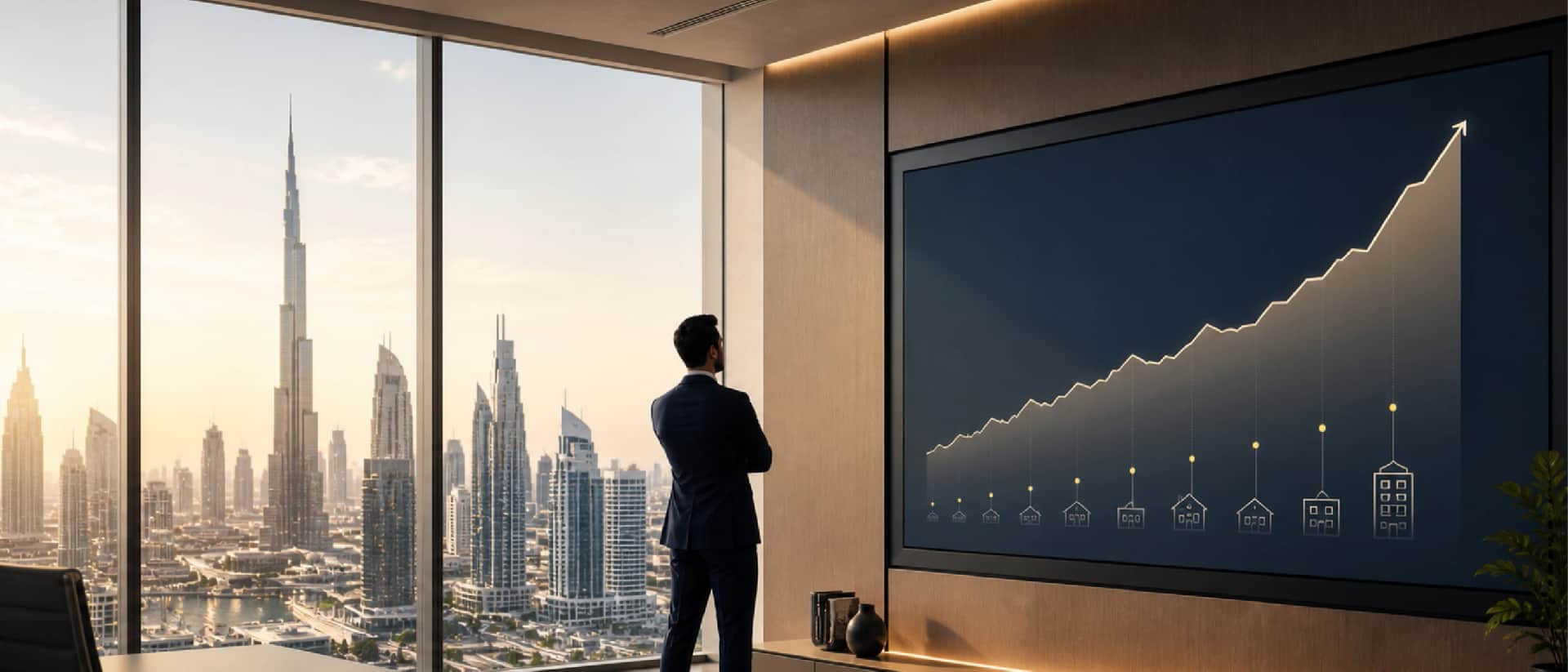
According to Dubai Land Department (DLD) statistics, the Dubai Property Market registered a sharp growth in April 2026, with total real estate transactions reaching AED 68.56 billion. It is more than a 20 percent month-on-month growth.
The surge is not a short-term spike but the result of structural demand drivers such as inflows of foreign investment, population growth, and sustained off-plan development activity across the masterplanned communities of the city of Dubai.
The Dubai Property Market has been able to exhibit its liquidity strength in both residential and commercial real estate segments. It will further help it to establish itself as one of the most dynamic global real estate hubs in 2026.