Adil Raza Khan | April 7, 2026
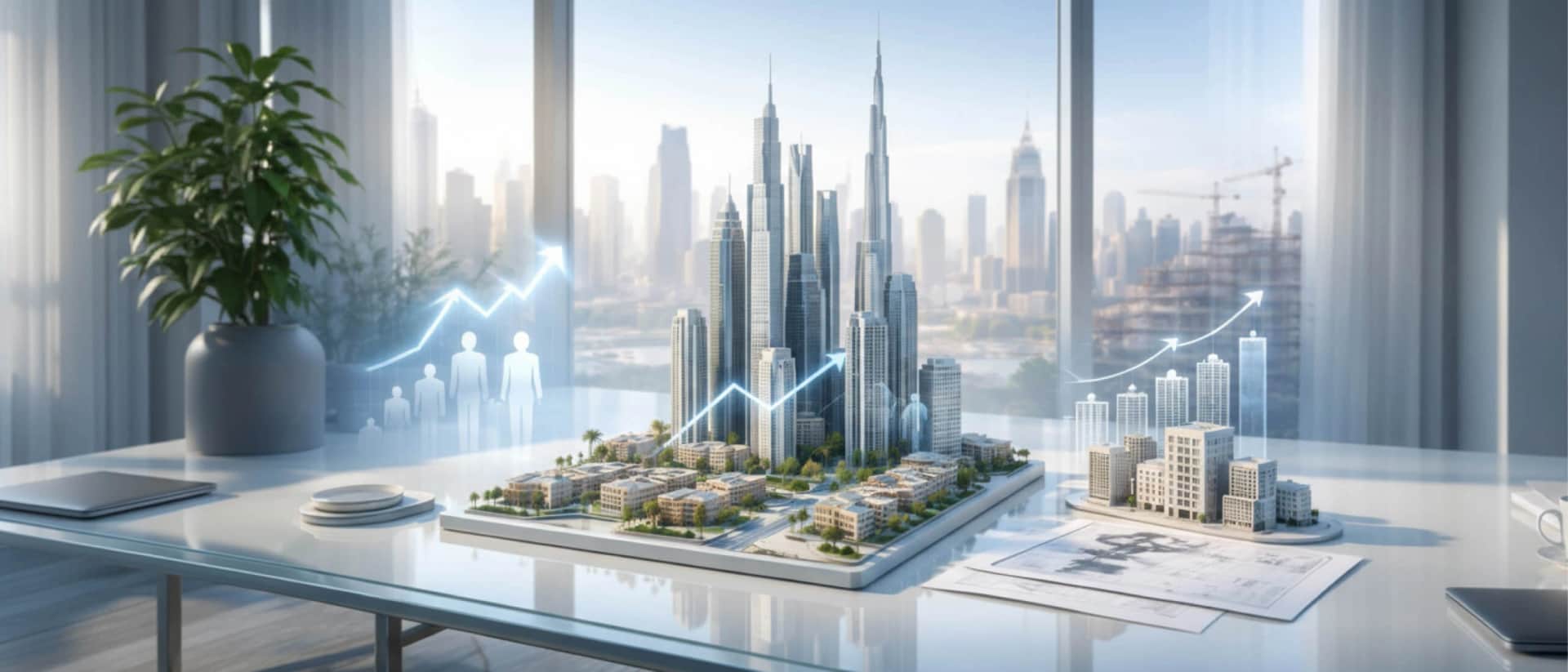
Dubai real estate market has always been a center of interest by both the investors and the inhabitants of the city and the trends of the recent Dubai Real Estate Supply vs Demand reveal a market that is dynamic but moving towards equilibrium. Dubai is still experiencing a high demand in 2026, especially on the off-plan development, and there is a consistent inflow of new supply in the market, influencing the pricing trends and investor behavior.
Curated Opportunities
Flexible buying options for smarter property decisions.
Handpicked properties sorted for the strongest value.
Investment-focused listings with return potential.
Browse Dubai communities with properties for sale.
To the point, the Dubai real estate supply and demand today are registering a good balance. The Q1 2026 transaction values were AED 176.7 billion, representing the high market activity, with almost all the sales being influenced by off-plan purchases and end-user interest.
Simultaneously, entry of new residential projects has augmented the supply of houses, especially in the apartment unit. This implies that buyers have additional options, and as demand is strong, the market is stabilizing instead of the continuing swift price increase observed in the past years.
Going more into the Dubai Real Estate Market Supply, the highest demand remains on the high quality and strategically situated properties. The villas and townhouses are undergoing increased demand compared to the limited supply of the same but the apartments are getting a rising inventory that may moderate the price increases.
The Dubai real estate supply and demand graph shows that completions are increasing whilst absorption is high but controlled, which is a positive sign that the market is approaching equilibrium instead of excess supply.
Such developers like DAMAC remain at the forefront in off-plan deals, a portent of long-term fundamentals. According to analysts, despite the cautionary measures that have been created by geopolitical dynamics and global uncertainties among investors, the fundamental need of end-user homes and strategic investment properties has not been undermined.
The latest news outlines the endurance of the Dubai real estate market. The total property transactions stood at Dh176.7 billion in Q1 2026, and its momentum remains high despite global uncertainties. DAMAC dominated March sales with more than Dh3 billion deals as an indication of investor confidence.
In the meantime, the real estate indices within the region were volatile as a result of the geopolitical occurrences, with some of the developer stock performances declining. Instead, experts note that the prices of physical property and off-plan demand do not change much, which indicates that there is a difference between sentiments in the market and housing trends.
The developments affirm that Dubai housing demand vs supply of housing remains competitive but stable to both investors and end-users.
Dubai residential supply forecast indicates a consistent supply to the year 2026 and beyond, especially in master-planned residential developments, such as Dubai Hills, Dubai Creek Harbour, and the upcoming peripheral developments.
The supply of apartments will be on the rise, and the supply of villas will remain low, which will be priced highly. With increased market penetration, the oversaturated segments could experience moderate price changes, whereas the constrained ones stand.
Such a balance between supply and demand is the reason why Dubai housing demand vs supply does not escalate to extreme levels making the market stable and providing a good choice to both buyers and investors.
The market is witnessing a shift from rapid price acceleration toward a more measured phase, with supply additions moderating growth expectations. Investors are advised to focus on quality, location, and developer credibility to navigate the evolving landscape successfully.
Current Dubai property market trends show that the off-plan sale is the most active in the market, which is backed by the existence of flexible payment plans and investor confidence. Ready properties are those with consistent interest, especially in the areas where the value of lifestyle and infrastructure is high.
Although the Dubai housing supply analysis indicates an increase in the apartment segment, the high-quality units demand is still able to absorb new inventory. The market is also experiencing a transition of the accelerated price growth to a more controlled stage, whereby the supply addition is taming growth anticipations. To successfully go through the changing landscape, investors are encouraged to look at quality, location and credibility of the developer.
The off-plan properties continue to contribute as one of the major forces in the Dubai Real Estate Supply vs Demand. Flexible pricing schemes, desirable master-planned community facilities, and strategic reputation of the developer maintain high investor confidence. This is because off-plan purchases are consuming big percentage of incoming supply so that the market is not experiencing oversaturation even when residential delivery increases.
Best Project Finder
Filter opportunities by budget, property type, bedroom mix, and strategy to uncover projects aligned with your investment goals.
Although apartments are witnessing an increase in supply, villas and townhouses are few, hence in high demand. This scarcity helps to maintain the stable prices and emphasize the disparities between the Dubai housing demand vs supply in the various property types. The competitive conditions experienced by buyers of family homes or luxury homes remain, and this shows the resilience in such segments.
Investor mood is determined by global and regional events, such as geopolitical tensions. The indicators of the stock market are somewhat cautionary, but physical real estate prices are relatively steady. Analysts point out that trends in the Dubai property market indicate a strong difference in sentiment in the short term and long-term housing fundamentals with the demand remaining on prime locations and high-quality developments.
The market is slowly shifting to the equilibrium. The total equilibrium of supply and demand is likely to stabilize prices given the Dubai residential supply forecast with predictable apartment delivery and prolonged demand of villas. Dubai housing supply analysis should be monitored by investors and buyers to see the opportunities, especially on the segments where demand exceeds supply.
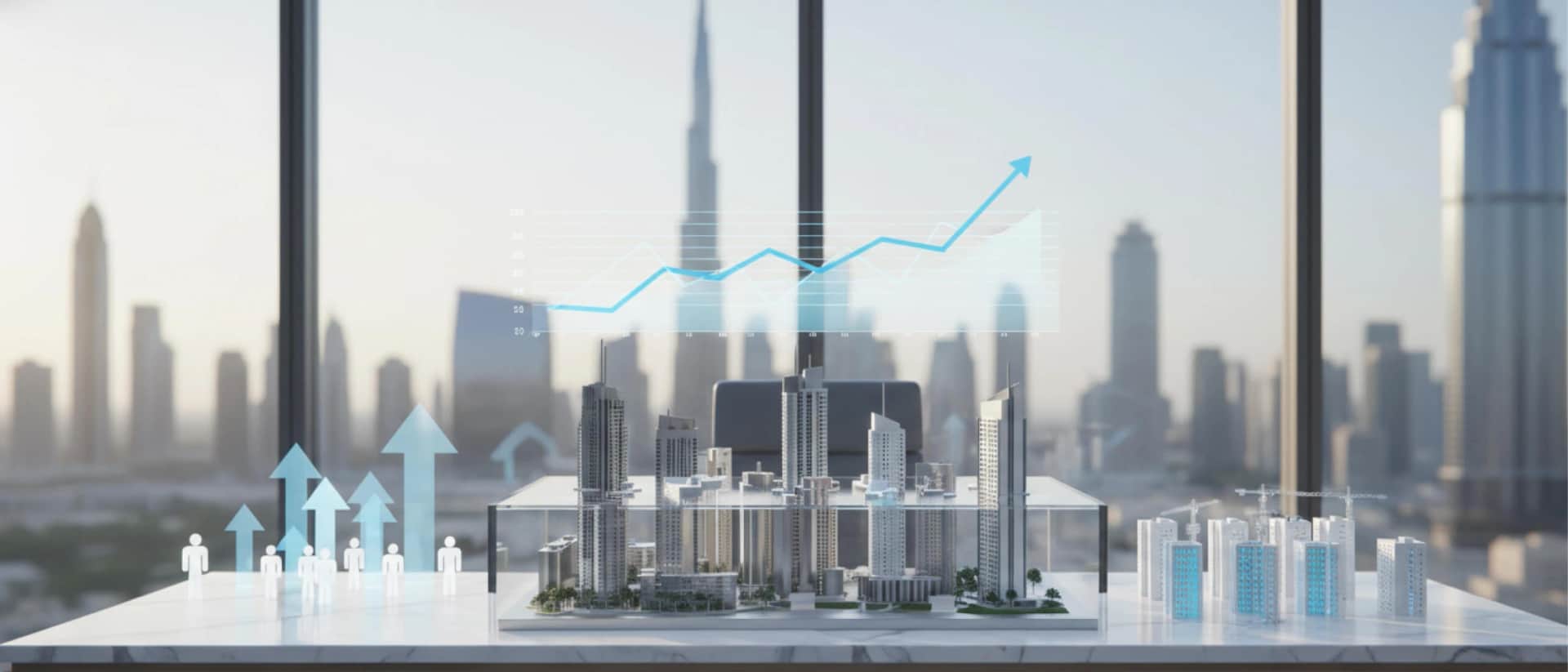
To conclude, there is a dynamic but stabilizing market with Dubai Real Estate Supply vs Demand in 2026. The demand on off-plan and high-quality property is high, and the residential supply, especially the apartments, is growing regularly. The supply demand balance makes the market stable, checks price inflation and the market remains attractive to end-users and investors. Monitoring Dubai housing supply analysis and market trends will enable buyers and investors to move around the market with confidence making strategic decisions that are in line with long-term growth.
Dubai’s real estate supply is rising with new completions while demand remains strong, resulting in a balanced market rather than oversupply.
No — while new launches are high, actual delivered inventory is being absorbed by population growth and end‑user demand.
Rapid population increases in Dubai drive continuous housing demand that supports the absorption of new supply.
No — villas and townhouses remain relatively limited in supply and continue to be in strong demand.
Rental markets show high occupancy and sustained tenant demand even as new units are delivered.
Yes — when measured against actual handovers and absorption rates, demand still outstrips available supply in many areas.
Off‑plan launches increase future supply, but staggered delivery and strong buyer interest help maintain demand balance.
Not necessarily — prices are more influenced by demand dynamics and location quality than by headline supply figures alone.
Developers phase deliveries, which helps prevent sudden oversupply and aligns new stock with market needs.
The market is moderating rather than slowing dramatically, with demand still strong and prices stabilising in many segments.

WRITTEN BY
Adil Raza Khan is a Dubai luxury real estate expert with over 13 years of experience in the UAE property market. He is the Chairman of APIL Properties.
Investment Finder
Use smart filters to discover Dubai projects matched to your investment goals.
Try the Investment Finder_1783320909.webp&w=1920&q=65)
Capital appreciation in Dubai property market is the rise in property value over time, influenced by factors such as demand, location development, and macroeconomic conditions. To an investor, it is the money gained by selling the property for more than the initial investment.
Simply put, when you buy real estate in Dubai, and the value of that property improves over the next several years, then that gain in value is your capital appreciation. In Dubai, however, this concept has more than just the notion of price growth; it is correlated to infrastructure growth, off-plan deals, and demand from investors all over the world.
Dubai has emerged as one of the world's most vibrant real estate markets. It is offering opportunities for both immediate profit and future investment and wealth. For anyone interested in investing strategically in Dubai properties instead of speculatively, it is crucial to understand the concept of capital appreciation in the local real estate market.
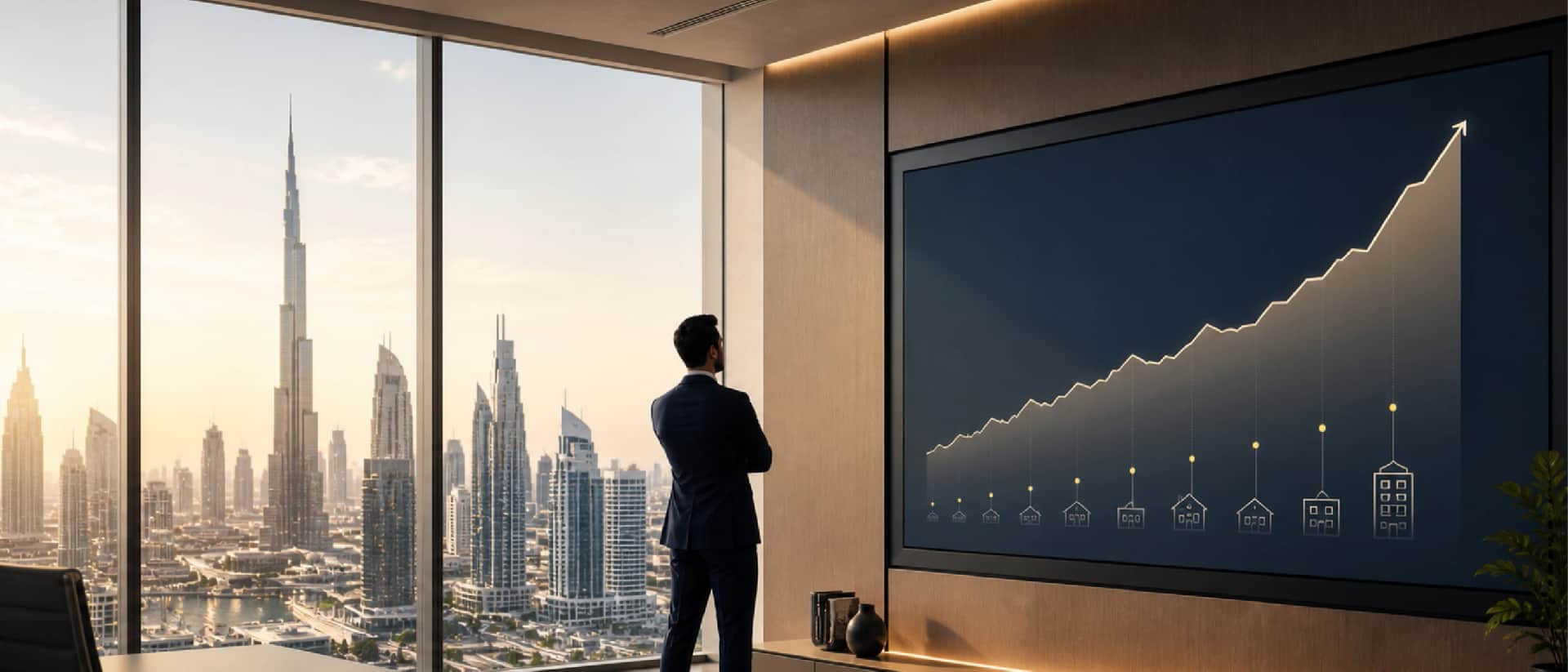
According to Dubai Land Department (DLD) statistics, the Dubai Property Market registered a sharp growth in April 2026, with total real estate transactions reaching AED 68.56 billion. It is more than a 20 percent month-on-month growth.
The surge is not a short-term spike but the result of structural demand drivers such as inflows of foreign investment, population growth, and sustained off-plan development activity across the masterplanned communities of the city of Dubai.
The Dubai Property Market has been able to exhibit its liquidity strength in both residential and commercial real estate segments. It will further help it to establish itself as one of the most dynamic global real estate hubs in 2026.

Yes - investing in Dubai luxury property in 2026 as a long-term strategy is a good opportunity to grow your capital rather than to earn rental income in the short-term. The high-net-worth migration, zero-tax ownership, and lack of ultra-prime supply make the Dubai luxury property market continue to outperform other cities around the world.
In 2025, Dubai registered approximately AED 900+ billion worth of real estate dealings, with luxury areas accounting for a significant portion of the worth increment. The global media reports about the increase in demand for branded homes and waterfront villas, indicating an evident surge in the Dubai luxury property market.
Prime area price increases have been 15-25% per year, and ultra-luxury properties over $10M are still setting sales records. This substantiates the robust momentum in Dubai's luxury property market, backed by international investors.
Nevertheless, rental yields remain at an average of 46 percent, and that is an appreciation. On the whole, luxury property in Dubai is a high-potential, fact-supported investment in long-term wealth creation.