Adil Raza Khan | December 19, 2025
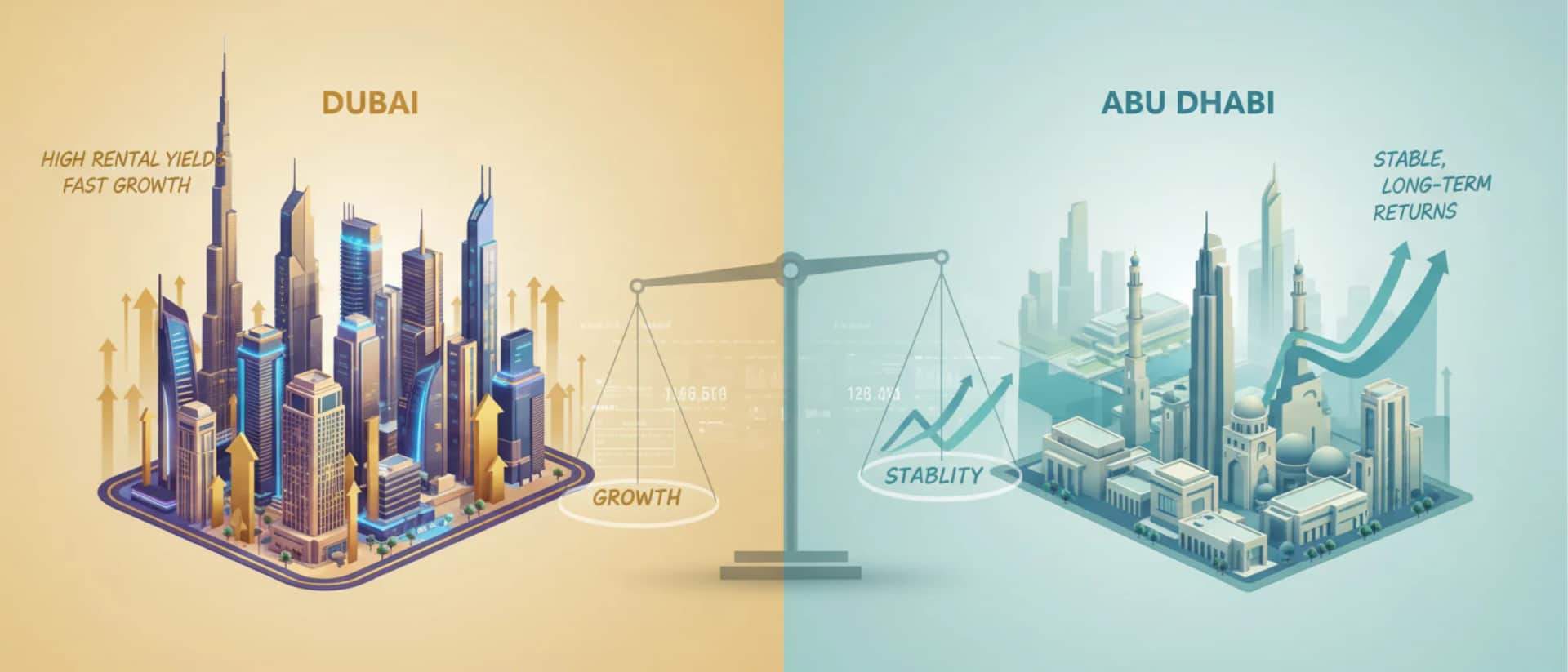
Dubai vs Abu Dhabi property returns in 2026 are a key consideration for investors, homeowners, and expatriates planning to invest in the UAE. In 2026, Dubai will achieve higher rental yields driven by strong liquidity and global demand.
Plus - Abu Dhabi will have a stable capital growth with consistent long-term returns. There are distinct advantages unique to both emirates that appeal to various investment strategies.
Curated Opportunities
Flexible buying options for smarter property decisions.
Handpicked properties sorted for the strongest value.
Investment-focused listings with return potential.
Browse Dubai communities with properties for sale.
Dubai vs Abu Dhabi property returns in 2026 will be influenced primarily by the type of investment, location, and property segment. Dubai still attracts investors seeking high rental returns and short-term capital gains.
And investors in Abu Dhabi would want stability and reduced market volatility. In the long-term wealth-building, Abu Dhabi can provide security, while Dubai can offer significantly higher and quicker returns over a shorter period.
Investors often ask: Why should they compare Dubai vs. Abu Dhabi property returns in 2026 for investment purposes? The economic drivers, tenant profiles, and government policies that drive property growth differ between the two emirates. These factors can be used to inform a decision on whether to invest in Dubai or Abu Dhabi.
Dubai could be a better short-term investment, but Abu Dhabi has a reliably long-term rental cash flow.
In the comparison of Dubai vs Abu Dhabi property returns in 2026, the capital increase plays the key role:
Tip: Abu Dhabi and Dubai may be the choices for investors interested in sustainable capital growth and high returns, respectively.
Choosing between Abu Dhabi or Dubai for living affects property returns: Investors often ask: “Should I invest in Dubai or Abu Dhabi?”
Tip: Align your choice with your risk appetite, investment horizon, and lifestyle preferences.
Understanding the Dubai vs Abu Dhabi cost of living is essential when analyzing returns:
For investors, the question “Invest in Dubai or Abu Dhabi?” often depends on whether priority is high rental yields or capital stability.
Best Project Finder
Filter opportunities by budget, property type, bedroom mix, and strategy to uncover projects aligned with your investment goals.

The returns in both emirates are good; however, the strategies are different. Dubai would be a good choice for active investors interested in high yields. Plus - Abu Dhabi would attract conservative investors seeking steady growth.
Dubai Property Investment Pros:
Dubai Property Investment Cons:
Abu Dhabi Property Investment Pros:
Abu Dhabi Property Investment Cons:

In 2026, the returns of Dubai vs Abu Dhabi property will be a good blend of opportunity and stability. Dubai has better future returns and faster growth, which dynamic investors would prefer, whereas Abu Dhabi has guaranteed growth and future stability.
An investment decision must be made in accordance with financial goals, lifestyle and risk appetite. Assessing market trends, property type, and location will yield the highest returns, whether you invest in Dubai or Abu Dhabi.
Invest in Dubai or Abu Dhabi property to make informed decisions by analysing the property returns in 2026, lifestyle, cost, and market knowledge.
Dubai offers higher rental yields, while Abu Dhabi provides steady capital growth.
Dubai suits high-yield, short-term investors; Abu Dhabi is better for long-term stability.
Dubai property prices may moderate, while Abu Dhabi property costs rise steadily.
Abu Dhabi generally has lower property costs, but Dubai offers higher rental income potential.
Dubai is cosmopolitan and vibrant; Abu Dhabi is family-friendly and quieter.
Choose Dubai for higher short-term returns and Abu Dhabi for consistent long-term growth.
Dubai is more expensive, while Abu Dhabi offers a slightly lower cost of living.
Abu Dhabi offers safer, stable investment, while Dubai carries higher short-term potential.
Invest in Dubai South, Business Bay, or JVC, and in Abu Dhabi on Yas or Saadiyat Island.
Dubai real estate has higher liquidity and yields, Abu Dhabi is steadier and less volatile.
Dubai generally provides higher rental yields, Abu Dhabi offers stable but slightly lower returns.
Dubai may see moderate price corrections; Abu Dhabi is expected to maintain steady growth.

WRITTEN BY
Adil Raza Khan is a Dubai luxury real estate expert with over 13 years of experience in the UAE property market. He is the Chairman of APIL Properties.
Investment Finder
Use smart filters to discover Dubai projects matched to your investment goals.
Try the Investment Finder
Capital appreciation in Dubai property market is the rise in property value over time, influenced by factors such as demand, location development, and macroeconomic conditions. To an investor, it is the money gained by selling the property for more than the initial investment.
Simply put, when you buy real estate in Dubai, and the value of that property improves over the next several years, then that gain in value is your capital appreciation. In Dubai, however, this concept has more than just the notion of price growth; it is correlated to infrastructure growth, off-plan deals, and demand from investors all over the world.
Dubai has emerged as one of the world's most vibrant real estate markets. It is offering opportunities for both immediate profit and future investment and wealth. For anyone interested in investing strategically in Dubai properties instead of speculatively, it is crucial to understand the concept of capital appreciation in the local real estate market.

According to Dubai Land Department (DLD) statistics, the Dubai Property Market registered a sharp growth in April 2026, with total real estate transactions reaching AED 68.56 billion. It is more than a 20 percent month-on-month growth.
The surge is not a short-term spike but the result of structural demand drivers such as inflows of foreign investment, population growth, and sustained off-plan development activity across the masterplanned communities of the city of Dubai.
The Dubai Property Market has been able to exhibit its liquidity strength in both residential and commercial real estate segments. It will further help it to establish itself as one of the most dynamic global real estate hubs in 2026.

Yes - investing in Dubai luxury property in 2026 as a long-term strategy is a good opportunity to grow your capital rather than to earn rental income in the short-term. The high-net-worth migration, zero-tax ownership, and lack of ultra-prime supply make the Dubai luxury property market continue to outperform other cities around the world.
In 2025, Dubai registered approximately AED 900+ billion worth of real estate dealings, with luxury areas accounting for a significant portion of the worth increment. The global media reports about the increase in demand for branded homes and waterfront villas, indicating an evident surge in the Dubai luxury property market.
Prime area price increases have been 15-25% per year, and ultra-luxury properties over $10M are still setting sales records. This substantiates the robust momentum in Dubai's luxury property market, backed by international investors.
Nevertheless, rental yields remain at an average of 46 percent, and that is an appreciation. On the whole, luxury property in Dubai is a high-potential, fact-supported investment in long-term wealth creation.