Adil Raza Khan | October 27, 2025
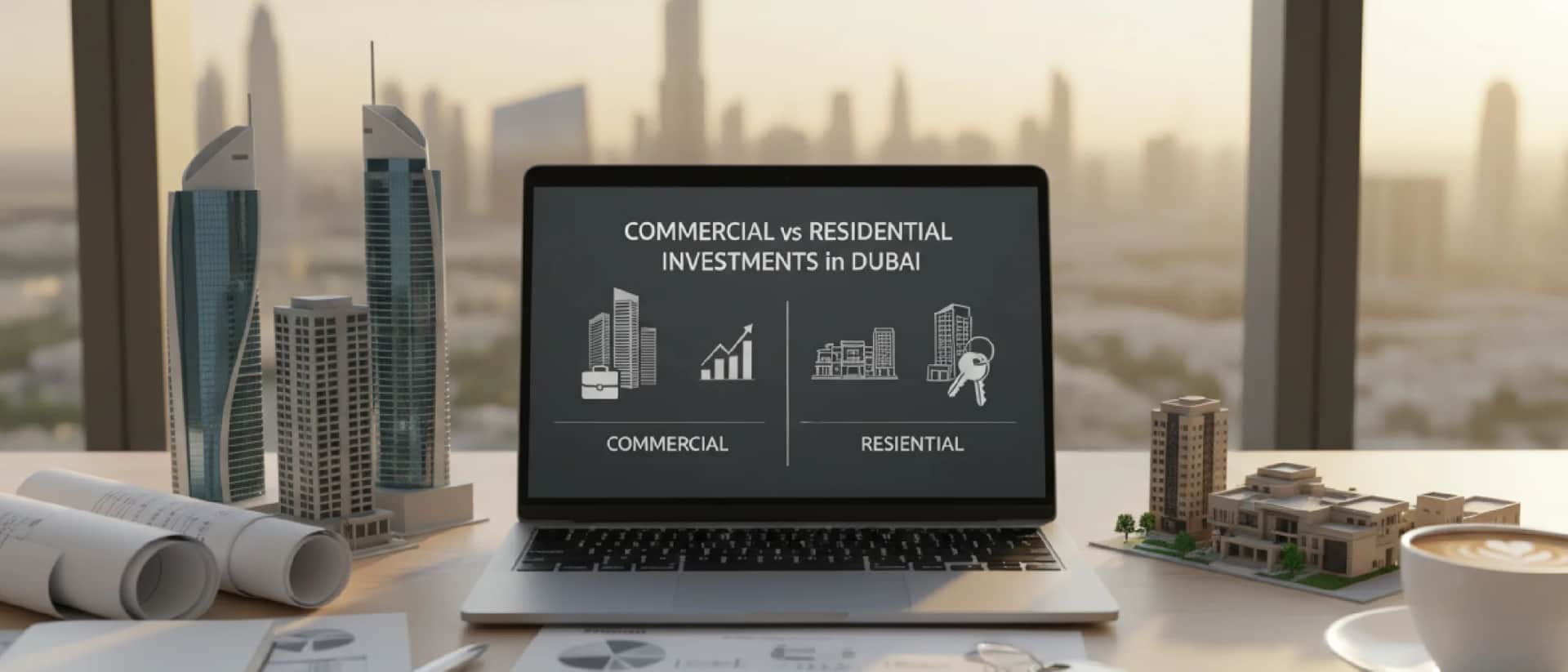
The real estate sector is an international investor paradise, offering stability, high returns, and the prospect of long-term business growth. However, in terms of commercial vs residential investments in Dubai, it is important to have complete know-how.
Every type of asset is associated with benefits and difficulties, as well as with its own profitability—and to foreign investors, these variations may cause a major difference in ROI and ability to hold ownership.
Foreign investment in the Dubai real estate market in 2025 is still high, as both commercial property investment in Dubai and residential real estate investment in Dubai are enjoying government reforms, tax-free rental income, and world-class infrastructure.
Curated Opportunities
Flexible buying options for smarter property decisions.
Handpicked properties sorted for the strongest value.
Investment-focused listings with return potential.
Browse Dubai communities with properties for sale.
Examples of commercial real estate are offices, retail, warehouses, and mixed-use developments. Investors in this category usually earn income from long-term corporate leases, which ensures a steady cash flow. Dubai's business-friendly atmosphere and free zones ensure that commercial properties appeal to international investors who wish to obtain a stable income.
Higher Rental Yields:
In locations of good business like Business Bay, Downtown and DIFC, commercial properties can give an average annual yield of between 8%-10% of the business property, which is quite high compared to the majority of residential property.
Long-Term Lease Stability:
Corporate tenants usually leave leases between three and ten years, which guarantees them a steady income and reduced vacancy rates.
Inflation Hedge:
The commercial leases are frequently pegged to inflation and this protects the investors against currency devaluation or economic changes.
Corporate Tenants:
The tenants are a business that is normally in place, which minimizes the problem of maintenance and enhances property maintenance.
Higher Initial Cost:
The entry cost of premium offices and retail space in Dubai is higher, with the entry points usually starting at above AED 2 million.
Market Sensitivity:
Commercial spaces are directly correlated with business demand. Slowdowns in the economy may influence occupancy.
Complex Management:
There are more detailed maintenance, compliance and regulatory requirements compared to the residential leasing.
Residential real estate (apartments, villas, townhouses) continues to be the most popular entry point for investors in Dubai. It is attractive to both end-users and landlords who seek short—and long-term rentals.
Pros of Residential Investment
High Demand and Liquidity:
The residential real estate investment in Dubai is very liquid. There is steady tenant demand, a constantly increasing number of expatriates, and a robust rental market.
Lower Entry Cost:
Studio and one-bedroom apartments begin with AED 650,000, which is easier to enter with compared to the other properties.
Flexibility in Leasing:
Websites such as Airbnb allow owners to rent out their homes for long-term or short-term periods, with the latter generating yearly revenue of up to 12% in certain regions.
Easier Financing:
Residential investment is affordable to foreigners due to the developers' mortgage options and payment plans.
Shorter Lease Duration:
Leased properties usually have one-year renewed leases, which leave room to have certain vacancies.
Higher Maintenance Responsibility:
There is a high chance of tenants resulting in increased wear and tear, particularly on furnished units.
Variable Returns:
The rental yields vary depending on the location, quality of the building and the efficiency of the property management.
The freehold zones in Dubai allow foreigners to invest and resell. The popular freehold areas are Dubai Marina, Business Bay, Downtown Dubai, and JVC.
Such a structure will make it easier to invest in Dubai properties and increase investor confidence across the globe.
Moreover, foreign investors enjoy the advantages of no annual property tax, 0 per cent tax on rental incomes, and simple and convenient repatriation of profits, making commercial and residential real estate attractive.
The property cycle in Dubai is exhibiting a fresh hope due to the expansion of infrastructure, development of tourism and the current economic diversification agenda.
Commercial Opportunities:
The expansion of free zones in Dubai South and Dubai Internet City has created the need to increase the demand for office and warehouse space. The economic plan, Dubai Economic Agenda D33, plans to increase GDP by two times within 10 years, and hence, commercial property investment in Dubai is a winner in the long run.
Residential Opportunities:
Luxury apartments and villas are booming in localities such as Palm Jumeirah, Jumeirah Village Circle, and Dubai Creek Harbour. Developers are also devising flexible payment schemes to attract first-time foreign investors to the Dubai real estate market in 2025.
Best Project Finder
Filter opportunities by budget, property type, bedroom mix, and strategy to uncover projects aligned with your investment goals.
At APIL Properties, our team has been monitoring the current trends regarding the shift in commercial and residential investments in Dubai to enable investors to make informed decisions. APIL provides clients with the highest ROI and the lowest risk with market depth, exclusive developer collaboration, and AI-driven analysis tools.
Whether you are investing in commercial offices in Business Bay or residential apartments in Dubai Marina, our advisors will guide you with transparency and localized knowledge. As a result, APIL Properties can be considered your preferred investment partner in Dubai.
The real estate market outperformed its international competitors in 2025, making the city one of the most profitable places to invest in real estate. Dubai Land Department (DLD) claims that in the first half of 2025, property deals reached a total of AED 430 billion, which is 15% more than in the previous year.
This is being fuelled by both commercial and residential investments in Dubai. The commercial segment was growing by 12 percent in leasing activity, due to the introduction of new business establishments in the free zones like Dubai South and DIFC. In the meantime, the residential market recorded an 18 per cent growth in the sales volume, driven by high demand among foreign purchasers and the flexible plans of developers to pay.
The rental returns are also impressive, with the commercial properties showing an average of 8-10% ROI, and residential properties showing 6-8%, depending on the location and property type. This stable performance underscores Dubai as a global real estate investment destination that pays off both short-term and long-term investors.

Commercial projects have better returns and stability – whereas residential property offers accessibility and liquidity hence being a good choice in a diversified portfolio of Dubai.
Your maximum investment objectives in commercial vs residential investments in Dubai are:
The two industries are both profitable; however, diversification, which includes one commercial and one residential house, usually provides the most balanced portfolio to the global investors.
It depends on your goals — commercial offers higher ROI, while residential provides liquidity and lower risk.
Yes, foreigners can buy freehold properties in designated areas with 100% ownership rights.
Residential properties offer an average ROI of 6%–8% annually in 2025.
Top locations include Business Bay, DIFC, and Dubai South due to growing corporate demand.
There is no annual property tax or rental income tax, making Dubai investor-friendly.
Yes. Dubai’s RERA and DLD ensure legal transparency and investor protection.
You can start investing with as low as AED 650,000 for residential units.
Yes, short-term rentals are allowed with a valid permit from DTCM.
Commercial properties with long-term leases typically offer steady, predictable returns.
APIL provides expert-led consultation, verified listings, and in-depth market analytics to help you invest smartly in Dubai’s dynamic market.

WRITTEN BY
Adil Raza Khan is a Dubai luxury real estate expert with over 13 years of experience in the UAE property market. He is the Chairman of APIL Properties.
Investment Finder
Use smart filters to discover Dubai projects matched to your investment goals.
Try the Investment Finder_1783320909.webp&w=1920&q=65)
Capital appreciation in Dubai property market is the rise in property value over time, influenced by factors such as demand, location development, and macroeconomic conditions. To an investor, it is the money gained by selling the property for more than the initial investment.
Simply put, when you buy real estate in Dubai, and the value of that property improves over the next several years, then that gain in value is your capital appreciation. In Dubai, however, this concept has more than just the notion of price growth; it is correlated to infrastructure growth, off-plan deals, and demand from investors all over the world.
Dubai has emerged as one of the world's most vibrant real estate markets. It is offering opportunities for both immediate profit and future investment and wealth. For anyone interested in investing strategically in Dubai properties instead of speculatively, it is crucial to understand the concept of capital appreciation in the local real estate market.
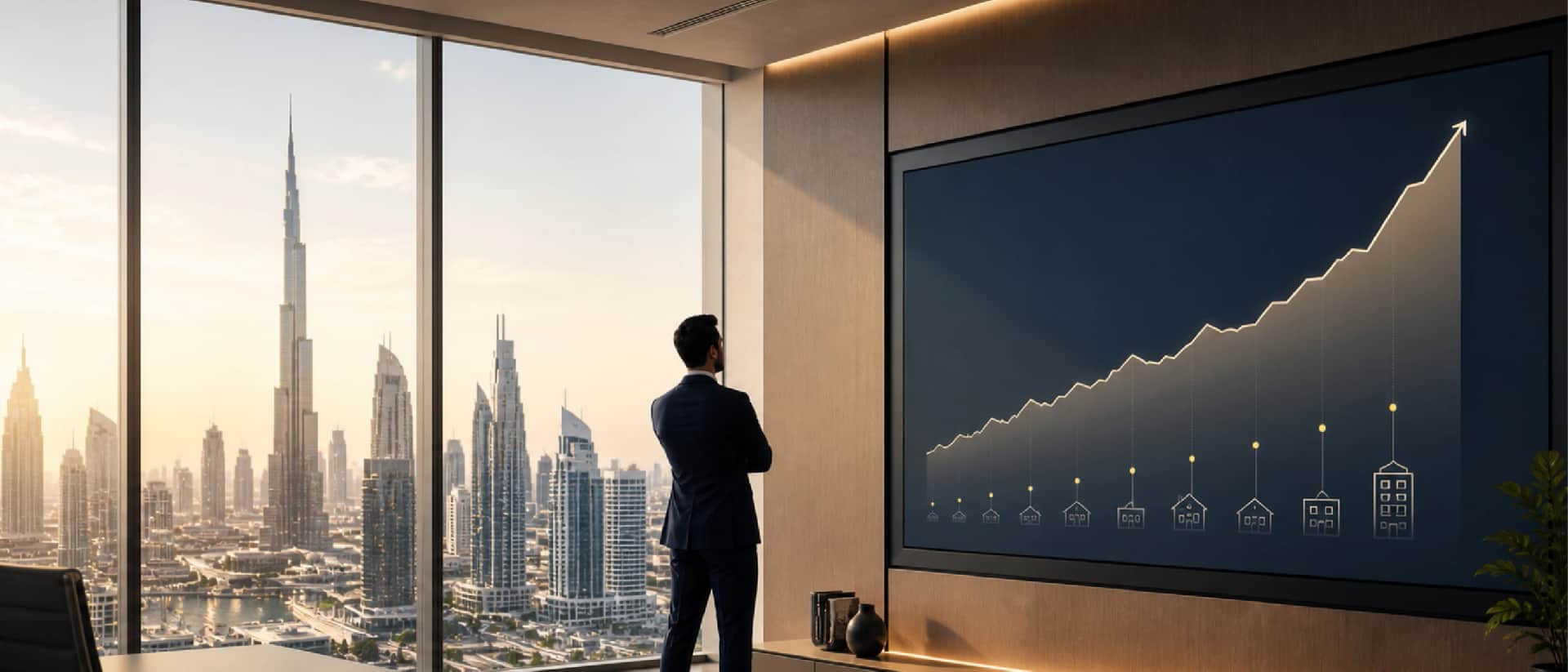
According to Dubai Land Department (DLD) statistics, the Dubai Property Market registered a sharp growth in April 2026, with total real estate transactions reaching AED 68.56 billion. It is more than a 20 percent month-on-month growth.
The surge is not a short-term spike but the result of structural demand drivers such as inflows of foreign investment, population growth, and sustained off-plan development activity across the masterplanned communities of the city of Dubai.
The Dubai Property Market has been able to exhibit its liquidity strength in both residential and commercial real estate segments. It will further help it to establish itself as one of the most dynamic global real estate hubs in 2026.

Yes - investing in Dubai luxury property in 2026 as a long-term strategy is a good opportunity to grow your capital rather than to earn rental income in the short-term. The high-net-worth migration, zero-tax ownership, and lack of ultra-prime supply make the Dubai luxury property market continue to outperform other cities around the world.
In 2025, Dubai registered approximately AED 900+ billion worth of real estate dealings, with luxury areas accounting for a significant portion of the worth increment. The global media reports about the increase in demand for branded homes and waterfront villas, indicating an evident surge in the Dubai luxury property market.
Prime area price increases have been 15-25% per year, and ultra-luxury properties over $10M are still setting sales records. This substantiates the robust momentum in Dubai's luxury property market, backed by international investors.
Nevertheless, rental yields remain at an average of 46 percent, and that is an appreciation. On the whole, luxury property in Dubai is a high-potential, fact-supported investment in long-term wealth creation.