Adil Raza Khan | March 25, 2026

Dubai Real Estate Tension in 2026 is settling, with the market still showing strength, consistent action, and long-term sustainability.
Although the current Iran war has brought some short-term uncertainty, the property market of Dubai is structurally sound. The levels of transaction volumes are stable, the volumes among high-net-worth investors are active, and selective price changes demonstrate a positive market consolidation and not a crisis. The trend in the luxury property market, coupled with the strong demand and high equity ownership in Dubai, has indicated the stability and growth prospects of the city over the long term.
Real estate Experts and reputable UAE news media attest that even in the time of market uncertainty, Dubai remains a place to invest in. This further proves that Dubai Real Estate Tension is a temporary change that is relatively easy and actually a short adjustment in an otherwise robust and opportunities-laden market.
The real estate industry in the city, which is very innovative and strategic, is adjusting to external uncertainties. Yet it is still appealing to international investors, which underscores the fact that the current Dubai real estate tension is just temporary and can be addressed.
Curated Opportunities
Flexible buying options for smarter property decisions.
Handpicked properties sorted for the strongest value.
Investment-focused listings with return potential.
Browse Dubai communities with properties for sale.
Dubai Real estate is: Stabilizing + Not crashing + Still structurally strong
Dubai Real Estate Tension 2026 continues to exist mainly because of the current geopolitical state of affairs in the Gulf, but the Dubai property prices and demand are still consistent. The world has positioned apprehension in the mind of investors, and the transactions have been slowed temporarily.
But according to the reports of reliable foreign media sources, such as Reuters and The National, the activity of the transactions has been stable, especially in such areas as luxury and prime residential. The property market in Dubai is reacting to global developments with a measured response and not exhibiting structural flaws.
The difference between short-lived sentiment-based caution and an all-out market crisis is severe. Whereas other overseas headlines speak about tension, the real estate basics in Dubai, such as demand, equity ownership, and liquidity, are strong.
The current phase suggests that tension is stabilizing rather than escalating further.
This indicates a transition from initial shock to gradual normalization, assuming no major escalation in the geopolitical situation.
The Dubai property market remains in healthy performance despite the global uncertainties in all segments. There are thousands of transactions every week, and this is an indication of trust not only by the end-users but also by the investors.
High-value properties are still sold in places such as the Palm Jumeirah, Downtown Dubai, and Dubai Marina, which are the prime ones. This is even though at the mid-market residential developments, there are still high levels of interest with investors seeing the potential in the long-run in Dubai.
This continued action proves that even in the case of market uncertainties, Dubai is still sound and investment-willing, and the Dubai Real Estate Tension has not hampered the basic activities of the market.
The statistics available in the Dubai real estate market show that there is a certain stability in the wake of tension. In March 2026, transaction volumes will level off. The main reason is careful investor activity. Price changes are, however, localized and selective, mainly touching on ultra-prime properties and not the whole market.
These controlled changes are represented by the Dubai real estate price index 2026. The prices are stable, although there are moderate adjustments in some of the luxury segments. Analysts observe that the property market in Dubai can absorb the external pressures, which indicates the strength of a mature market.
Empirical evidence proves that Dubai Real Estate Tension is interim and can be handled, but not a sign of a general market crisis.
Although there are the occasional headlines that the Dubai real estate crisis is a real threat, the market is not under systemic threats. The market has been spared of volatility by high levels of equity ownership, regulatory cynicism, and good liquidity levels.
In contrast to the past downturns, property owners in Dubai do not feel pressure to sell off their property. The city is still in the process of attracting both local and foreign investment. This is strengthening the property market stability of Dubai in 2026.
Despite the uncertainty, Dubai displays the features of a mature and strong real estate market that can withstand the shock without causing any systemic harm.
The Dubai luxury property market trend is not diminishing even in the face of global geopolitical issues. High-net-worth investors are also still actively involved in the ultra-prime residential developments. This is an indication that they are confident in the city in the long run.
Luxury transactions are tough, and the occasional price changes are short-term deals to be taken advantage of by strategic investors, and not signs of pain. This shows that the issue of Dubai Real Estate Tension has not tempered with investor confidence in the high-end, which tends to dictate how the international community views the strength of the market in Dubai.
The future projections of the Dubai real estate market are also positive. APIL analysts believe that the market will likely remain steady and gradually pick up with the relaxation of tensions in the external environment.
Key drivers for the Dubai real estate market future outlook include:
These fundamentals point to the fact that the real estate business in Dubai will rise despite the intervals of temporary uncertainty in the world.
Best Project Finder
Filter opportunities by budget, property type, bedroom mix, and strategy to uncover projects aligned with your investment goals.
Several factors have allowed Dubai’s real estate market to remain resilient during tension:
All these factors serve to clarify the continued smooth operations of Dubai in the face of market uncertainty, despite the world geopolitical risks that are still taking place.
Dubai market confusion is undergoing considered adaptations as opposed to decreases. Localized moderation of the select luxury areas enables the buyers to enter strategic locations, as the transaction volumes in other segments keep booming.
The dynamics of the Dubai real estate market in 2026 are consolidated in a healthy way, which is the natural cycle of a mature market in response to external stimuli. Such changes form a normal market cycle and do not reflect a crisis.
The prevailing market situations are favorable to strategic investors and house buyers. This situation of temporary low-end pricing and long-term efforts in mid-market and luxury segments will result in value-based investments.
Dubai has long-term prospects of growth, and investors who take advantage of the opportunities can gain during the stabilization of the market. It is observed by analysts that Dubai Real Estate Tension is not a detriment but presents selective points of entry to informed buyers.
The overall trends of the Dubai real estate market in 2026 are stable and resilient, with an estimated growth. Key trends include:
These patterns confirm the perception that the real estate business in Dubai is in good ways to develop long-term, despite the current period of temporary tension.
The future outlook of the Dubai real estate market in general is good and stable. Although the Dubai Real Estate Tension still exists within the present picture, the market still shows strength, investor trust, and opportunities.
The fundamentals of the property market in Dubai, such as the high demand, equity ownership, and the performance of the luxury segment, guarantee that the city will continue to bring long-term value to both investors and residents.
Overall, it can be concluded that Dubai Real Estate Tension is on the downturn and the market is stable, active, and growth-oriented.
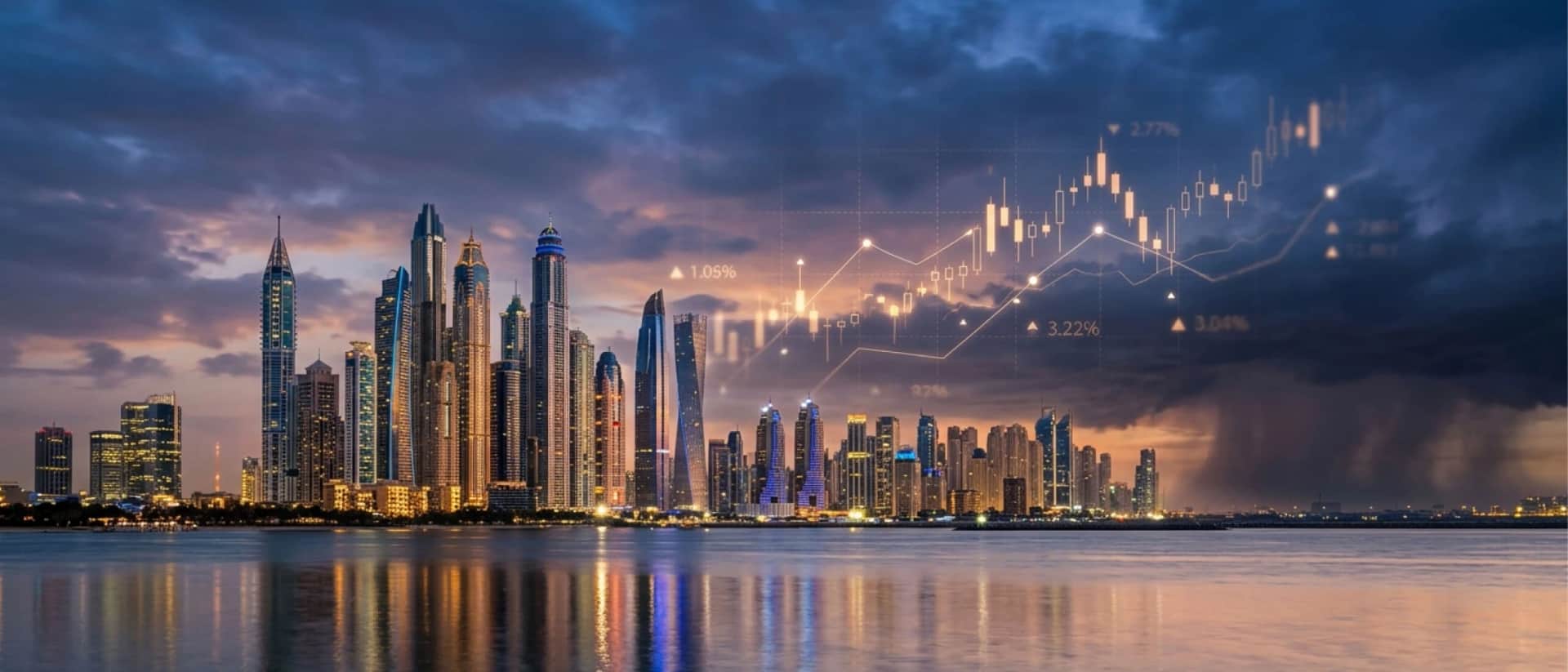
Dubai Real Estate tension in 2026 is leveling, and the market is still strong and full of opportunities. Deals keep going on, the luxury sector is doing well, and strategic investors can take advantage of short-term changes.
The real estate market of Dubai indicates the fact that short-term geopolitical conflicts do not compromise the long-term stability. Dubai remains among the most trusted and competitive real estate markets globally with its good fundamentals, a steady demand, and a worldwide investor base.
Even under the conditions of tension, Dubai provides confidence, stability and long term potential of growth, adding to its image as a global real estate center which is resistant to uncertainties.
Dubai Real Estate Tension refers to short-term market pressure caused by geopolitical uncertainty, affecting investor sentiment and transactions.
Dubai Real Estate Tension 2026 is easing gradually, with market activity and investor confidence remaining stable.
Despite headlines, Dubai’s property market is not in crisis, with strong fundamentals and healthy liquidity maintaining stability.
Dubai during market uncertainty continues to record steady transactions and strong demand, especially in luxury and prime segments.
Dubai real estate price index 2026 shows only localized adjustments, with overall prices remaining stable across most areas.
Dubai luxury property market trend remains robust, attracting high-net-worth investors and sustaining strong activity.
Dubai real estate market statistics show measured activity and selective price moderation, reflecting a resilient and healthy market.
Dubai real estate future predictions remain optimistic, with long-term growth expected as geopolitical uncertainty stabilizes.
Short-term market adjustments offer strategic buying opportunities, particularly in mid-market and luxury segments.
Dubai real estate market future outlook is positive, with continued stability, active transactions, and long-term growth potential.

WRITTEN BY
Adil Raza Khan is a Dubai luxury real estate expert with over 13 years of experience in the UAE property market. He is the Chairman of APIL Properties.
Investment Finder
Use smart filters to discover Dubai projects matched to your investment goals.
Try the Investment Finder
The Dubai Real Estate Market is set to see record-breaking momentum with transaction value reaching AED139.2 billion in Q1 2026—fueled by strong off-plan demand, foreign capital inflows, and increasing end-user activity.
Dubai is keeping its lead over other property hubs around the world thanks to its investor-friendly policies and the high potential for returns, as noted in market reports by Arabian Business and major brokerage data providers.
The Dubai Real Estate Market is not only expanding in terms of volume but also gaining greater value and quality as buyers are increasingly looking towards projects that are supported by infrastructure, credibility of the developers, and potential appreciation of capital value.
The Dubai Real Estate boom has evolved into a more stable, investment-driven cycle thanks to this structural shift in demand.

Capital appreciation in Dubai property market is the rise in property value over time, influenced by factors such as demand, location development, and macroeconomic conditions. To an investor, it is the money gained by selling the property for more than the initial investment.
Simply put, when you buy real estate in Dubai, and the value of that property improves over the next several years, then that gain in value is your capital appreciation. In Dubai, however, this concept has more than just the notion of price growth; it is correlated to infrastructure growth, off-plan deals, and demand from investors all over the world.
Dubai has emerged as one of the world's most vibrant real estate markets. It is offering opportunities for both immediate profit and future investment and wealth. For anyone interested in investing strategically in Dubai properties instead of speculatively, it is crucial to understand the concept of capital appreciation in the local real estate market.
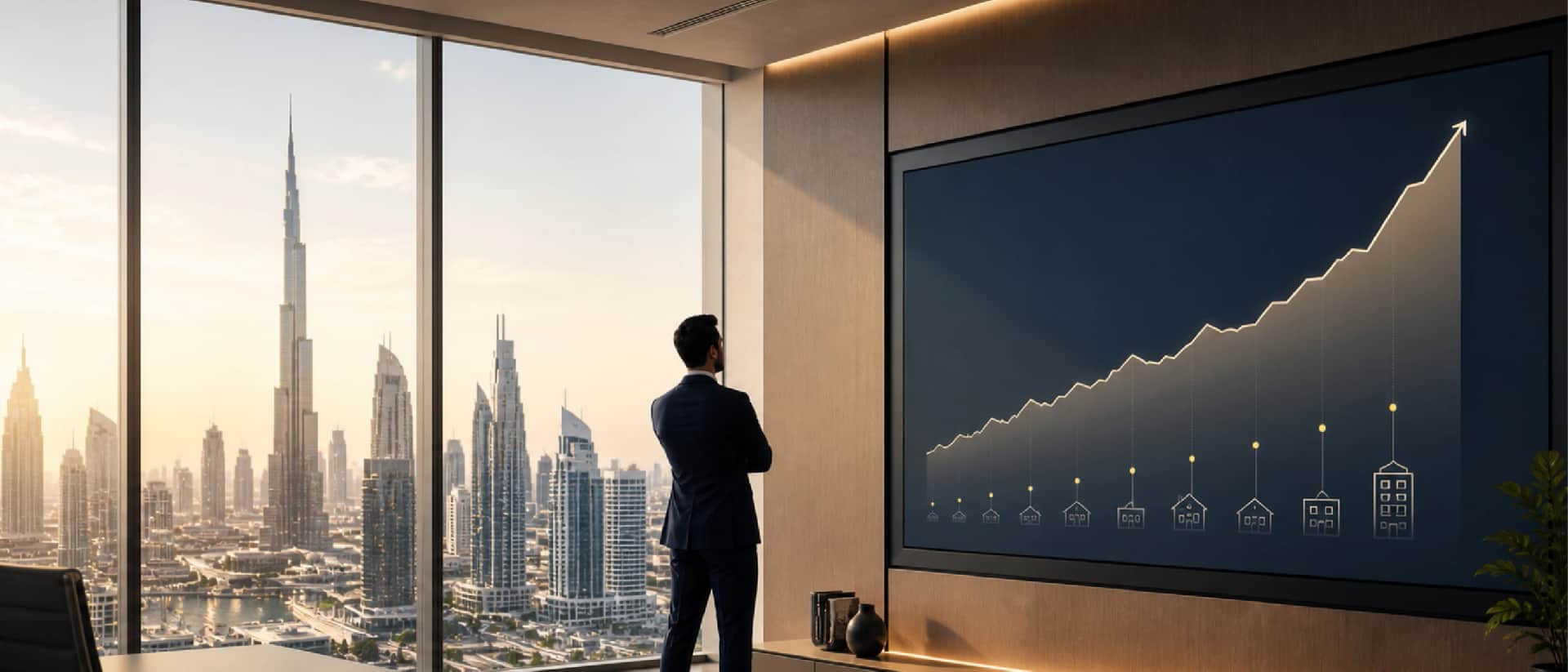
According to Dubai Land Department (DLD) statistics, the Dubai Property Market registered a sharp growth in April 2026, with total real estate transactions reaching AED 68.56 billion. It is more than a 20 percent month-on-month growth.
The surge is not a short-term spike but the result of structural demand drivers such as inflows of foreign investment, population growth, and sustained off-plan development activity across the masterplanned communities of the city of Dubai.
The Dubai Property Market has been able to exhibit its liquidity strength in both residential and commercial real estate segments. It will further help it to establish itself as one of the most dynamic global real estate hubs in 2026.