Adil Raza Khan | December 25, 2025

Non-Freehold Areas in Dubai 2026 refer to areas where ownership of the entire land is limited, and the property may be occupied by UAE/GCC nationals only or by expatriates within the framework of long-term use rights via leasehold or usufruct. These regions are an integral part of the Dubai real estate market that is not well understood in 2026.
This guide clarifies what non-freehold is in Dubai, the non-freehold areas in the city, who is allowed to purchase in these areas, and whether such properties are profitable to investors.
Curated Opportunities
Flexible buying options for smarter property decisions.
Handpicked properties sorted for the strongest value.
Investment-focused listings with return potential.
Browse Dubai communities with properties for sale.
The non freehold property in Dubai meaning is simple. The buyer does not permanently acquire the land. The buyer is instead granted legal rights to use, occupy, rent, or transfer the property for a given period.
In Non-Freehold Real Estate Areas in Dubai 2026, ownership structures typically consist of:
These privileges are accepted and governed by Dubai Land Department (DLD).
The Non-Freehold Areas in Dubai 2026 is still in existence because of long-term urban planning of the city. Most of these zones are pre-established before the enactment of freehold legislation and conserved to maintain the conventional house designs.
Dubai kept non-freehold zones in 2026 to:
That is why Non-Freehold Areas in Dubai 2026 are centrally established neighborhoods and not new master-planned communities.
The question: What are the non-freehold areas in Dubai? This can be answered based on official zoning rather than popularity and price.
The following is a practical list of non-freehold regions in Dubai that will still be mostly restricted in 2026, with the exceptions, which are based on a project.
Although redevelopment projects at an individual level can be freehold, non-freehold is found in the overall districts.

Yes, foreigners are allowed to acquire property rights in Non-Freehold Real Estate Areas in Dubai 2026 - but not freehold ownership.
Foreign buyers typically acquire:
Such rights are legal occupancy, leasing, and resale within the term of a contract. Property terms differ according to the property and have to be checked prior to purchasing.
Understanding this distinction is essential when dealing with non freehold properties in Dubai.
Leasehold
Usufruct
They are both legally binding in Non-Freehold Real Estate Areas in Dubai 2026.
They can be—depending on the investment goal.
Investors do not usually purchase non-freehold properties to achieve a quick price increase. Instead, they are used for:
Most investors opt to invest in non-freehold real estate in Dubai in 2026 due to the stability of yield and not speculative growth.
The non-freehold zones have high rental demands because of:
Most of the non freehold area in Dubai have a low vacancy rate compared to newer freehold projects - especially where villas and family housing are concerned.
Yes, with conditions.
In Non-Freehold Real Estate Areas in Dubai 2026:
Not all the rights are the same and buyers should inspect the clauses of the contract.
Best Project Finder
Filter opportunities by budget, property type, bedroom mix, and strategy to uncover projects aligned with your investment goals.
Mortgage access is limited.
Majority of non freehold Properties in Dubai are bought:
Banks can finance leasehold properties on a selective basis but the terms are more severe than when dealing with freehold assets.
The majority of the non-freehold in Dubai is not being converted to freehold in 2026. The freehold is only limited to selected projects, but not districts within Dubai. Although new freehold projects are still coming up, the traditional non-freehold areas are still limited unless officially reclassified by the Dubai Land Department.
Dubai is still coming up with additional freehold initiatives, yet:
Title classification should always be checked with DLD, and not on market assumptions.
Before buying in Non-Freehold Areas in Dubai 2026, confirm:
Professional verification is essential to avoid ownership misunderstandings.
Non-freehold property may not fit the buyer who wants to have permanent land and the ability to resell in short term.
Dubai Non-freehold property is suitable in:
A common misconception is that non-freehold property is dangerous or unregulated. As a matter of fact, the non-freehold real estate territories in Dubai are regulated under the same laws as the freehold real estate, with the only distinction being the ownership system.
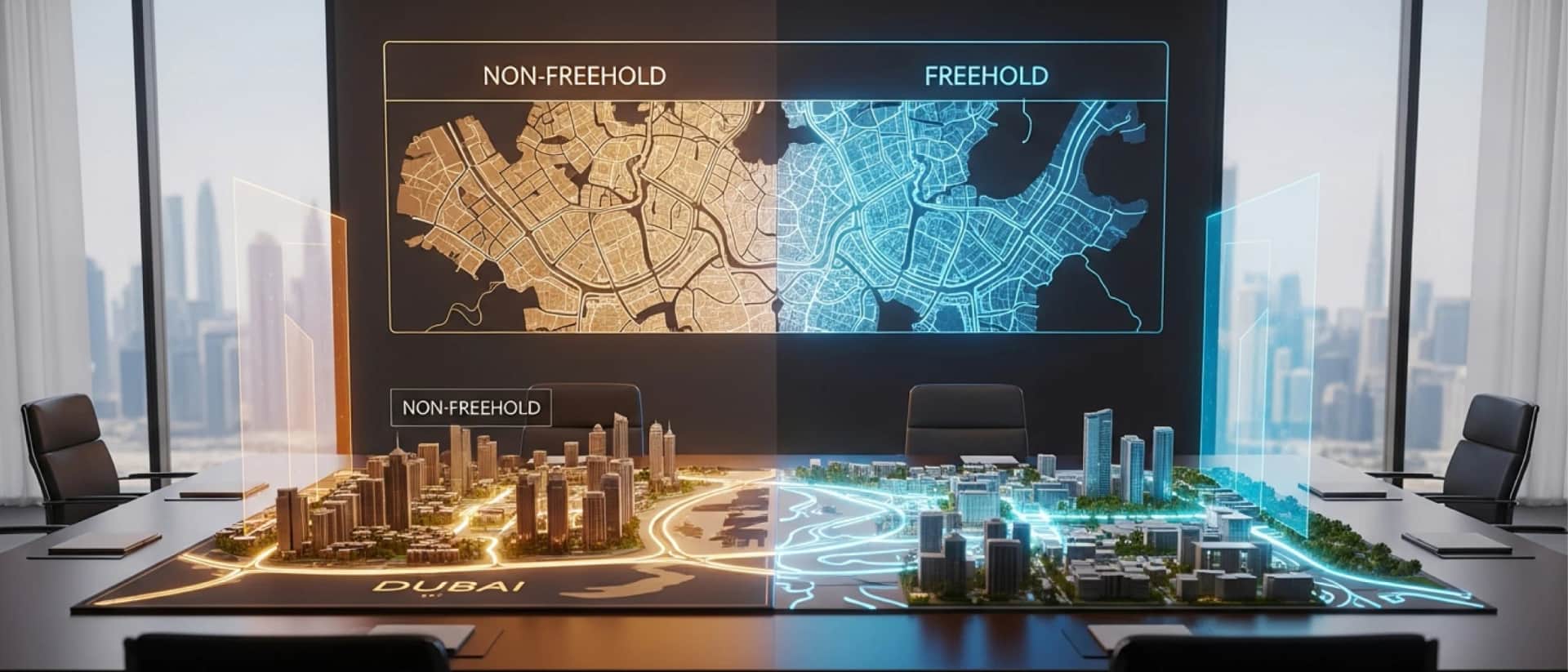
There are various purposes of two types of property in the Dubai real estate ecosystem.
The non-freehold market in Dubai is developing in 2026. Dubai Land Department sanctioned 457 plots on Sheikh Zayed road and Al Jaddaf. They are to be converted from leasehold to freehold to allow new ownership opportunities.
Such historic neighbourhoods as Satwa are being redeveloped with limited freehold opportunities, and non-freehold areas continue to play a 20 to 25 percent role in central Dubai. Rental prices are between AED 750 and 1200 per sq. ft with a rental yield of 5-6. This is a bit lower than that of the freehold regions.
The Non-Freehold Areas in Dubai 2026 is an appreciable opportunity considering the potential of this area to accommodate long-term residents and the investors who may be interested in renting properties since the government initiatives such as the First-Time Home Buyer Programme are increasing the demands.
Some of the oldest locations in the city are still legally and regulated under Non-Freehold Areas in Dubai 2026. Although they do not give permanent ownership of land, they offer stability, rental demand and long term usability where they are selected appropriately.
It is important to understand the legal structure, tenure, and exit rules. Non-freehold property is also a viable and strategic solution in the developing property market in Dubai, as long all it is done with due diligence.
Areas where property ownership is restricted and land is not owned permanently.
Yes, through leasehold or usufruct rights, not freehold ownership.
It means owning usage rights without owning the land.
Jumeirah, Umm Suqeim, Al Safa, Mirdif, Deira, and Bur Dubai.
Yes, they are legally regulated by Dubai Land Department.
Yes, if the ownership agreement allows it.
It suits rental income more than capital appreciation.
Freehold offers permanent ownership, non-freehold does not.
Yes, within the remaining lease or usufruct period.
Financing is limited and conditions are stricter.
Only select projects, not entire areas.
Check the title deed with Dubai Land Department.

WRITTEN BY
Adil Raza Khan is a Dubai luxury real estate expert with over 13 years of experience in the UAE property market. He is the Chairman of APIL Properties.
Investment Finder
Use smart filters to discover Dubai projects matched to your investment goals.
Try the Investment Finder_1783320909.webp&w=1920&q=65)
Capital appreciation in Dubai property market is the rise in property value over time, influenced by factors such as demand, location development, and macroeconomic conditions. To an investor, it is the money gained by selling the property for more than the initial investment.
Simply put, when you buy real estate in Dubai, and the value of that property improves over the next several years, then that gain in value is your capital appreciation. In Dubai, however, this concept has more than just the notion of price growth; it is correlated to infrastructure growth, off-plan deals, and demand from investors all over the world.
Dubai has emerged as one of the world's most vibrant real estate markets. It is offering opportunities for both immediate profit and future investment and wealth. For anyone interested in investing strategically in Dubai properties instead of speculatively, it is crucial to understand the concept of capital appreciation in the local real estate market.
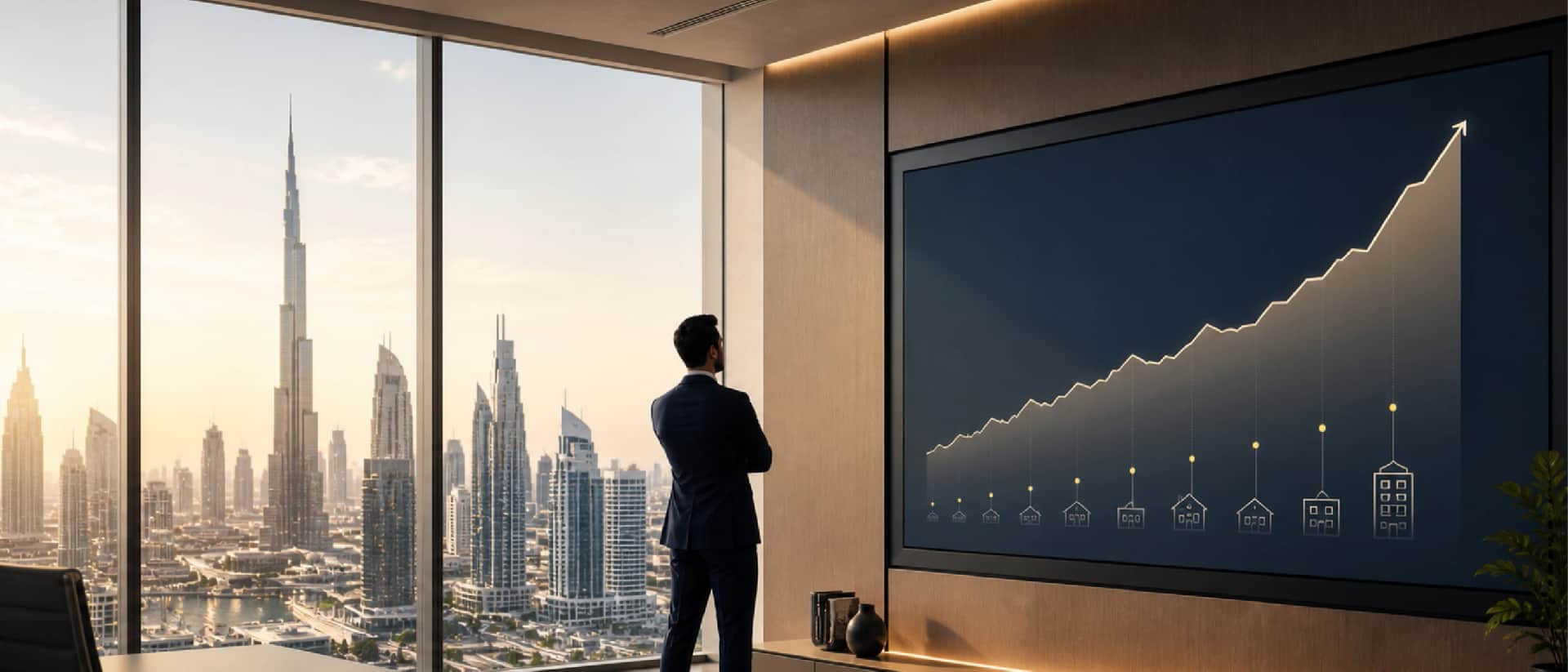
According to Dubai Land Department (DLD) statistics, the Dubai Property Market registered a sharp growth in April 2026, with total real estate transactions reaching AED 68.56 billion. It is more than a 20 percent month-on-month growth.
The surge is not a short-term spike but the result of structural demand drivers such as inflows of foreign investment, population growth, and sustained off-plan development activity across the masterplanned communities of the city of Dubai.
The Dubai Property Market has been able to exhibit its liquidity strength in both residential and commercial real estate segments. It will further help it to establish itself as one of the most dynamic global real estate hubs in 2026.

Yes - investing in Dubai luxury property in 2026 as a long-term strategy is a good opportunity to grow your capital rather than to earn rental income in the short-term. The high-net-worth migration, zero-tax ownership, and lack of ultra-prime supply make the Dubai luxury property market continue to outperform other cities around the world.
In 2025, Dubai registered approximately AED 900+ billion worth of real estate dealings, with luxury areas accounting for a significant portion of the worth increment. The global media reports about the increase in demand for branded homes and waterfront villas, indicating an evident surge in the Dubai luxury property market.
Prime area price increases have been 15-25% per year, and ultra-luxury properties over $10M are still setting sales records. This substantiates the robust momentum in Dubai's luxury property market, backed by international investors.
Nevertheless, rental yields remain at an average of 46 percent, and that is an appreciation. On the whole, luxury property in Dubai is a high-potential, fact-supported investment in long-term wealth creation.